Sweden at the 2026 World Cup: Preview, group opponents, squad and team guide
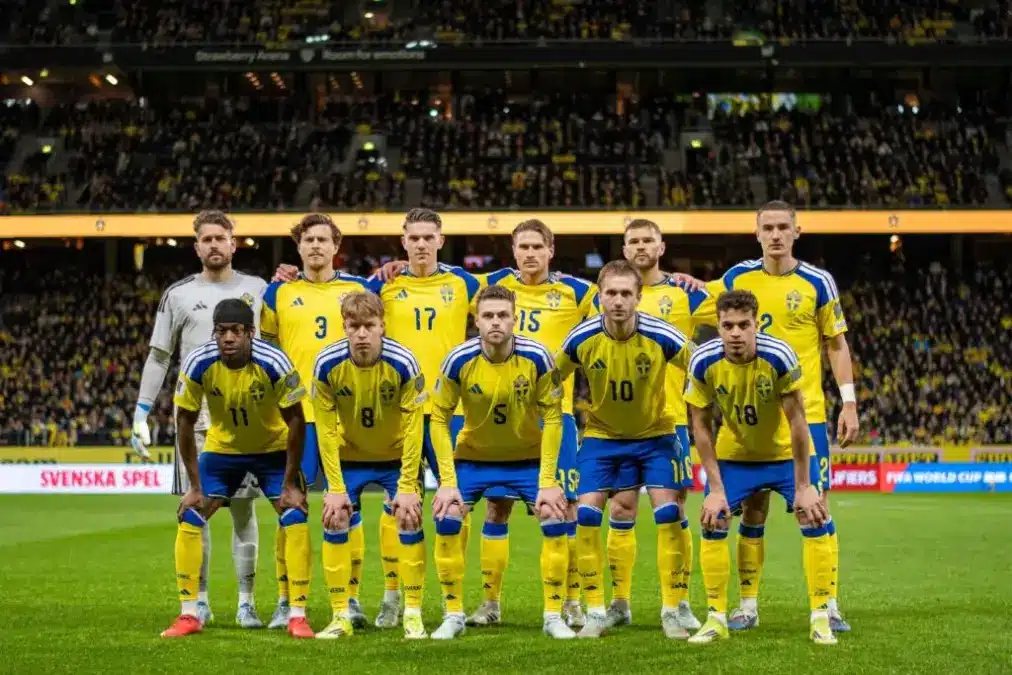
Sweden arrive at the 2026 World Cup ranked 38th in the world, carrying one of the most intriguing contradictions in international football.
A squad capable of producing elite moments, yet one that stumbled through qualification in unprecedented fashion, the Scandinavians head to North America as both survivors and wildcards.
Now led by Graham Potter, Sweden’s story is framed by history, unpredictability and the hope that structure and belief can turn inconsistency into something far more dangerous.
Team identity and global standing
Sweden remain a team defined by organisation, physical discipline and direct attacking transitions. Traditionally difficult to break down, they combine defensive structure with a strong aerial and counter-attacking profile.
Their FIFA ranking of 38 reflects a side outside the elite tier, but still capable of disrupting higher-ranked opposition when functioning collectively. In tournament football, Sweden have often outperformed expectations, a reputation they will lean on again in 2026.
Qualification campaign: the paradox of progress
Sweden’s route to the World Cup defied logic. They finished bottom of UEFA Group B with just two points from eight matches, failing to register a single win (0 wins, 2 draws, 6 defeats).
Yet, remarkably, they still progressed to the play-offs, where they defeated Poland to secure qualification for the finals in North America. It was a campaign defined less by consistency and more by survival, exposing weaknesses but also revealing resilience under pressure.
World Cup history: tradition of punching above weight
Sweden are one of Europe’s most established World Cup nations, with 12 previous appearances. Their best performance came in 1958, when they reached the final on home soil.
They have also finished third twice (1950, 1994), fourth in 1938 and reached the quarter-finals in 2018. Sweden’s tournament identity has long been built on discipline, organisation and collective strength rather than individual stardom.
Coach: Graham Potter and the search for identity
Graham Potter brings one of the most unconventional managerial paths in modern international football. Previously celebrated for transforming Östersunds FK from Sweden’s fourth tier into European competition, he now returns to Scandinavian football with a national team project defined by volatility.
There is historical symmetry in his appointment. Sweden reached the 1958 World Cup final under English coach George Raynor, and Potter now carries hopes of replicating that legacy.
His challenge is clear: impose tactical clarity on a team capable of brilliance and collapse in equal measure.
Sweden World Cup squad
Goalkeepers
Viktor Johansson (Stoke City), Kristoffer Nordfeldt (AIK), Jacob Widell Zetterström (Derby County)
Defenders
Hjalmar Ekdal (Burnley), Gabriel Gudmundsson (Leeds United), Isak Hien (Atalanta), Herman Johansson (FC Dallas), Gustaf Lagerbielke (Braga), Victor Lindelöf (Aston Villa), Erik Smith (St. Pauli), Carl Starfelt (Celta Vigo), Elliot Stroud (Mjällby), Daniel Svensson (Borussia Dortmund)
Midfielders
Taha Ali (Malmö), Yasin Ayari (Brighton), Lucas Bergvall (Tottenham), Jesper Karlström (Udinese), Ken Sema (Pafos), Mattias Svanberg (Wolfsburg), Besfort Zeneli (Union St-Gilloise)
Forwards
Alexander Bernhardsson (Holstein Kiel), Anthony Elanga (Newcastle United), Viktor Gyökeres (Arsenal), Alexander Isak (Liverpool), Gustaf Nilsson (Club Brugge), Benjamin Nygren (Celtic)
Defensive structure: experience meets uncertainty
Sweden’s defensive core is anchored by Victor Lindelöf, whose leadership and experience remain crucial to organisation at the back. Alongside him, Isak Hien and Carl Starfelt provide physicality and aerial strength, while Daniel Svensson and Gabriel Gudmundsson offer width and balance from deeper positions.
However, depth and consistency remain concerns, particularly against elite attacking sides.
Midfield: youth, energy and transition
The midfield group reflects a transitional generation. Lucas Bergvall and Yasin Ayari represent the future, combining technical quality with mobility and pressing intelligence.
Jesper Karlström and Mattias Svanberg provide balance and experience, while Ken Sema and Taha Ali add wide versatility and direct attacking support. Sweden’s midfield identity will hinge on energy and compactness rather than control.
Attack: Gyökeres, Isak and elite finishing power
Sweden’s greatest strength lies in attack, where they possess genuine top-level quality.
Viktor Gyökeres (Arsenal) has emerged as the focal point of the system, his physical presence and finishing ability making him a decisive threat. Alongside him, Alexander Isak (Liverpool) brings elegance, movement and world-class technical finishing.
Anthony Elanga adds pace and direct running, while Benjamin Nygren and Gustaf Nilsson provide rotation options in different tactical setups.
If Sweden are to progress deep into the tournament, their attacking duo of Gyökeres and Isak will be central.
Group F fixtures: a brutal but defining schedule
Sweden face one of the tournament’s most demanding groups.
- 14 June (03:00 BST, 15 June): Sweden vs Tunisia – Monterrey, Mexico
- 20 June: Netherlands vs Sweden – Houston, USA
- 25 June (00:00 BST, 26 June): Japan vs Sweden – Dallas, USA
The schedule offers no respite, with European precision and Asian discipline forming a stern test of Sweden’s consistency.
Tactical outlook: chaos control or controlled chaos
Under Potter, Sweden are expected to combine structure with controlled risk-taking. The system prioritises compact defending, vertical transitions and rapid attacking movement through Gyökeres and Isak.
Yet the defining question remains unchanged: can Sweden eliminate the instability that defined their qualification campaign?
Outlook: between collapse and breakthrough
Sweden enter the 2026 World Cup as one of the tournament’s most unpredictable teams. Their path to qualification suggested fragility, but their squad suggests genuine knockout potential.
If Potter stabilises the system and the attacking duo fires consistently, Sweden could become one of the tournament’s most disruptive forces. If not, their campaign may once again reflect the same inconsistency that defined their road to North America.
Popular News



-

AFCON 2025: Fixtures, Results, Scores and Standings
Jan 18, 2026 -
Leadership and long-term vision key to rescuing Zamalek and inspiring Egyptian football – Hany Abou Rida
Nov 5, 2025 -
South African giants Orlando Pirates set to lose influential forward Monnapule Saleng
Mar 19, 2025 -
Full schedule for 2025 Africa Cup of Nations in Morocco confirmed
Feb 12, 2025




-
Mohamed Ouahbi explains Sofiane Boufal omission from Morocco’s World Cup squad and reveals emergency plan
May 27, 2026 -
Jamaica set up Unity Cup final showdown with Nigeria after disciplined win over India
May 28, 2026 -
World Cup 2026: Complete Group C fixture guide, team analysis and qualification predictions
May 27, 2026 -
Morocco begin new World Cup era under Mohamed Ouahbi
May 28, 2026