Morocco begin new World Cup era under Mohamed Ouahbi
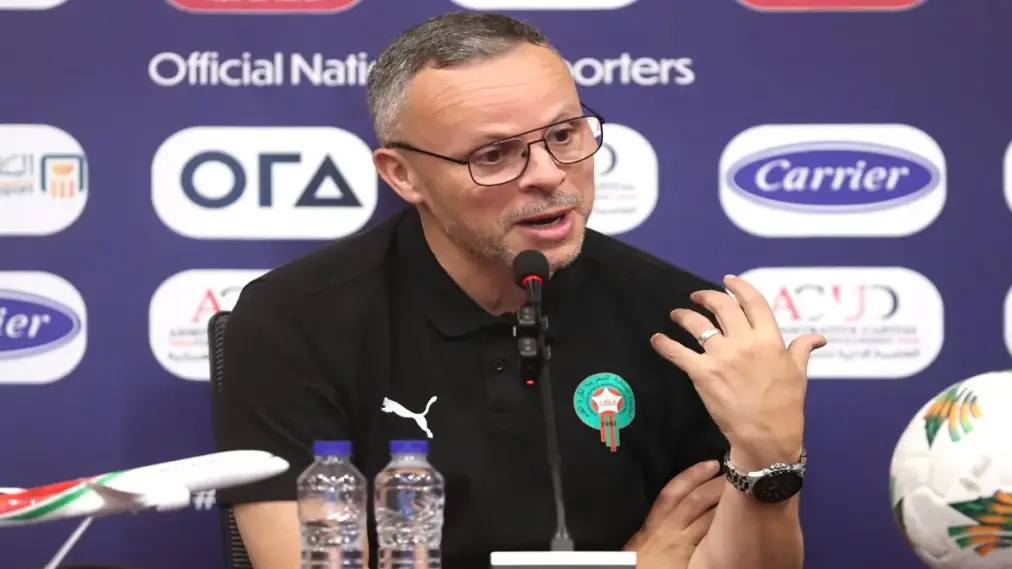
Morocco will head into the 2026 World Cup with a significantly reshaped squad after coach Mohamed Ouahbi introduced a new tactical direction marked by youth, versatility and several high-profile selection decisions.
The Atlas Lions coach unveiled a 26-man squad that reflects a clear desire to renew the team ahead of the tournament in the United States, Canada and Mexico.
Several emerging players have been included in the group, notably Samir El Mourabet, Chemsdine Talbi and young midfielder Ayyoub Bouaddi, while established names such as Youssef En-Nesyri have been left out.
The omission of En-Nesyri has become one of the most debated decisions surrounding the squad selection and underlines Ouahbi’s intention to progressively reshape the national team before the global competition.
Morocco, semi-finalists at the 2022 World Cup in Qatar, will enter the tournament with heightened expectations after becoming the first African nation to reach the last four of a World Cup.
This time, however, the Atlas Lions will no longer be viewed as outsiders but as one of the teams expected to compete at the highest level.
Placed in Group C, Morocco will face Brazil, Scotland and Haiti during the first stage of the competition.
Their opening match against Brazil on Saturday, 13 June in New York/New Jersey is already being viewed as a major test for the team’s new direction under Ouahbi.
The Moroccan coach has attempted to strike a balance between experienced players and a younger generation capable of adapting to multiple tactical systems.
The squad selection suggests a desire to build a more flexible and dynamic side, particularly in attacking areas where mobility and positional rotation are expected to play a central role.
New attacking profiles such as Gessime Yassine and Ayoube Amaimouni reflect that approach, with both players viewed as capable of bringing pace, direct movement and one-on-one ability.
The tactical evolution has been welcomed by former Moroccan international and coach Faouzi Jamal, although he warned that the squad will still face important challenges.
“It’s a bold and deliberate squad. Mohamed Ouahbi has clearly chosen to refresh certain areas while retaining an experienced core. Morocco has players capable of keeping possession under pressure and accelerating play between the lines, but the real test will be their defensive balance during transitions against top nations.”
Jamal believes Morocco possess the technical quality required to compete but insists defensive organisation and mental control will be crucial throughout the tournament.
Among the players highlighted by the former coach is goalkeeper Yassine Bounou, whose experience is expected to remain essential within the group.
“The presence of Yassine Bounou , alongside Munir and Tagnaouti , provides exceptional stability. These goalkeepers are intimately familiar with the pressure of major competitions. They reassure the dressing room and greatly solidify the entire defensive line.”
Jamal also pointed to the attacking qualities of Abde Ezzalzouli, who is expected to play an important role in Morocco’s offensive transitions.
“With players like Brahim Diaz , Rahimi , and Ezzalzouli , Morocco boasts highly mobile players who can interchange positions frequently. Ezzalzouli, in particular, is capable of attacking space, creating imbalances, and eliminating defenders in tight spaces.”
The midfield combination of Sofyan Amrabat and Neil El Aynaoui could also become central to Morocco’s tactical balance during the competition.
“With Sofyan Amrabat and Neil El Aynaoui , Morocco has players capable of protecting the centre and cutting off opposing transitions as soon as they lose possession.”
Young midfielder Ayyoub Bouaddi has emerged as one of the symbols of Morocco’s new generation.
“Bouaddi, like El Khannouss or Ounahi , represents this new generation capable of playing under pressure, breaking lines with passing or dribbling and accelerating the pace of the game.”
In the absence of En-Nesyri, Jamal believes Brahim Diaz could become one of the team’s attacking leaders.
“We’re moving towards a more mobile, fluid, and faster style of football in attacking transitions with Brahim Diaz. He’s a key player to bring this system, based on positional rotation and creativity, to life.”
Morocco’s preparations are now centred on ensuring the team can adapt quickly to the demands of elite opposition.
The opening match against Brazil is expected to provide an immediate measure of whether Ouahbi’s tactical changes can succeed on the biggest stage.
For Jamal, the decisive factor will be how the players manage pressure during the tournament.
“The potential is enormous. Now, everything will depend on the team’s ability to handle the pressure, maintain its defensive balance, and consistently perform well off the ball from the very first match against Brazil. The highest level demands a great deal of emotional control and strong team cohesion.”
Morocco’s 2026 World Cup squad
Goalkeepers
Yassine Bounou, Munir Mohamedi, Reda Tagnaouti
Defenders
Achraf Hakimi, Noussair Mazraoui, Anass Salah-Eddine, Youssef Belammari, Zakaria El Ouahdi, Nayef Aguerd, Chadi Riad, Redouane Halhal, Issa Diop
Midfielders
Sofyan Amrabat, Neil El Aynaoui, Bilal El Khannouss, Azzedine Ounahi, Ismael Saibari, Samir El Mourabet, Ayyoub Bouaddi
Attackers
Brahim Diaz, Soufiane Rahimi, Ayoub El Kaabi, Abde Ezzalzouli, Chemsdine Talbi, Gessime Yassine, Ayoube Amaimouni
Reservists
El Mehdi Al Harrar, Amine Sbai, Marwane Saâdane
Morocco’s Group C fixtures
- 13 June 2026: Brazil vs Morocco – New York/New Jersey Stadium
- 20 June 2026: Scotland vs Morocco – Boston Stadium
- 25 June 2026: Morocco vs Haiti – Atlanta Stadium
-
 Ghana’s Black Maidens ready to take on Norway as Joe Nana Adarkwa targets winning World Cup start Oct 18, 2026
 -
Lamine Yamal hailed as world’s best player after Barcelona win Oct 17, 2026
-
Malawi thrash Seychelles 10-1 to seal third beach soccer AFCON appearance Oct 17, 2026
-
Bafana Bafana set for November double-header against Kenya in 2027 AFCON qualifiers Oct 17, 2026




-
AFCON 2025: Fixtures, Results, Scores and Standings Jan 18, 2026
-
Match hero Taiwo Awoniyi reflects on team effort after Chelsea triumph May 5, 2026
-
Leadership and long-term vision key to rescuing Zamalek and inspiring Egyptian football – Hany Abou Rida Nov 5, 2025
-
South African giants Orlando Pirates set to lose influential forward Monnapule Saleng Mar 19, 2025




-
Real Betis v Barcelona: kick-off time, TV details and match preview Oct 16, 2026
-
Morocco to face New Zealand as FIFA U-17 Women’s World Cup kicks off in Rabat Oct 16, 2026
-
Roma v Real Madrid: home side tipped to score first in Champions League clash Oct 12, 2026
-
Atletico Madrid v Manchester United: probable line-ups for Champions League clash Oct 12, 2026