Collina rejects interference claims, defends integrity of FIFA World Cup referees
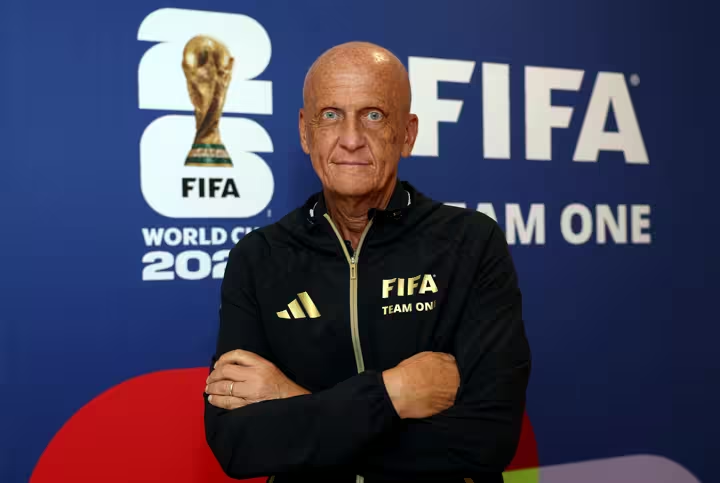
FIFA Chief Refereeing Officer Collina rejects interference claims, defends integrity of FIFA World Cup referees has firmly dismissed suggestions that FIFA World Cup maatch officials are influenced by external figures, insisting referees operate with complete independence and integrity.
Speaking after the completion of the Round of 16 at the FIFA World Cup, Collina said constructive debate over refereeing decisions is a natural part of football, but warned that baseless allegations undermine officials and can lead to abuse and threats against them and their families.
“We are not influenced by anyone,” Collina said. “Nobody can claim that FIFA Refereeing can be influenced by anyone, not even by the FIFA President. He has always shown his full support for FIFA Team One while trusting us to work with complete independence.”
The legendary Italian referee stressed that FIFA match officials make honest decisions and, like players and coaches, strive to perform to the highest standards in every game.
With 96 matches completed – 50 percent more than were played at the 2022 FIFA World Cup in Qatar at the same stage – Collina expressed satisfaction with the overall standard of officiating.
“Overall, we are happy,” he said. “However, with such a high number of matches played in a relatively short period of time, it is normal that some things do not go as expected. When that happens, they are ready to work even harder to ensure they are fully prepared for the next match.”
Collina also addressed recent discussions surrounding the Video Assistant Referee (VAR) protocol, particularly regarding fouls in the attacking possession phase (APP) before a goal is scored.
He explained that after every goal, VAR reviews the entire attacking sequence leading to the goal. If a foul is identified that had an impact on the goal, the VAR will recommend an on-field review regardless of how far from goal or how long before the goal the incident occurred.

“There is no defined limit regarding either the distance from goal or the amount of time between the incident and the goal,” he said.
Using Argentina’s match against Egypt as an example, Collina cited an incident where Egypt midfielder Marwan Attia stepped on the foot of Argentina defender Lisandro Martínez, describing it as a clear foul that warranted VAR intervention if missed by the referee.
“We believe that a foul is a foul. Regardless of whether the foul appears obvious, if the referee did not see it on the field of play, the VAR can intervene,” he explained.
He contrasted that with another incident late in the same match involving Egypt’s Mohamed Salah and Argentina’s Julián Alvarez, where officials ruled that the defender had played the ball first before making normal football contact.
“Stepping on an opponent’s foot is a foul, whereas a defender who touches the ball first and then makes normal football contact has not committed a foul,” Collina said.
While acknowledging that some refereeing decisions will always involve an element of subjectivity, Collina expressed confidence in the consistency of officiating throughout the tournament.
“Of course, there will always be an element of subjectivity in some decisions, but we are happy with how this principle has been applied throughout the tournament,” he concluded.
-
 Collina rejects interference claims, defends integrity of FIFA World Cup referees Jul 9, 2026
 -
World Cup 2026: Brahim Diaz prioritises Morocco’s success over personal glory ahead of France clash Jul 9, 2026
-
Senegal FA to sanction midfielder Pape Gueye over coach criticism Jul 9, 2026
-
FIFA refereeing chief Pierluigi Collina defends integrity of 2026 World Cup officiating Jul 9, 2026




-
AFCON 2025: Fixtures, Results, Scores and Standings Jan 18, 2026
-
Leadership and long-term vision key to rescuing Zamalek and inspiring Egyptian football – Hany Abou Rida Nov 5, 2025
-
South African giants Orlando Pirates set to lose influential forward Monnapule Saleng Mar 19, 2025
-
Full schedule for 2025 Africa Cup of Nations in Morocco confirmed Feb 12, 2025




-
World Cup 2026: Fixtures, Results, Scores and Standings Jul 8, 2026
-
Antar Yahia set to become Algeria’s new head coach after Vladimir Petković exit Jul 5, 2026
-
World Cup 2026: Lamine Yamal matches Jay-Jay Okocha’s iconic dribbling record Jul 3, 2026
-
From Mahrez to Kessie: Are Al Ahli’s glory years beginning to fade? Jul 2, 2026