Tunisia at the 2026 World Cup: Preview, group opponents, squad and team guide
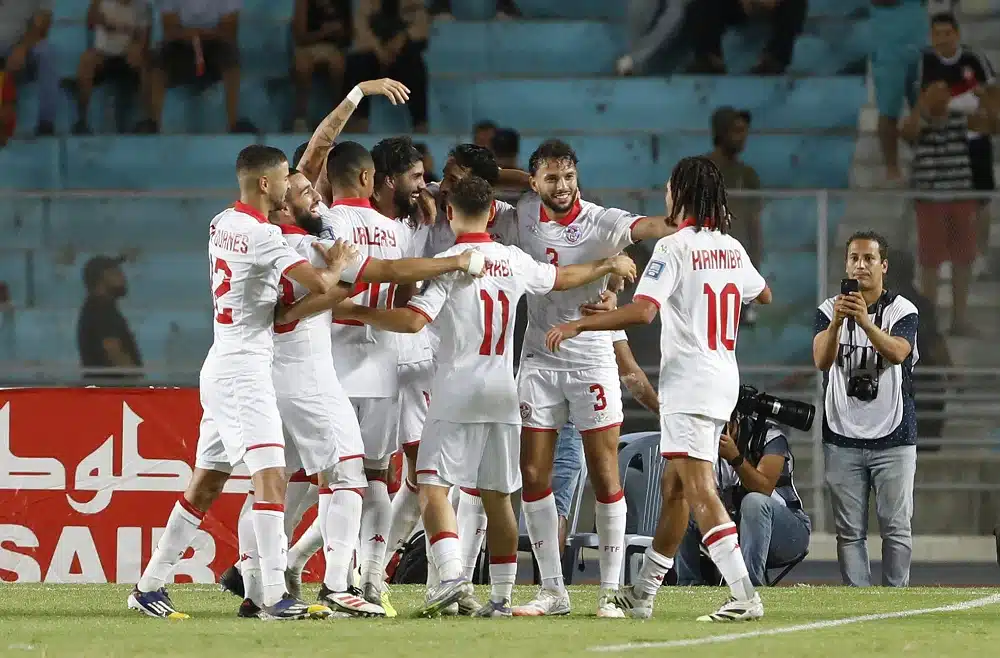
Tunisia enter the 2026 World Cup ranked 44th in the world, arriving in North America with a clear identity built on defensive discipline but lingering doubts over attacking consistency.
The “Carthage Eagles” have earned their place through one of the most remarkable qualifying campaigns in African football history, yet their ability to convert structure into goals remains their defining challenge.
Placed in Group F, Tunisia face Sweden in their opening match on 15 June before taking on Japan and the Netherlands in what promises to be one of the most tactically demanding groups of the tournament.
Team identity and global standing
Tunisia’s footballing identity has long been shaped by organisation, compactness and defensive resilience. Their FIFA ranking of 44 reflects a side firmly established as one of Africa’s most consistent performers, even if they have yet to translate that consistency into World Cup progress beyond the group stage.
At their best, Tunisia are difficult to break down, tactically disciplined and capable of frustrating more fancied opponents. The question heading into 2026 is whether that defensive strength can be matched by sufficient creativity and goals in the final third.
Team profile
- Year of foundation: 1957
- Most appearances: Radhi Jaïdi (105 caps)
- Top scorer: Issam Jemaa (36 goals)
- Captain: Ellyes Skhiri
- FIFA ranking (April 2026): 44
Qualification campaign: perfect defence, controlled efficiency
Tunisia’s route to the World Cup was defined by near-total defensive dominance. They qualified after finishing the CAF campaign with nine wins and one draw from 10 matches, securing their place with a 1-0 victory over Equatorial Guinea on 8 September 2025.
Remarkably, Tunisia did not concede a single goal during qualifying, becoming one of only two teams globally to complete the campaign without being breached, alongside Ivory Coast. They scored 22 goals while maintaining perfect defensive discipline, underlining their structural strength.
World Cup history: experience without breakthrough
Tunisia will make their seventh World Cup appearance in 2026, having previously featured in 1978, 1998, 2002, 2006, 2018 and 2022. They hold historical significance as the first African nation to win a World Cup match, achieving that milestone in 1978.
Despite their regular presence on the global stage, Tunisia have never progressed beyond the group stage, a record they are determined to change in 2026.
Coach: Sabri Lamouchi and a new tactical direction
Sabri Lamouchi, appointed in January 2026, is the sixth coach to lead Tunisia in a two-year span, highlighting recent instability in the dugout. A former France international of Tunisian descent, Lamouchi brings valuable World Cup experience from his time in charge of Ivory Coast in 2014.
His approach is expected to prioritise caution, structure and game management, aligning with Tunisia’s traditional strengths. The challenge lies in improving attacking output without compromising the defensive foundation that defines the team.
Tunisia’s full squad
Goalkeepers
Sabri Ben Hessen (Etoile Sahel), Abdelmouhib Chamakh (Club Africain), Aymen Dahman (CS Sfaxien)
Defenders
Ali Abdi (Nice), Adem Arous (Kasimpasa), Mohamed Amine Ben Hamida (Esperance), Dylan Bronn (Servette Geneva), Raed Chikhaoui (US Monastir), Moutaz Neffati (Norrkoping), Omar Rekik (NK Maribor), Montassar Talbi (Lorient), Yan Valery (Young Boys Bern)
Midfielders
Mortadha Ben Ouanes (Kasimpasa), Anis Ben Slimane (Norwich City), Ismael Gharbi (FC Augsburg), Rani Khedira (Union Berlin), Mohamed Hadj Mahmoud (Lugano), Hannibal Mejbri (Burnley), Ellyes Skhiri (Eintracht Frankfurt)
Forwards
Elias Achouri (FC Copenhagen), Khalil Ayari (Paris Saint-Germain), Firas Chaouat (Club Africain), Rayan Elloumi (Vancouver Whitecaps), Hazem Mastouri (Dynamo Makhachkala), Elias Saad (Hannover 96), Sebastian Tounekti (Celtic)
Midfield engine: Mejbri and Skhiri at the core
Tunisia’s midfield is anchored by Ellyes Skhiri and Hannibal Mejbri, who provide the tactical balance between defensive stability and creative progression. Skhiri’s experience at Eintracht Frankfurt offers control and structure, while Mejbri remains the team’s most influential attacking midfielder, responsible for linking play and injecting intensity in advanced areas.
Support from Rani Khedira and Anis Ben Slimane adds physicality and tactical discipline, ensuring Tunisia remain compact and difficult to break down.
Defensive strength: the foundation of Tunisia’s identity
Tunisia’s back line remains their strongest asset, led by Montassar Talbi and Dylan Bronn. Both bring experience in European football and a strong sense of organisation.
Full-back options such as Ali Abdi and Yan Valery provide balance between defensive solidity and attacking support, while Mohamed Amine Ben Hamida and Omar Rekik add depth and versatility.
The defensive record from qualifying underlines their ability to maintain structure, even against sustained pressure.
Attack: efficiency and uncertainty
Tunisia’s forward line is less defined, with goals expected to be shared rather than concentrated in a single prolific striker. Elias Achouri and Elias Saad offer width and movement, while Khalil Ayari brings youthful promise from Paris Saint-Germain.
Sebastian Tounekti and Firas Chaouat provide additional options, but Tunisia’s attacking output will largely depend on midfield contributions and set-piece efficiency rather than individual brilliance in the final third.
Group F fixtures: a defining challenge
Tunisia face one of the tournament’s most demanding groups:
- 15 June: Sweden vs Tunisia
- 21 June: Tunisia vs Japan
- 26 June: Tunisia vs Netherlands
Opening against Sweden sets the tone for a campaign that will require defensive precision from the outset, followed by tactical tests against Japan’s organisation and the Netherlands’ attacking depth.
Tactical outlook: survival first, ambition second
Lamouchi is expected to prioritise compact defensive shape, structured pressing and controlled transitions. Tunisia’s success will depend on maintaining their defensive standards while finding enough attacking efficiency to compete in tightly contested matches.
Set pieces, midfield transitions and Mejbri’s creativity are likely to be decisive factors.
Outlook: can defensive perfection be enough?
Tunisia arrive in 2026 as one of the most defensively reliable teams in world football, yet also one of the least proven in attack. Their perfect qualifying defensive record offers confidence, but Group F presents a significant step up in quality.
To break their long-standing group stage barrier, Tunisia will need to convert resilience into results. The structure is in place. The question is whether it is enough.
Popular News




-

AFCON 2025: Fixtures, Results, Scores and Standings
Jan 18, 2026 -
Leadership and long-term vision key to rescuing Zamalek and inspiring Egyptian football – Hany Abou Rida
Nov 5, 2025 -
South African giants Orlando Pirates set to lose influential forward Monnapule Saleng
Mar 19, 2025 -
Full schedule for 2025 Africa Cup of Nations in Morocco confirmed
Feb 12, 2025




-
Mohamed Ouahbi explains Sofiane Boufal omission from Morocco’s World Cup squad and reveals emergency plan
May 27, 2026 -
Jamaica set up Unity Cup final showdown with Nigeria after disciplined win over India
May 28, 2026 -
World Cup 2026: Complete Group C fixture guide, team analysis and qualification predictions
May 27, 2026 -
Morocco begin new World Cup era under Mohamed Ouahbi
May 28, 2026