World Cup 2026: Norway return with expectations resting on their golden generation

Norway head to the 2026 World Cup carrying the hopes of a generation after ending a 28-year absence from football’s biggest tournament and securing a long-awaited return to the global stage.
The Nordic nation arrives in North America with renewed optimism, driven by a squad widely regarded as the most talented Norway has produced in decades.
After years of disappointment and near misses, the country’s so-called “golden generation” now has the opportunity to prove itself against the world’s elite.
For Norwegian football, qualification alone represents a significant achievement.
The national team has not appeared at a World Cup since France 1998, when it reached the Round of 16 and earned global attention with a memorable victory over Brazil during the group stage.
That long wait has finally come to an end.
Under the leadership of coach Stale Solbakken, Norway produced one of the most impressive qualifying campaigns in Europe.
The team won all eight of its matches, finishing with a perfect record while scoring 37 goals and conceding only five.
Among the standout results were emphatic victories over Moldova and two eye-catching wins against Italy, triumphing 3-0 and 4-1.
Those performances strengthened belief within the squad and reinforced the idea that Norway could become one of the tournament’s most intriguing teams.
The qualifying campaign saw Norway finish top of Group I, ahead of Italy, Israel, Estonia and Moldova.
The statistics highlighted the team’s dominance.
Twenty-four points from eight matches, 37 goals scored and only five conceded underlined the balance between attacking quality and overall efficiency.
At the heart of that success stands Erling Haaland.
The Manchester City striker remains the team’s most recognisable figure and continues to be Norway’s principal attacking weapon.
During qualification, Haaland delivered an extraordinary return of 16 goals, making him the leading scorer of the campaign.
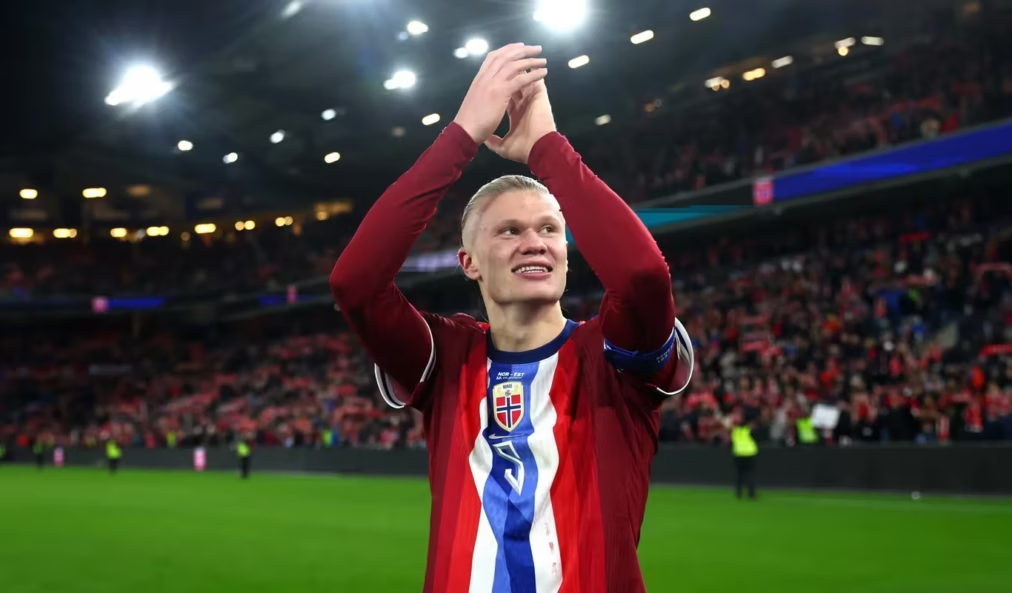
His ability to change matches with a single moment ensures that he will once again be central to Norway’s ambitions.
However, this Norway side is no longer viewed as a team reliant solely on one player.
Captain Martin Odegaard has become one of the most influential midfielders in European football and enters the tournament at the peak of his career.
The Arsenal playmaker led the qualifying competition in assists with seven and continues to serve as the creative heartbeat of the national team.
His vision, passing range and leadership have provided Norway with a level of control and imagination that has often been missing in previous generations.
The attacking options do not end there.
Alexander Sorloth arrives in strong form and has established himself as another key figure in the forward line.
The striker has enjoyed a productive period with Atletico Madrid, offering Norway a powerful attacking presence alongside Haaland.
Meanwhile, Antonio Nusa has emerged as one of the team’s most exciting young talents.
His pace, direct running and ability to create opportunities have added another dimension to Norway’s attack and increased the variety of options available to Solbakken.
Yet despite the excitement surrounding the squad, concerns remain.
Defensively, Norway still faces questions that could prove significant against stronger opponents.
The central defensive unit has not entirely convinced observers, and there are also doubts surrounding the consistency of veteran goalkeeper Orjan Nyland, who is now 35 years old.
Those uncertainties have become one of the principal talking points ahead of the tournament.
Unlike the Norway team coached by Egil Olsen during the 1990s, the current side is not built primarily on defensive organisation and pragmatism.
Instead, Solbakken’s team plays with greater attacking intent and creativity.
While that approach has made Norway more entertaining and dangerous going forward, it has also left them vulnerable at times when possession is lost.
The challenge at the World Cup will be finding the right balance.
Norway enters the competition as the 31st-ranked team in the FIFA rankings published in April 2026.
Although not among the tournament favourites, the squad possesses enough quality to believe it can compete with established football powers.
Historically, Norway has appeared at the World Cup on three previous occasions: 1938, 1994 and 1998.
Its best performances came in 1938 and 1998, when the team reached the Round of 16.
The 2026 edition marks the country’s fourth participation and offers an opportunity to achieve even greater success.
Leading the team is Solbakken, a former midfielder who represented Norway during one of the country’s strongest footballing eras.
As coach, he has guided the national team back to the World Cup after nearly three decades away.
His achievements with FC Copenhagen, where he won eight Danish league titles, have strengthened his reputation as one of Scandinavia’s most respected coaches.
The spotlight, however, will remain firmly on Haaland.
At 25, the striker remains Norway’s biggest hope of progressing beyond the group stage and reaching the knockout rounds.
Even if his form in 2026 has not matched some of his most prolific years, his goalscoring ability continues to make him one of the world’s most dangerous forwards.
Norway begin their World Cup campaign against Iraq on 17 June before facing Senegal on 23 June.
Their final group-stage fixture comes against France on 27 June in what could prove to be a decisive encounter.
For a nation that has waited almost three decades to return to the World Cup, the tournament represents more than just participation.
It is a chance for Norway’s golden generation to leave a lasting mark on football’s biggest stage.
Norway’s 2026 World Cup squad
Goalkeepers
- Orjan Haskjold Nyland
- Egil Selvik
- Sander Tangvik
Defenders
- Kristoffer Vassbakk Ajer
- Fredrik Bjorkan
- Henrik Falchener
- Sondre Langas
- Torbjorn Heggem
- Marcus Holmgren Pedersen
- Julian Ryerson
- David Moller Wolfe
- Leo Ostigard
Midfielders
- Thelonious Aasgaard
- Fredrik Aursnes
- Patrick Berg
- Sander Berge
- Oscar Bobb
- Jens Petter Hauge
- Antonio Nusa
- Andreas Schjelderup
- Morten Thorsby
- Kristian Thorstvedt
- Martin Odegaard
Forwards
- Erling Haaland
- Jorgen Strand Larsen
- Alexander Sorloth

Popular News



-

AFCON 2025: Fixtures, Results, Scores and Standings
Jan 18, 2026 -
Leadership and long-term vision key to rescuing Zamalek and inspiring Egyptian football – Hany Abou Rida
Nov 5, 2025 -
South African giants Orlando Pirates set to lose influential forward Monnapule Saleng
Mar 19, 2025 -
Full schedule for 2025 Africa Cup of Nations in Morocco confirmed
Feb 12, 2025




-
Mohamed Ouahbi explains Sofiane Boufal omission from Morocco’s World Cup squad and reveals emergency plan
May 27, 2026 -
Jamaica set up Unity Cup final showdown with Nigeria after disciplined win over India
May 28, 2026 -
World Cup 2026: Complete Group C fixture guide, team analysis and qualification predictions
May 27, 2026 -
Morocco begin new World Cup era under Mohamed Ouahbi
May 28, 2026