World Cup 2026: DR Congo aim to surprise heavyweights in Group K
More than five decades after their only previous appearance at football’s greatest tournament, DR Congo will arrive at the 2026 FIFA World Cup carrying renewed ambition, fresh belief and a determination to prove they belong among the game’s elite.
The African nation, known as the Leopards, secured their place at the tournament after overcoming Jamaica in an intercontinental play-off, ensuring that the Democratic Republic of Congo will once again experience the atmosphere of the World Cup after a long absence from the global stage.
While Group K contains established football powers Portugal and Colombia, alongside Uzbekistan, DR Congo travel to North America convinced they can be far more than participants. Under the guidance of French coach Sebastien Desabre, the Leopards have developed into a disciplined and difficult side to break down, one capable of frustrating stronger opponents and capitalising on opportunities when they arise.
For a nation whose previous World Cup campaign ended in disappointment in 1974, the 2026 edition presents an opportunity to create an entirely different legacy.
DR Congo Team Profile
Nickname: Leopards
Head Coach: Sebastien Desabre
Captain: Chancel Mbemba
FIFA Ranking (April 2026): 46th
World Cup Appearances: 2
The upcoming tournament will mark only the second World Cup appearance in the nation’s history. Their first participation came in 1974 when the country competed under the name Zaire.
Much has changed since then. African football has grown significantly, and DR Congo now possess a squad featuring players competing in some of Europe’s strongest leagues. The team’s increased quality and experience have helped fuel optimism that they can leave a far greater impression this time around.
A New Chapter After 52 Years
The story of DR Congo’s return to the World Cup is one of patience and persistence.
For decades, the country watched from afar as other African nations represented the continent on football’s biggest stage. Despite producing talented players and enjoying moments of success in continental competition, qualification for the World Cup remained elusive.
That wait finally came to an end when the Leopards secured a narrow but decisive 1-0 victory over Jamaica in the intercontinental play-off on 31 March, becoming one of the final teams to book their place at the tournament.
The result sparked celebrations among supporters who had waited generations to witness their national team return to the World Cup.
Qualification itself was a significant achievement, but inside the camp there appears to be a desire for much more. Rather than simply celebrating participation, the focus has shifted toward performance and the possibility of causing an upset.
Group K Presents a Major Test
DR Congo have been drawn into Group K alongside Portugal, Colombia and Uzbekistan.
On paper, the group represents a formidable challenge. Portugal enter the tournament with a reputation as one of Europe’s leading football nations, while Colombia remain one of South America’s most competitive sides.
Uzbekistan, meanwhile, will also be eager to make their mark and will see matches against DR Congo as a potential opportunity to secure valuable points.
For the Leopards, every game will require concentration and discipline.
Their opening fixture against Portugal could prove particularly important. A positive result would immediately transform expectations and potentially alter the dynamics of the entire group.
The clash against Colombia offers another stern examination, while the final encounter against Uzbekistan could become decisive in determining the final standings.
Although progression from the group stage will not be straightforward, DR Congo have shown enough resilience in recent years to believe they can compete against any opponent.
The Sebastien Desabre Effect

One of the major reasons behind DR Congo’s resurgence has been the influence of head coach Sebastien Desabre.
Born in 1976, Desabre took charge of the national team in 2022 and has overseen a period of steady improvement.
His greatest achievement with the Leopards so far came at the 2023 Africa Cup of Nations, where DR Congo finished fourth.
Beyond results, Desabre has established a clear identity for the team.
Under his leadership, DR Congo have become known for their organisation, defensive solidity and efficiency. They rarely make life easy for opponents and often prioritise effectiveness over unnecessary risks.
This pragmatic approach has helped the team compete against stronger nations and has created a platform upon which individual talents can flourish.
At the World Cup, those qualities may become even more valuable.
Tournament football often rewards teams capable of remaining compact, disciplined and patient. DR Congo’s ability to execute that game plan could be one of their greatest strengths.
Chancel Mbemba’s Leadership
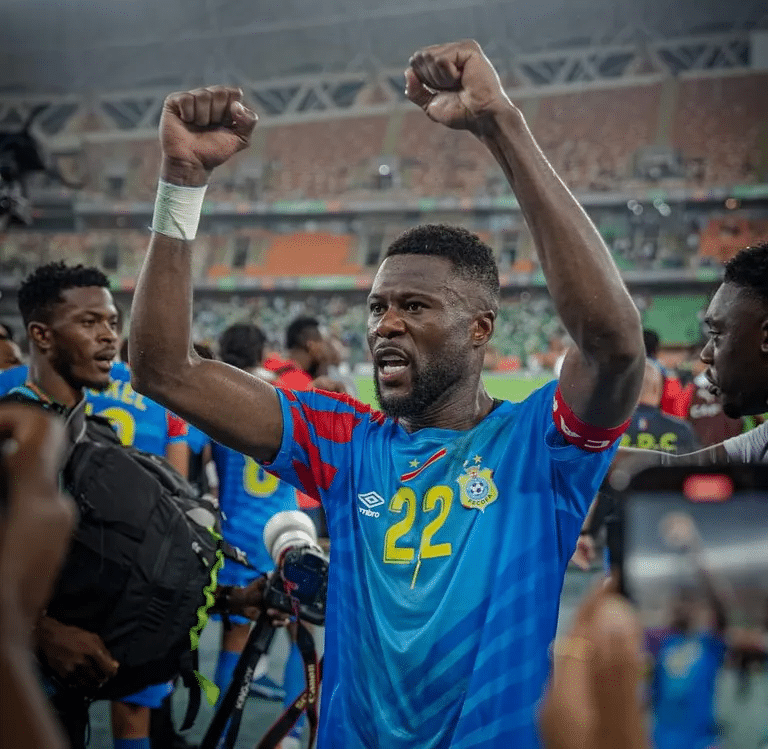
Every successful tournament team requires strong leadership, and DR Congo will look to captain Chancel Mbemba to provide exactly that.
As one of the most experienced figures in the squad, Mbemba brings calmness, authority and understanding to the team.
His presence in defence helps organise the back line, while his leadership off the pitch provides an important example for younger teammates.
For a squad preparing for one of the biggest challenges in its history, Mbemba’s influence could prove crucial.
Cedric Bakambu Remains the Main Man

At 35 years of age, Cedric Bakambu continues to be the focal point of DR Congo’s attack.
Despite experiencing a difficult season with Real Betis, the striker remains the national team’s leading attacking threat and enters the World Cup as one of its most important players.
Bakambu scored four goals during the qualification campaign and remains the Leopards’ primary source of goals.
His experience at club and international level gives him a unique role within the squad. Younger players can look to him for guidance, while opponents remain aware of his ability to produce decisive moments.
Born in France to a family of Congolese heritage, Bakambu chose to represent DR Congo in 2015.
His commitment has been rewarded with a distinguished international career, and he now stands just one goal away from equalling Dieumerci Mbokani’s all-time scoring record for the national team.
The World Cup therefore presents not only an opportunity to help his country but also a chance to write another chapter in his own personal story.
Should DR Congo enjoy a successful campaign, Bakambu is likely to play a central role.
European Experience Across the Squad
One of the notable features of the current DR Congo team is the number of players competing in Europe.
Alongside Chancel Mbemba and Cedric Bakambu, the squad contains several individuals accustomed to performing at a high level.
Yoane Wissa brings attacking quality and versatility, while Aaron Wan-Bissaka offers defensive reliability and experience.
The presence of players operating in competitive European environments has strengthened the overall standard of the national team.
It has also contributed to a growing sense that DR Congo can challenge established nations rather than merely compete against them.
Full DR Congo World Cup 2026 Squad
The Leopards are expected to travel to North America with a squad built around a blend of experience and emerging talent.
Goalkeepers
- Lionel Mpasi
- Dimitry Bertaud
- Timothy Fayulu
Defenders
- Chancel Mbemba
- Aaron Wan-Bissaka
- Gedeon Kalulu
- Arthur Masuaku
- Rocky Bushiri
- Dylan Batubinsika
- Henock Inonga
- Joris Kayembe
Midfielders
- Samuel Moutoussamy
- Edo Kayembe
- Gael Kakuta
- Charles Pickel
- Meschack Elia
- Theo Bongonda
- Grady Diangana
- Silas Katompa Mvumpa
Forwards
- Cedric Bakambu
- Yoane Wissa
- Simon Banza
- Fiston Mayele
- Cédric Mokaou
- Afimico Pululu
- Jonathan Bolingi
World Cup Record
DR Congo’s previous and only World Cup appearance came in 1974 when the nation competed under the name Zaire.
It was a difficult tournament.
The team lost all three matches, failed to score a goal and conceded 14 times before exiting the competition.
Those statistics remain a reminder of the challenges faced by African teams during that era, but they also provide additional motivation for the current generation.
The players travelling to World Cup 2026 have the opportunity to achieve something no Congolese team has previously managed at the tournament.
Every point earned and every positive result secured would represent a new milestone.
Group Stage Fixtures

Portugal vs DR Congo
18 June – 00:00
Colombia vs DR Congo
24 June – 09:00
DR Congo vs Uzbekistan
28 June – 06:30
These three fixtures will determine whether the Leopards can extend their stay in the competition and potentially reach the knockout rounds.
Head-to-Head Record Against Group Rivals
Portugal
The two nations have never met.
Colombia
The two nations have never met.
Uzbekistan
The two nations have never met.
The absence of previous meetings adds another layer of intrigue to Group K, with all three encounters representing entirely new challenges for DR Congo.
FIFA Ranking and World Standing
DR Congo enter World Cup 2026 ranked 46th in the FIFA World Ranking as of April 2026.
While that places them below several of the tournament’s traditional powers, it also reflects the progress made under Sebastien Desabre.
The ranking highlights a team that has steadily improved and earned its place among the 48 nations competing in North America.
For DR Congo, however, rankings alone will mean little once the tournament begins.
The focus will be on performances, results and the opportunity to demonstrate that they can compete with teams from every corner of the football world.
The Leopards may not arrive among the favourites, but they carry hopes of writing a memorable chapter in the nation’s football history.
After waiting more than half a century to return to the tournament, simply being present is no longer enough. With experienced leaders, a disciplined coach and proven attacking talent led by Cedric Bakambu, DR Congo head to North America determined to show that they can be one of the surprise packages of World Cup 2026.
For a team that once left the competition without a point or a goal, the challenge now is to create a new narrative—one that reflects how far Congolese football has come and how ambitious it has become.
Popular News


-

AFCON 2025: Fixtures, Results, Scores and Standings
Jan 18, 2026 -
Leadership and long-term vision key to rescuing Zamalek and inspiring Egyptian football – Hany Abou Rida
Nov 5, 2025 -
South African giants Orlando Pirates set to lose influential forward Monnapule Saleng
Mar 19, 2025 -
Full schedule for 2025 Africa Cup of Nations in Morocco confirmed
Feb 12, 2025




-
Mohamed Ouahbi explains Sofiane Boufal omission from Morocco’s World Cup squad and reveals emergency plan
May 27, 2026 -
Jamaica set up Unity Cup final showdown with Nigeria after disciplined win over India
May 28, 2026 -
Morocco begin new World Cup era under Mohamed Ouahbi
May 28, 2026 -
World Cup 2026: Complete Group C fixture guide, team analysis and qualification predictions
May 27, 2026