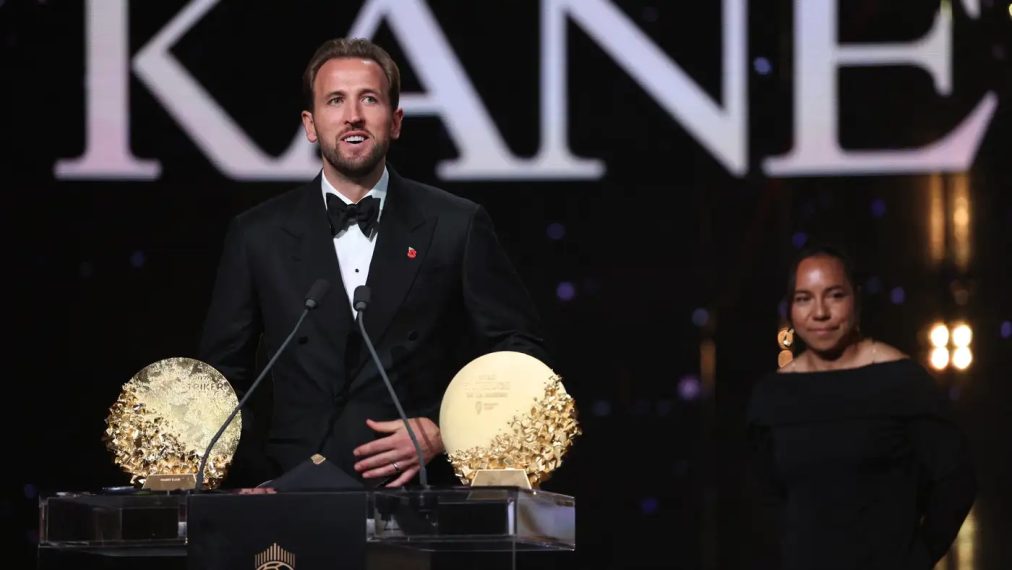
Harry Kane’s Ballon d’Or victory in London on Monday has failed to settle the familiar debate over the award. Instead, it has renewed questions over whether the voting system can identify the world’s best player, or whether the result is shaped by subjective criteria, team success and media momentum.
The England captain and Bayern Munich striker finished ahead of Kylian Mbappe and Lamine Yamal after scoring 73 goals for club and country during the 2025-26 season. He also helped Bayern Munich win a domestic treble and scored 14 goals in the Champions League.
Those figures provide a compelling case for Kane, but they do not explain how individual achievements are converted into votes, or how much importance should be attached to each factor when players occupy different positions and perform different roles.
Jose Felix Diaz, director of Spanish newspaper AS and the only Spanish representative on the voting panel, said his top three were Kane, Mbappe and Yamal, although his order differed from the final result.
“I expected Mbappe or Lamine Yamal, because Harry Kane is missing something,” he told radio station Cadena SER’s El Larguero programme.
Diaz added that nine of the 10 players on his ballot finished in the final top 10. He has not yet revealed his complete ranking or said whether Mbappe or Yamal was his first choice.
The view of one journalist does not prove Kane was an undeserving winner, but it highlights the central problem: voters may interpret “the best” in different ways, and the award cannot be decided by a single clear statistical formula.
If goals alone determined the result, a ranking could be produced from goals, assists and attacking contributions. If trophies were the only consideration, a list of honours would be enough. Instead, the rules combine decisive individual performances, collective achievements and sporting conduct, without showing precisely how each voter weighs them.
An argument that stretches beyond one year
One of the award’s most debated outcomes came in 2010, when Lionel Messi won after Spain lifted the World Cup in South Africa. Andres Iniesta, who scored the winning goal against the Netherlands in the final, finished second, with Xavi Hernandez third.
Messi had a strong individual claim, but the result raised questions over the fairness of the voting system used at the time and how personal excellence should be balanced against an historic team achievement.
In April 2018, Pascal Ferre, then editor-in-chief of France Football, addressed the issue in a tribute to Iniesta and apologised for never awarding him the Ballon d’Or.
“Forgive us, Andres,” he wrote, describing Iniesta’s absence from the winners’ list as one of the most painful omissions and referring to a “democratic anomaly” that he hoped Iniesta could correct with an outstanding performance at the World Cup in Russia.
Iniesta had finished runner-up to Messi in 2010 and third in 2012, behind Messi and Cristiano Ronaldo, despite winning the European Championship with Spain and being named the tournament’s best player.
Kane’s victory again demonstrates the complexity of the decision. Mbappe and Yamal also had strong claims based on their performances and influence with Real Madrid, Barcelona, France and Spain.
Messi’s fall to fifth, after previously winning the Ballon d’Or following Argentina’s triumph at the Qatar World Cup, despite reaching another World Cup final with Argentina and achieving success with Inter Miami, also shows how media narratives can shape attention. Both Messi and Ronaldo have benefited from that momentum in the past, while at other times their recognition has prompted questions about how their rivals’ achievements were covered.
Reform does not require new rules whenever there is disagreement over a winner. But greater clarity is needed over how the criteria are applied, how nominees are selected and how individual and collective success are balanced. The unresolved question remains: who decides what makes one player the world’s best, and by which measure?
-
 Justin Njinmah closing in on Werder Bremen comeback ahead of Hoffenheim clash Oct 27, 2026
-
Ragnar Ache faces late fitness test ahead of FC Koln’s DFB-Pokal clash against Union Berlin Oct 27, 2026
-
Ajax face salary challenge in bid to keep Moroccan prospect Abdellah Ouazane Oct 27, 2026
-
Three former Algerian FA presidents sentenced to up to eight years in prison Oct 27, 2026




-
AFCON 2025: Fixtures, Results, Scores and Standings Jan 18, 2026
-
Match hero Taiwo Awoniyi reflects on team effort after Chelsea triumph May 5, 2026
-
Leadership and long-term vision key to rescuing Zamalek and inspiring Egyptian football – Hany Abou Rida Nov 5, 2025
-
South African giants Orlando Pirates set to lose influential forward Monnapule Saleng Mar 19, 2025




-
Barcelona v Real Madrid: Catalans backed at 1.65 to win October Clasico Oct 23, 2026
-
Barcelona and Real Madrid meet in pivotal 265th Clasico Oct 23, 2026
-
Sevilla FC v Osasuna: probable line-ups for Monday’s La Liga meeting Oct 25, 2026
-
Champions League: PSG beat Barcelona as Liverpool complete comeback against Villarreal Oct 20, 2026