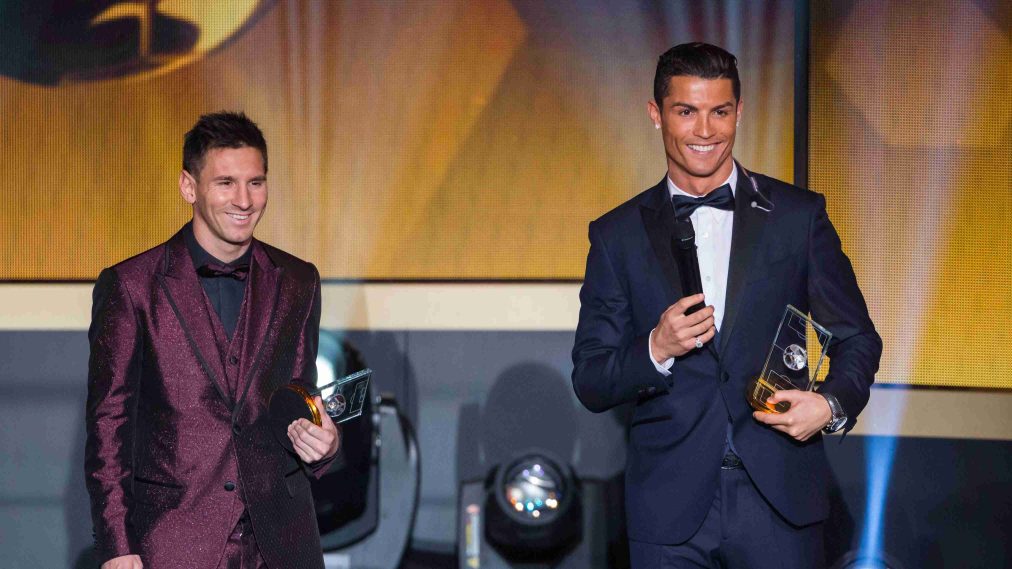
A statistical study covering 69 editions of the Ballon d’Or has placed Cristiano Ronaldo above Lionel Messi on cumulative points, while Real Madrid emerged as the most influential club in the award’s history.
The analysis, conducted by Santi Garcia Cremades and reported by Spanish newspaper Marca, ranks players according to their positions in the annual voting rather than simply counting victories. Cristiano Ronaldo leads with 460 points, narrowly ahead of Messi on 450.
The result differs from the traditional measures. Messi has won the Ballon d’Or eight times, three more than Ronaldo, and has finished on the podium 14 times compared with Ronaldo’s 12. His average score per appearance is also higher, at 28.125 points to Ronaldo’s 25.556.
The study examined 69 awards held between 1956 and 2025, excluding 2020 when the prize was not presented. It included 2099 player records representing 213 clubs and 66 countries or nationalities.
Under the system, called P30, the winner receives 30 points, the runner-up 29, the third-placed player 28, and so on. The method is designed to reward sustained presence among the leading contenders, rather than isolated victories.
Real Madrid clear of Barcelona
Real Madrid top the club standings with 3189 points, well ahead of Barcelona on 2717. Juventus are third with 2059, followed by Bayern Munich on 2027 and Milan on 1829.
Manchester United are sixth with 1636 points, ahead of Inter Milan (1362), Liverpool (1098), Ajax (734) and Manchester City (719).
Real Madrid have appeared in the historical rankings across 57 editions, from the eras of Alfredo Di Stefano and Raymond Kopa to Cristiano Ronaldo and later generations. Ronaldo contributed 261 points during his time at the club, but that represented only 8.2% of Real Madrid’s total.
Barcelona’s figure is more heavily linked to Lionel Messi, who supplied 14.9% of the club’s 2717 points.
Germany lead the nationality rankings
Germany head the national standings with 3854 points, followed by Italy on 3229, France on 2976, England on 2821 and Spain on 2551.
The distribution of points is relatively broad for Germany: its leading contributor accounts for 8.3% of the total. Italy’s highest contributor represents 6.9%.
Portugal, however, is more closely associated with Ronaldo, whose points make up 29.9% of the country’s total. Messi accounts for 44.5% of Argentina’s score, meaning almost half of its historical tally is connected to one player.
The study also identified different models of club influence. Eusebio contributed 53.8% of Benfica’s Ballon d’Or points, while Thierry Henry supplied 31.6% of Arsenal’s total. Kylian Mbappe represents 24.7% of Paris Saint-Germain’s score and Kevin De Bruyne 21.1% of Manchester City’s.
By contrast, the leading contributors for Real Madrid and Juventus account for only 8.2% and 8.1% respectively. Bobby Charlton’s share of Manchester United’s total is 12.7%.
Power shifts across the decades
Real Madrid led the opening period from 1956 to 1959 with 260.5 points. Manchester United topped the 1960s on 389, with Bobby Charlton among the leading figures.
Bayern Munich dominated the 1970s with 541 points, driven by Franz Beckenbauer’s generation, before Juventus led the 1980s on 452. Milan were first in the 1990s with 494.
Real Madrid returned to the top between 2000 and 2009, collecting 649 points. Barcelona then produced the highest total recorded for any period, scoring 930 between 2010 and 2019 during Messi’s defining era.
Real Madrid led again from 2021 to 2025 with 378 points.
The nationality leaders changed in parallel. Hungary topped the opening period, Italy led the 1960s, Germany the 1970s and 1980s, and Italy returned to first place in the 1990s. Brazil collected 758 points in the 2000s, Spain led from 2010 to 2019 with 625, and France topped the most recent period with 302.
The club-country links also produced notable findings. German players account for 75.1% of Bayern Munich’s total, while Dutch players represent 73.6% of Ajax’s. Real Madrid players contribute 46.1% of Spain’s points and Barcelona players 28.1%, meaning the two clubs together account for almost three-quarters of the Spanish total.
In Argentina, players who represented Barcelona account for 42.9% of the country’s points. Benfica represents 27.2% of Portugal’s historical presence, while Real Madrid contributes 23.1%.
On average, the four highest-ranked clubs in each edition share 50% of all points awarded. The top four nationalities receive 57.7%. Club concentration was especially high in 2010, 2014 and 2015, while the 1974, 1982 and 1990 editions showed particularly strong concentration among nationalities.
The P30 system measures Ballon d’Or voting presence, rather than the number of trophies won by clubs or their overall team performance. It therefore offers an alternative view of legacy: Messi leads on victories and average scores, Ronaldo on accumulated points, Real Madrid among clubs and Germany among nationalities.
-
 FIFA U15 World Cup & Festival: DR Congo edged out by El Salvador in five-goal opener Oct 24, 2026
-
Azam FC v ZED FC: Predicted line-ups for CAF Confederation Cup tie Oct 24, 2026
-
CAF Confederation Cup: ZED FC target historic group-stage qualification against Azam FC Oct 24, 2026
-
CAF Confederation Cup: Club Sportif Sfaxien and Al-Ahli Tripoli target group-stage places Oct 24, 2026



-
AFCON 2025: Fixtures, Results, Scores and Standings Jan 18, 2026
-
Match hero Taiwo Awoniyi reflects on team effort after Chelsea triumph May 5, 2026
-
Leadership and long-term vision key to rescuing Zamalek and inspiring Egyptian football – Hany Abou Rida Nov 5, 2025
-
South African giants Orlando Pirates set to lose influential forward Monnapule Saleng Mar 19, 2025




-
Barcelona v Real Madrid: Catalans backed at 1.65 to win October Clasico Oct 23, 2026
-
PSG v Barcelona: fiery attacks set up Champions League classic at Parc des Princes Oct 18, 2026
-
Barcelona and Real Madrid meet in pivotal 265th Clasico Oct 23, 2026
-
Champions League: PSG beat Barcelona as Liverpool complete comeback against Villarreal Oct 20, 2026