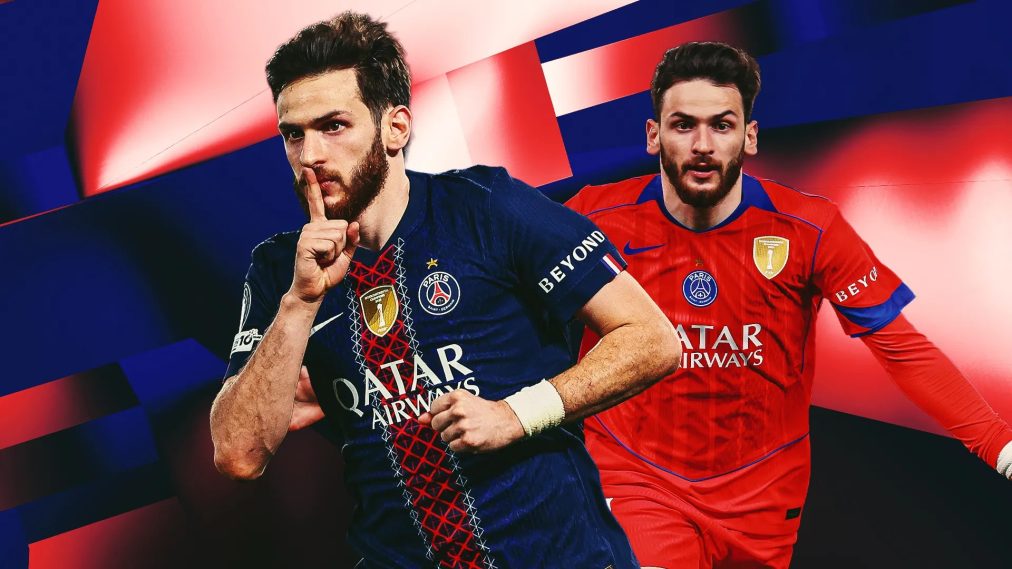
With the Ballon d’Or ceremony approaching, the contest between Lamine Yamal and Khvicha Kvaratskhelia highlights the difficulty of judging individual excellence in football. The most impressive European achievement does not automatically belong to the player who attracts the most attention, just as the most captivating talent does not necessarily have the strongest season-long case.
Yamal, Barcelona’s outstanding young talent, arrives surrounded by enormous media and public interest. Kvaratskhelia, meanwhile, produced an exceptional European campaign with Paris Saint-Germain before suffering an anterior cruciate ligament injury in the sides’ most recent meeting. The injury occurred in front of a player widely regarded as one of the leading contenders for the award.
Beyond sympathy for Kvaratskhelia or admiration for Yamal, the central question is what should carry the greatest weight: team success, individual performance, ability, or the power to occupy the public and media conversation?
Kvaratskhelia’s Champions League argument
Kvaratskhelia’s strongest case comes in the Champions League. The Georgian was not simply a good player in a team that won the competition; he was one of the main reasons Paris Saint-Germain succeeded.
He scored 10 goals and provided six assists, performances that led UEFA to name him the competition’s best player. Those figures represent a direct influence on the most important club tournament and give Kvaratskhelia a powerful argument for the Ballon d’Or.
Winning a trophy alone is not enough, but combining that success with such a significant individual contribution makes it difficult to reduce his season to a medal or European title. Yamal did not have the same level of influence in last season’s Champions League. That does not diminish his ability or technical quality, but it shows why the comparison cannot be viewed in only one direction.
Yamal possesses a different major advantage: winning the World Cup with Spain. No international football title is bigger, and appearing on that stage can have a lasting effect on a player’s place in the collective memory. However, winning the World Cup does not automatically mean a player was the best performer in the tournament.
Kvaratskhelia did not play at the World Cup because Georgia did not qualify, denying him an opportunity to perform before voters and supporters on football’s biggest stage. That was not the player’s fault, but international football does not offer every leading player the same platform.
The battle for attention
Yamal also benefits from a remarkable media profile. He is seen as Barcelona’s most prominent talent since Lionel Messi, combining his young age, striking skills, clear individual style and the visibility that comes with playing for a club known worldwide for producing stars.
His good performances quickly become subjects of analysis, while individual moments can spread widely. The attention is not necessarily artificial: his talent is genuine and his performances justify the interest. Nevertheless, that constant exposure keeps him at the forefront of the public’s mind.
Kvaratskhelia’s Champions League displays have not generated the same level of momentum. His Georgian background may partly explain the difference, given that the country lacks the international football history of the sport’s major powers. That does not mean his nationality has decided his chances or that deliberate bias exists, but it raises questions about the unequal platforms available to players.
The contrasting start to the current season has sharpened the difference in perception. Yamal has continued to impress for Barcelona, while Kvaratskhelia endured a less convincing spell before his serious injury against Barcelona left him facing a long recovery.
However, neither development can directly determine the vote. The current season began outside the voting period, and the ballot has already closed. Yamal’s recent form and Kvaratskhelia’s injury affect the broader image surrounding them, not the votes already submitted.
Ultimately, Yamal offers rare creativity, daring and unpredictability, while Kvaratskhelia has shown he can decide major Champions League matches. The Ballon d’Or should judge the whole seasonnot simply talent, popularity, a club badge or one trophy.
-
 Al Ahly back coach Hussein Ammouta despite growing pressure after Al Qanah draw Oct 22, 2026
-
Mourinho praises Morocco’s Brahim Diaz after Real Madrid assist against Leipzig Oct 22, 2026
-
Namibia FA pushes 2026/27 football season to November 7, demands urgent compliance from leagues Oct 22, 2026
-
Al Ahly and Zamalek in same path after Egypt Cup round 32 draw Oct 22, 2026


-
AFCON 2025: Fixtures, Results, Scores and Standings Jan 18, 2026
-
Match hero Taiwo Awoniyi reflects on team effort after Chelsea triumph May 5, 2026
-
Leadership and long-term vision key to rescuing Zamalek and inspiring Egyptian football – Hany Abou Rida Nov 5, 2025
-
South African giants Orlando Pirates set to lose influential forward Monnapule Saleng Mar 19, 2025




-
PSG v Barcelona: fiery attacks set up Champions League classic at Parc des Princes Oct 18, 2026
-
Champions League: PSG beat Barcelona as Liverpool complete comeback against Villarreal Oct 20, 2026
-
Real Betis v Barcelona: kick-off time, TV details and match preview Oct 16, 2026
-
PSG beat Barcelona 4-2 in Champions League thriller Oct 21, 2026