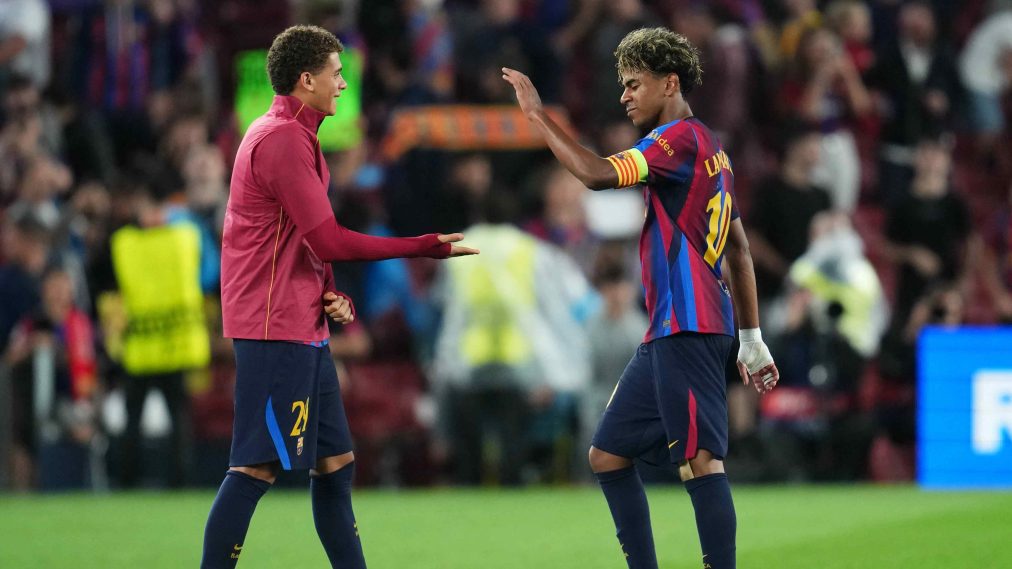
Barcelona’s recruitment process goes beyond statistics, with the club combining data analysis, live scouting and intuition with detailed assessments of a player’s personality and social background.
That approach was outlined by Joan Amaral, the club’s head of talent scouting, in comments reported by Spanish newspaper Mundo Deportivo. Amaral said relying too heavily on data could obscure important information, while watching a player in person often reveals tactical and behavioural details that may not be clear from video footage.
He said Barcelona’s main challenge was not identifying established players, but finding emerging talent suited to the team’s needs and style of play. Scouts are encouraged to record their observations whenever they see signs that a player possesses exceptional ability.
The process begins by establishing the team’s technical requirements, in coordination with sporting director Deco and head coach Hansi Flick. Barcelona’s data-analysis department then creates specific indicators for each position, helping to narrow the list of candidates before they undergo more detailed scouting and are compared with the coaching staff’s demands.
Why Barcelona abandoned numerical ratings
Amaral revealed that Barcelona had moved away from a digital rating system based on a scale from zero to 10 because of its subjective nature.
Instead, scouts now produce written reports covering a player’s physical, technical and tactical qualities, alongside a summary of their performance during the match. Amaral also stressed that travelling to watch players in person remains a fundamental part of the club’s scouting method.
The assessment continues beyond what happens on the pitch. Barcelona seeks to understand a player’s character, family and wider social circle, using direct conversations and social media to assess how well they might adapt to the team and the city.
The club also considers whether a player’s psychological traits are compatible with its requirements. Amaral said those factors could not be captured fully through statistics or isolated match footage.
Vitor Roque experience
Amaral cited the example of Brazilian striker Vitor Roque, who joined Barcelona before arriving at the club. He said Roque’s characteristics were compatible with the team’s style, but the timing of his move created one of the main difficulties.
Roque arrived during the winter transfer window, in the middle of the season, meaning he faced immediate pressure to prove his ability and make the expected contribution. That pressure came alongside the expectations associated with the value of the transfer.
Amaral said previous experiences should inform future decisions at Barcelona. Summing up the lesson from the Roque case, he said: “If we do not learn from our mistakes, we will not improve.”
-
 AC Milan consider Algeria midfielder Adem Zorgane as Luka Modric replacement Oct 11, 2026
 -
Bayer Leverkusen face Christian Kofane contract hurdle amid Premier League interest Oct 11, 2026
-
Chelsea, Barcelona and Paris Saint-Germain tracking Inter Milan midfielder Andy Diouf Oct 11, 2026
-
Sibisi warns of ‘very painful week’ after Pirates lose MTN8 final Oct 11, 2026


-
AFCON 2025: Fixtures, Results, Scores and Standings Jan 18, 2026
-
Match hero Taiwo Awoniyi reflects on team effort after Chelsea triumph May 5, 2026
-
Leadership and long-term vision key to rescuing Zamalek and inspiring Egyptian football – Hany Abou Rida Nov 5, 2025
-
South African giants Orlando Pirates set to lose influential forward Monnapule Saleng Mar 19, 2025




-
Croatia face Spain with Nations League hopes on the line in Split Oct 5, 2026
-
Manchester United host winless Tottenham in Premier League clash Oct 7, 2026
-
Morocco coach Mohamed Ouahbi refuses to single out player after Mali draw Oct 4, 2026
-
Lens v Lyon: Can the in-form visitors extend their unbeaten Ligue 1 run? Oct 6, 2026