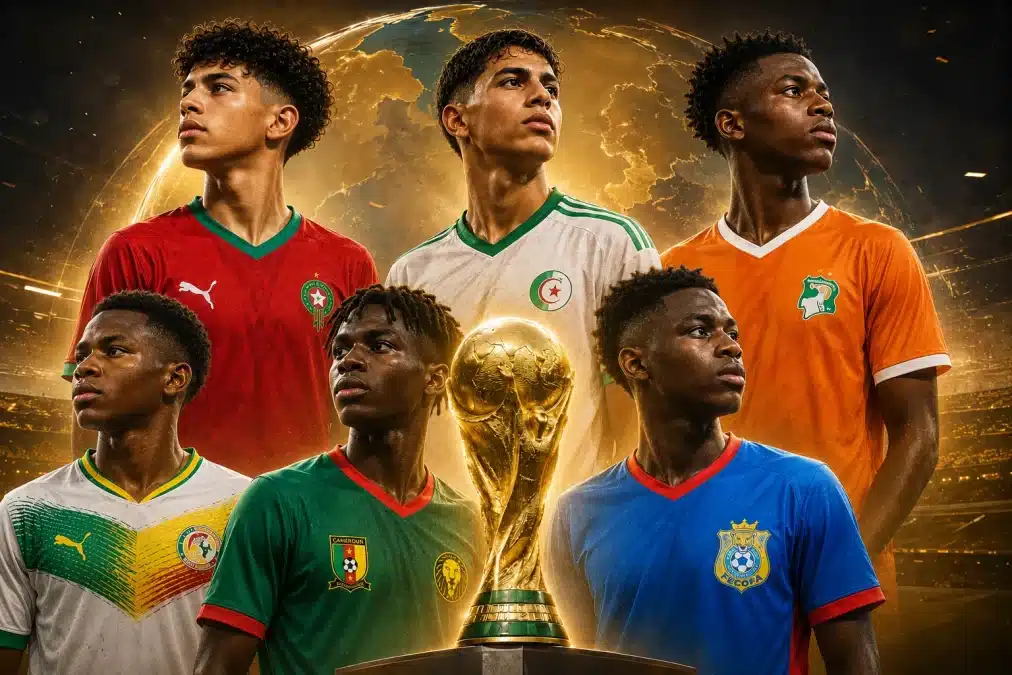
Gianni Infantino has announced that FIFA will stage its first Under-15 World Cup this year, inviting all 211 member associations to take part in an event expected to bring together more than 4,000 young players.
The format has yet to be confirmed, but the FIFA president presented the tournament as a global festival of youth football rather than a conventional competition.
“This year, we will organise for the first time at FIFA an Under-15 World Cup where all 211 FIFA countries are invited,” Infantino said.
The announcement could offer African football an unusually large international platform at an age when differences in infrastructure, finance and player development have not yet become as decisive as they are at senior level.
Africa has a strong record in youth football, particularly at Under-17 level. Nigeria remain the most successful nation in the FIFA Under-17 World Cup with five titles, while Ghana have won the competition twice. Mali have reached one final and Burkina Faso have appeared in the semi-finals.
Those achievements suggest the continent would not enter a global Under-15 event without considerable potential.
At 15 and 17, natural ability, athleticism, creativity and early maturity can still have a major influence on results. Africa possesses a substantial pool of players with those qualities. The gap with teams from wealthier football systems often widens later, as leading European prospects move into highly funded academies with sophisticated medical, tactical and physical support.
Many young African players, by contrast, continue to develop in environments with fewer resources and less extensive post-training support. A World Cup played at Under-15 level could therefore provide a stage before those structural inequalities have had as much time to shape the players’ progress.
The value for Africa would extend beyond winning matches. A tournament involving every FIFA member association would allow countries rarely seen in major international youth competitions to present their best players to a worldwide audience.
Scouts, academies and clubs could identify talent from nations that possess promising players but seldom reach the biggest FIFA tournaments. That opportunity would need to be managed carefully, with the welfare and interests of minors kept at the centre of the process.
Strong performances could also give African associations a further reason to invest in academies, coaching, basic facilities and wider player development.
A potential route from school football to the world stage
Africa already has a structure that could help supply players for the proposed tournament: the CAF African Schools Football Championship. Launched in 2022, the programme has expanded rapidly.
CAF says more than three million boys and girls have taken part since its creation, with tens of thousands of schools represented across almost the entire continent.
The competition uses zonal qualifying tournaments before a continental final. In 2026, that final was held in Harare, Zimbabwe, with teams representing Morocco, Senegal, the Democratic Republic of the Congo, Benin, Tanzania, Ghana and Burkina Faso among those involved.
The programme also extends beyond matches. The continental champions in both the boys’ and girls’ competitions receive $300,000, while the runners-up are awarded $200,000 and the third-placed teams receive $150,000.
The money is intended to fund educational football projects, including sports facilities, classrooms, libraries and other equipment. CAF also runs development programmes for young referees, reporters, coaches and medical staff.
That means a system for identifying talent at an early age is already in place. FIFA’s proposed Under-15 World Cup could offer it a natural route to a global audience.
There is, however, a major condition for the tournament to succeed: credibility.
African football has long faced criticism over alleged age fraud, an issue that has unfortunately become structural in parts of the continent’s game. FIFA uses wrist MRI examinations among the methods designed to assess players’ bone maturity.
Several incidents have damaged Africa’s reputation. In 2023, Cameroon excluded 21 of 30 players following tests conducted before an Under-17 competition. Guinea were disqualified from the FIFA Under-17 World Cup in 2019 after a case involving the identity and ages of players, while Senegal also had to withdraw several players before that year’s World Cup.
Some players who later became internationals, including Cote d’Ivoire midfielder Franck Kessie, had been accused of age fraud during youth competitions.
Nigeria have also faced numerous similar controversies in the past. With an Under-15 category, the issue would become even more sensitive because of the players’ age.
CAF and the national associations would therefore need to apply rigorous checks well before tournaments begin, rather than carrying out limited testing only a few days before matches.
Handled properly, the new competition could give Africa an important opportunity to display one of its greatest assets: a huge supply of emerging talent, before the unequal development systems in world football begin to have their full effect.
If it were followed by further scandals over players’ ages, however, the tournament could produce the opposite result and damage the very football systems it is intended to showcase.
-
 Achraf Hakimi warns PSG must be at their best against Barcelona Oct 16, 2026
 -
Soufiane Bahassa proud to continue with Bordeaux in R1 Oct 16, 2026
-
CAF 1st Vice President Fouzi Lekjaa appointed Morocco’s Minister of Economy and Finance Oct 16, 2026
-
Besiktas explore loan deal for Morocco winger Chemsdine Talbi Oct 16, 2026


-
AFCON 2025: Fixtures, Results, Scores and Standings Jan 18, 2026
-
Match hero Taiwo Awoniyi reflects on team effort after Chelsea triumph May 5, 2026
-
Leadership and long-term vision key to rescuing Zamalek and inspiring Egyptian football – Hany Abou Rida Nov 5, 2025
-
South African giants Orlando Pirates set to lose influential forward Monnapule Saleng Mar 19, 2025




-
Roma v Real Madrid: home side tipped to score first in Champions League clash Oct 12, 2026
-
Real Betis v Barcelona: kick-off time, TV details and match preview Oct 16, 2026
-
Atletico Madrid v Manchester United: probable line-ups for Champions League clash Oct 12, 2026
-
Celta Vigo v Juventus: Probable line-ups for Europa League encounter Oct 14, 2026