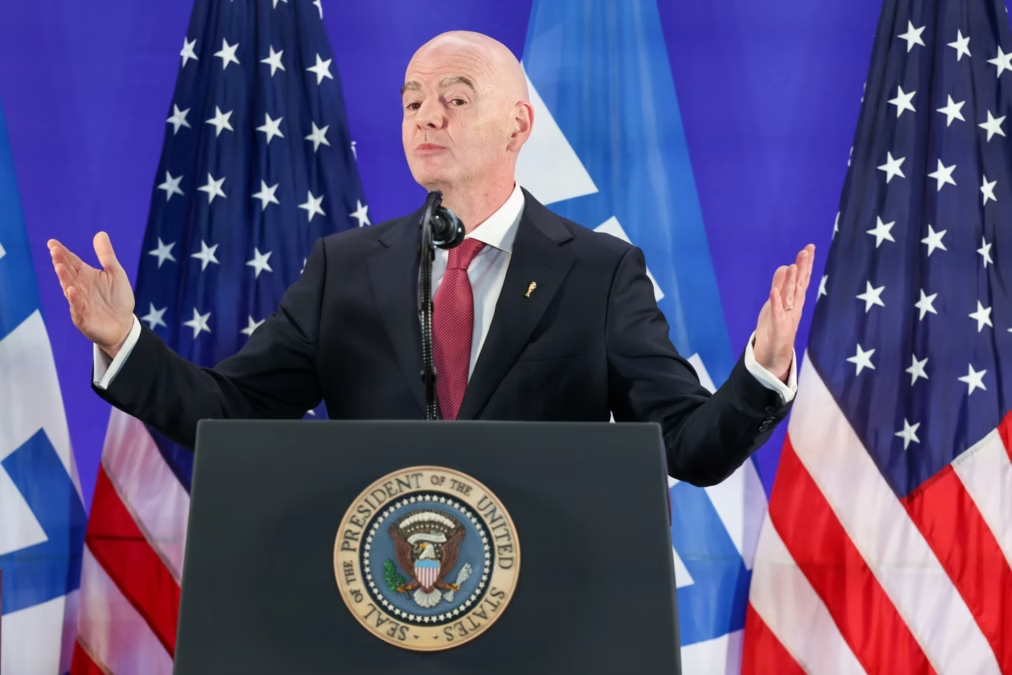
Carlos Cordeiro, the senior adviser to FIFA president Gianni Infantino, has resigned over a controversial proposal to sell a stake linked to the World Cup.
The 70-year-old American said in a statement circulated by several major media organisations that he had played no part in developing the plan. His departure represents another significant setback for Infantino, whose proposal has already faced strong opposition from UEFA, CONCACAF and the Asian Football Confederation (AFC).
Cordeiro said the proposed arrangement would be “a bad deal for FIFA member countries and a bad deal for football”.
The plan involves creating a commercial company that would operate outside the federation’s existing rules. Investors could then acquire shares in the organisation and generate profits from the World Cup.
“As the senior adviser to the FIFA president and someone who has been passionate about football all my life, I cannot stand by while FIFA considers selling a stake in the World Cup,” Cordeiro said.
“Let us be clear: I played no role in this project. The FIFA president himself has pointed out that $15bn in revenue was generated between 2022 and 2026. In that context, it is difficult to conceive of selling a permanent stake in football’s most valuable asset in order to raise $4.2bn.”
Cordeiro’s resignation comes as pressure on Infantino continues to build. Three of football’s largest confederations have opposed the proposal, while a series of departures from within FIFA has further weakened support for the president.
The controversy follows criticism directed at Infantino after last summer’s World Cup. He faced scrutiny over the organisation of the tournament and over the involvement of United States president Donald Trump.
Cordeiro previously served as president of the United States Soccer Federation before becoming Infantino’s senior adviser in 2021. In preparation for the 2026 World Cup, he was also appointed as an adviser to the White House.
Before entering football administration, Cordeiro spent several years working as an international banker at Goldman Sachs, among other roles.
His decision is the latest in a sequence of developments that appear to have increased the pressure on Infantino. With opposition from UEFA, CONCACAF and the AFC, alongside growing internal unrest at FIFA, questions are increasingly being raised over the future of the organisation’s president.
The proposed commercial structure has become a particular point of contention because it would allow outside investors to secure an interest in the World Cup, which is FIFA’s most valuable asset. Cordeiro argued that the projected income made it difficult to justify selling a permanent stake for $4.2bn.
The resignation therefore adds to the uncertainty surrounding an initiative that Infantino had presented as a way of creating a new commercial vehicle for FIFA. It also leaves the president facing renewed criticism from leading football authorities and from a senior adviser who says he was not involved in the plan.
-
 Europa League: Juventus, Besiktas and Crystal Palace begin with big wins Sep 17, 2026
 -
Gambia beat Liberia to reach UFOA-A U17 final and qualify for 2027 AFCON Sep 17, 2026
-
Juventus make flying Europa League start with emphatic 5-0 win over NEC Nijmegen Sep 17, 2026
-
Bournemouth begin Europa League campaign with 2-1 win at Real Sociedad Sep 17, 2026




-
AFCON 2025: Fixtures, Results, Scores and Standings Jan 18, 2026
-
Leadership and long-term vision key to rescuing Zamalek and inspiring Egyptian football – Hany Abou Rida Nov 5, 2025
-
South African giants Orlando Pirates set to lose influential forward Monnapule Saleng Mar 19, 2025
-
Match hero Taiwo Awoniyi reflects on team effort after Chelsea triumph May 5, 2026




-
African Stars choose Botswana’s Lucas Moripe Stadium to host Orlando Pirates in CAF Champions League Sep 16, 2026
-
Europa League: AC Milan, Benfica and Lyon begin new league phase Sep 16, 2026
-
Mohamed Fathi emerges as potential PSL option amid South Africa coaching shake-up Sep 11, 2026
-
Besiktas and Marseille reveal probable line-ups for Europa League opener Sep 15, 2026