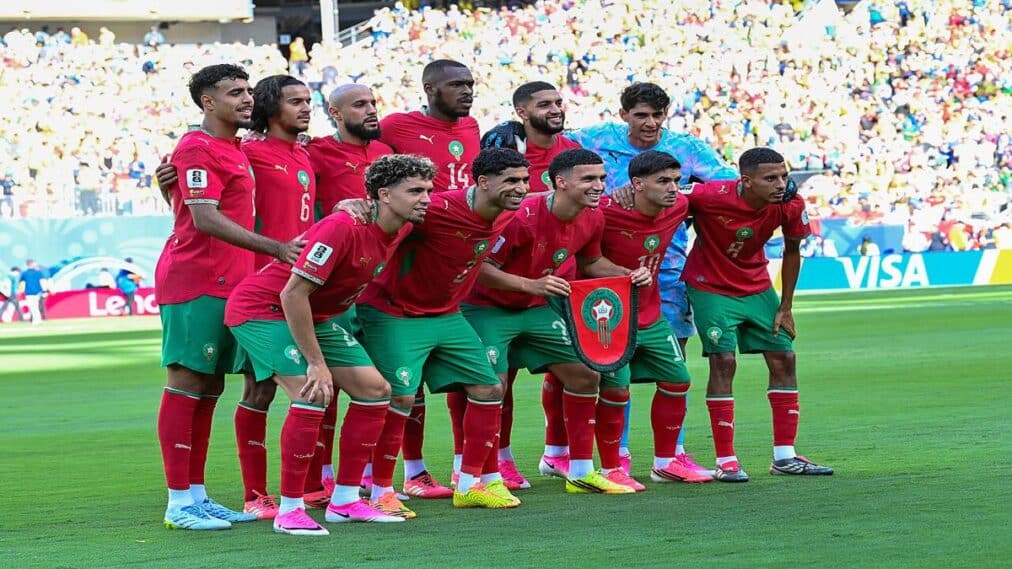
Morocco’s 2026 World Cup campaign confirms Africa’s standard-bearers despite quarter-final exit

Morocco ended its 2026 FIFA World Cup campaign with a place in the quarter-finals, reinforcing its position as Africa’s leading national team despite falling short of another historic semi-final appearance.
The Atlas Lions finished among the tournament’s last eight after progressing through the group stage with seven points, defeating Canada in the round of 16 and overcoming the Netherlands on penalties before their journey ended with a 2-0 defeat to France.
Although Morocco could not repeat the achievements of the previous World Cup, the tournament highlighted the depth of a squad valued at a record €512.7 million, the highest ever recorded for an African national team.
Strong tournament despite difficult preparations
Morocco arrived at the World Cup as the seventh-ranked nation in FIFA’s rankings, the highest position in the country’s history heading into the tournament.
Preparation for the competition came under difficult circumstances after Mohamed Ouahbi took charge only months before the finals.
Injuries and notable absences also affected preparations, yet the team still produced consistent performances throughout six matches.
Morocco recorded three victories, two draws—including a penalty shootout success against the Netherlands—and one defeat.
The campaign demonstrated the team’s ability to remain competitive against elite opposition while maintaining the consistency expected after its breakthrough performances in recent years.
Record squad value reflects growing strength
One of the standout indicators of Morocco’s development was the overall market value of the squad.
With an estimated valuation of €512.7 million, the Atlas Lions entered the tournament with the most valuable African squad in World Cup history.
Captain Achraf Hakimi and teenage midfielder Ayyoub Bouaddi were jointly the squad’s highest-valued players at €80 million each, followed by Ismael Saibari, Brahim Diaz and Chadi Riad.
The midfield represented almost half of the team’s total market value, underlining Morocco’s emphasis on technical quality and ball control.
The squad also reflected the country’s growing international footprint, with most players competing in Europe’s leading leagues while only a handful remained in domestic football.
Balanced squad and clear tactical identity
Morocco relied on a consistent 4-2-3-1 formation throughout the competition.
The team’s passing statistics reflected its preference for possession football, completing more than 3,200 successful passes at an accuracy rate above 88%.
Across six matches, Morocco scored ten goals while conceding five.
The Atlas Lions averaged nearly 12 shots per match and maintained a solid defensive record, keeping two clean sheets during the tournament.
While the defensive structure remained one of Morocco’s strengths, the statistics also suggested room for improvement in front of goal, with the team converting chances less efficiently than eventual champions Spain.
Saibari leads standout individual performances
Several players emerged as key contributors during Morocco’s campaign.
Ismael Saibari finished as the team’s leading scorer with three goals, delivering important strikes throughout the group stage and confirming his growing importance for the national side.
Achraf Hakimi once again demonstrated his influence by contributing one goal and two assists while playing every available minute of the tournament.
Brahim Diaz provided four assists, making him Africa’s leading creator during the World Cup, while teenager Ayyoub Bouaddi established himself as one of Morocco’s brightest young talents after becoming a regular starter in midfield.
Defender Issa Diop also produced one of the defining moments of Morocco’s tournament by scoring the dramatic stoppage-time equaliser against the Netherlands that forced extra time before the Atlas Lions progressed on penalties.
Comparison with 2022 shows continued progress
Although Morocco exited one round earlier than in 2022, several indicators pointed towards continued development.
The team again collected seven points in the group stage but improved its attacking output by scoring more goals than four years earlier.
The squad also became significantly younger while nearly doubling its overall market value compared with the previous World Cup.
Rather than relying heavily on one goalscorer, Morocco shared attacking responsibility across multiple players, reflecting greater squad depth and tactical flexibility.
Areas for improvement remain
Despite another successful campaign, several weaknesses became apparent.
Morocco’s finishing efficiency remained below that of the tournament’s strongest attacking sides.
The defence also struggled at times against crosses into the penalty area, while the absence of an established central striker limited the team’s attacking options in tighter matches.
Discipline also proved costly, with Morocco accumulating a high number of yellow cards throughout the tournament.
A promising foundation for the future
Morocco leaves the 2026 World Cup with renewed optimism despite missing out on another semi-final appearance.
A youthful core featuring Ayyoub Bouaddi, Bilal El Khannouss and Chadi Riad provides a platform for the years ahead, while experienced leaders such as Hakimi continue to guide the national team.
The tournament reinforced Morocco’s status as one of Africa’s strongest footballing nations, combining technical quality, squad depth and increasing international experience.
Although improvements remain necessary, particularly in attack, the Atlas Lions demonstrated that they possess the talent and structure needed to remain among the continent’s leading contenders heading towards future major tournaments.
-
 Pitso Mosimane urges South Africa fans to fill stadiums after Guinea win Sep 27, 2026
 -
Kaizer Chiefs beat champions Orlando Pirates in DStv Diski Challenge opener Sep 27, 2026
-
Steven Mendes penalty seals COSAFA U20 Championship glory for Amajita Sep 27, 2026
-
The Bees deny Joel Masutha talks as hunt for new coach begins Sep 27, 2026




-
AFCON 2025: Fixtures, Results, Scores and Standings Jan 18, 2026
-
Leadership and long-term vision key to rescuing Zamalek and inspiring Egyptian football – Hany Abou Rida Nov 5, 2025
-
Match hero Taiwo Awoniyi reflects on team effort after Chelsea triumph May 5, 2026
-
South African giants Orlando Pirates set to lose influential forward Monnapule Saleng Mar 19, 2025




-
AFCON 2027 Qualifiers: Matchday 1 & 2 fixtures, kick-off times and venues confirmed Sep 22, 2026
-
Sierra Leone step up AFCON 2027 preparations ahead of Zimbabwe opener Sep 22, 2026
-
AFCON 2027 qualifiers: Burkina Faso held by Benin in Group F Sep 25, 2026
-
AFCON 2027 Qualifiers: Burkina Faso face Benin in West African battle Sep 23, 2026