World Cup 2026: Ghana’s ananse-inspired kit sidelined as FIFA blocks home strip in group stage

Ghana’s much-anticipated Kwaku Ananse-inspired home jersey will not feature during the group stage of the 2026 FIFA World Cup after FIFA’s official match colour allocations ruled out the Black Stars wearing their traditional white strip in any of their opening three matches.
The development comes just weeks after sportswear manufacturer Puma unveiled Ghana’s new kits in New York, with the home shirt receiving widespread praise for its strong cultural symbolism and distinctly Ghanaian identity.
Yet despite the excitement surrounding the design, supporters will have to wait longer to see it on football’s biggest stage.
FIFA colour rules deny home kit appearance
FIFA has confirmed match colour designations for all 72 group-stage fixtures at the tournament in North America, with Ghana among the nations affected by the governing body’s colour-contrast regulations.
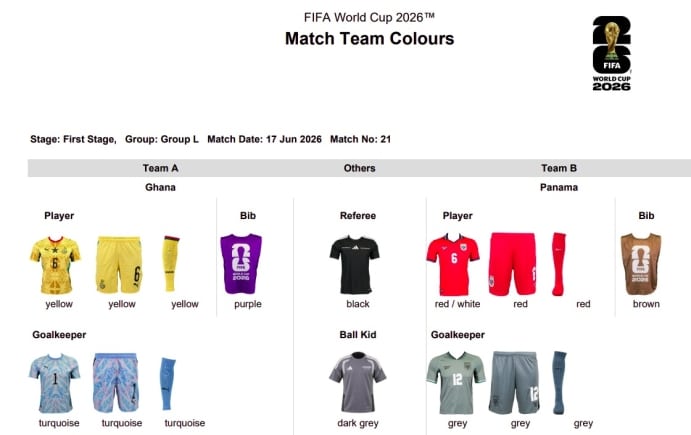
Under FIFA guidelines, every participating nation submits designated home and away kits before the tournament begins. While teams generally prefer to wear their primary colours, FIFA ultimately determines matchday attire to eliminate colour clashes and improve visual distinction for players, officials, broadcasters and viewers, including those with colour vision deficiencies.
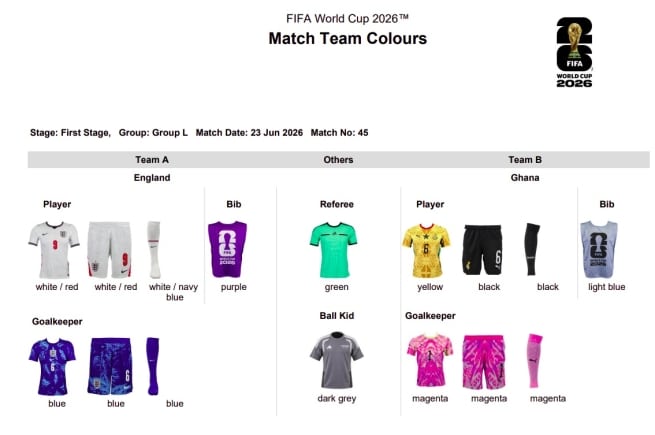
As a result, Ghana will not wear their white home jersey in Group L, regardless of its status as the team’s first-choice strip.
The Black Stars begin their campaign against Panama at BMO Field in Toronto on June 17 before facing England at Boston Stadium on June 23. Their final group fixture comes against Croatia at Lincoln Financial Field in Philadelphia on June 27.

Although FIFA has not publicly detailed the specific colour combinations for every fixture, the governing body has confirmed that Ghana’s home shirt will not be used during any of those three encounters.
A kit inspired by Ghanaian heritage
The absence of the home shirt from the group stage is particularly notable given the attention it attracted following its launch.
Puma designed the jersey around the story of Kwaku Ananse, the legendary spider figure celebrated across West African folklore. The white base is overlaid with an intricate cobweb pattern, while interwoven red, yellow, green and blue lines are intended to represent wisdom, creativity and resilience.
The design was widely viewed as one of the most culturally distinctive kits unveiled ahead of the tournament, blending football with elements of Ghanaian storytelling and tradition.
Ghana’s away kit, meanwhile, takes inspiration from the vibrancy of Accra’s famous Makola Market. Featuring a bright yellow base, the shirt incorporates tonal Adinkra motifs and Kente-inspired details to reflect the country’s rich artistic heritage.
With the home jersey unavailable during the group phase, the away strip is expected to play a prominent role in Ghana’s opening matches.
Knockout qualification could change the picture
There is still hope for supporters eager to see the home shirt in action.
Should Ghana progress beyond the group stage, FIFA’s match allocations for the knockout rounds could create an opportunity for the Black Stars to wear the jersey later in the competition.
That possibility now adds another layer of significance to Ghana’s quest for qualification. Advancing from a challenging group containing England, Croatia and Panama would not only extend the country’s World Cup journey but could also provide the first glimpse of the celebrated shirt on the global stage.
New World Cup kit features unveiled
The 2026 FIFA World Cup will also introduce several new visual additions to team kits.
Every shirt worn during the tournament will feature the official World Cup badge on the right sleeve and a social impact campaign emblem on the left.
During the group stage, teams will wear the “Unite for Peace” badge, while the knockout rounds will carry the “Unite for Education” message.
FIFA will also recognise individual milestones through special patches. Players making their World Cup debut will receive a debut badge, while previous winners of the Golden Ball, Golden Boot and Golden Glove will wear commemorative gold honours patches.
In addition, football icons participating in a fifth or sixth World Cup will be recognised through a special legacy patch, a list that includes Lionel Messi, Cristiano Ronaldo and Guillermo Ochoa.
For now, however, Ghanaian fans will have to be patient. One of the tournament’s most talked-about jerseys has already won admiration off the pitch, but seeing the Kwaku Ananse-inspired design under the World Cup spotlight will depend entirely on how far the Black Stars can go in North America.
-
 Benabou heroics deny Ittihad Tanger as Moghreb Tetouan miss late penalty Oct 3, 2026
 -
Chelsea and Brighton target South African prospect Relebohile Mofokeng Oct 2, 2026
-
Nigeria suffer late squad blows before Russia friendly Oct 2, 2026
-
Ghana name squad for Mauritius ties in 2028 Olympic qualifying Oct 2, 2026



-
AFCON 2025: Fixtures, Results, Scores and Standings Jan 18, 2026
-
Match hero Taiwo Awoniyi reflects on team effort after Chelsea triumph May 5, 2026
-
Leadership and long-term vision key to rescuing Zamalek and inspiring Egyptian football – Hany Abou Rida Nov 5, 2025
-
South African giants Orlando Pirates set to lose influential forward Monnapule Saleng Mar 19, 2025




-
AFCON 2027 Qualifiers: McCarthy warns South Africa to expect tough test against Eritrea Sep 29, 2026
-
AFCON 2027 qualifiers: Algeria, Morocco and Nigeria among winners on opening matchday Sep 26, 2026
-
Denmark v Portugal: Nations League kick-off time, TV channel and match prediction Sep 29, 2026
-
South Sudan vs Egypt: Where to watch AFCON 2027 qualifier Sep 29, 2026