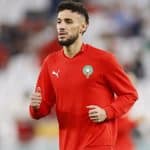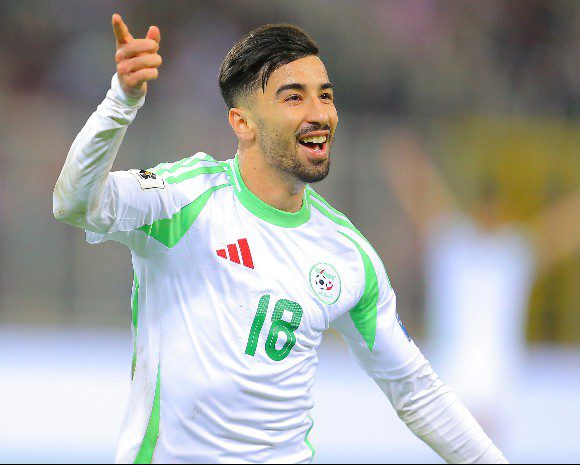
Whenever Mohamed Amoura slips on Algeria’s green shirt, a piece of home travels with him. The number 18 stitched across his back is neither a charm nor a nod to some footballing idol. It is the administrative code of Jijel, the north-eastern province where he was raised as one of five children by a farmer.
This summer, the 26-year-old Wolfsburg forward will carry that number to the World Cup in North America, standing as one of the emblems of Algeria’s long-awaited return to the sport’s biggest occasion after a 12-year wait.
No player matched his return of 10 goals in African qualifying, a tally that made up almost half of Algeria’s haul and dragged the Desert Foxes back into the global conversation.
Forged on the streets, not in an academy
What elevates Amoura’s story beyond the statistics is the path he travelled. He did not graduate from a polished academy or a meticulously plotted development plan.
Instead, he honed his craft on the streets of Oudjana, a small town outside Jijel, kicking a ball for the sheer joy of it with little notion that football might one day pay the bills. For him it was a pastime rather than a career ambition, and remarkably he was the only member of his household who genuinely adored the game.
Algeria boasts just one truly reputable academy, Paradou AC, established by French coach Jean-Marc Guillou and the sole training centre in the country tied to a professional club.
After lifting the Algerian Under-13 Cup with the police sports club where he started out, Amoura was among a handful of youngsters sent to Algiers to trial there. Paradou rejected him – not once, but twice – citing his lack of height. He has admitted it was one of the rare occasions football reduced him to tears.
The breaks that changed everything
Returning home, he joined JS Jijel at 16, and there fortune finally intervened. When the first team went on strike, the club leaned on its youngsters, and Amoura seized his moment with two goals that alerted the Under-19 national side and earned a proper move to ES Setif.
His debut campaign there nearly ended his career before it began. Homesick, broke and far from family, he stopped training and told his coach he was finished with the game, intending to find regular work instead.
For a week he turned his back on his passion, until a family intervention – parents, uncle and coach gathered together – convinced him his talent was real and that quitting would haunt him. He listened, and returned.
Conquering Europe
His steady improvement caught the eye of FC Lugano in Switzerland, where teammates christened him ‘Le petit Salah’, a nickname that has shadowed him across four countries. His own idol, fittingly, is Zinedine Zidane, the creative genius whose Kabyle heritage still inspires Algerian children.
After a Swiss Cup triumph and 17 goals, Amoura moved to Union Saint-Gilloise, where 22 goals in 45 games — including a strike against Liverpool in the Europa League — made the bigger clubs take notice. By the summer of 2024, Wolfsburg came calling.
A weapon unleashed
He arrived at a side that had flirted with relegation, saved only after Ralph Hasenhuttl replaced Niko Kovac. Amoura swiftly became central to everything the Austrian was building, scoring twice against Bayern Munich and inspiring a 5-1 rout of RB Leipzig.
Wolfsburg made his move permanent for €14.75 million, with Hasenhuttl effusive in his praise. “Amoura, we know, has unbelievable quality… He has incredible speed, and I am better off just leaving him up front to cause chaos. He is a real weapon for us.”
At just 1.7m, the player once branded too small has weaponised his stature, using a low centre of gravity and explosive changes of direction to torment taller defenders. For Algeria, the goals keep flowing — a hat-trick against Mozambique, braces against Botswana, Somalia and Uganda, and now 19 in 38 caps, with supporters dreaming he might one day chase Islam Slimani’s record of 47.
Flawed but fearless
His rise has not been without controversy, from a training-ground bust-up with Joakim Maehle to an ill-judged AFCON celebration for which he apologised.
Yet Vladimir Petkovic hails him as “a modern, unpredictable player, capable of turning a match on his own” — a raw talent now ready for the World Cup stage, number 18 forever reminding him where he began.
-
 Nigeria’s DR Congo protest dismissed over technicalities, source claims Oct 9, 2026
 -
Senegal’s AFCON title appeal decision expected within days, CAS says Oct 9, 2026
-
Gianni Infantino pledges more FIFA investment in African football Oct 9, 2026
-
Senegal take control as Mali stumble in Olympic qualifiers Oct 9, 2026


-
AFCON 2025: Fixtures, Results, Scores and Standings Jan 18, 2026
-
Match hero Taiwo Awoniyi reflects on team effort after Chelsea triumph May 5, 2026
-
Leadership and long-term vision key to rescuing Zamalek and inspiring Egyptian football – Hany Abou Rida Nov 5, 2025
-
South African giants Orlando Pirates set to lose influential forward Monnapule Saleng Mar 19, 2025




-
Croatia face Spain with Nations League hopes on the line in Split Oct 5, 2026
-
France v Belgium: Probable line-ups for Nations League clash Oct 3, 2026
-
Morocco coach Mohamed Ouahbi refuses to single out player after Mali draw Oct 4, 2026
-
Noussair Mazraoui leaves Morocco squad early after injury Oct 2, 2026