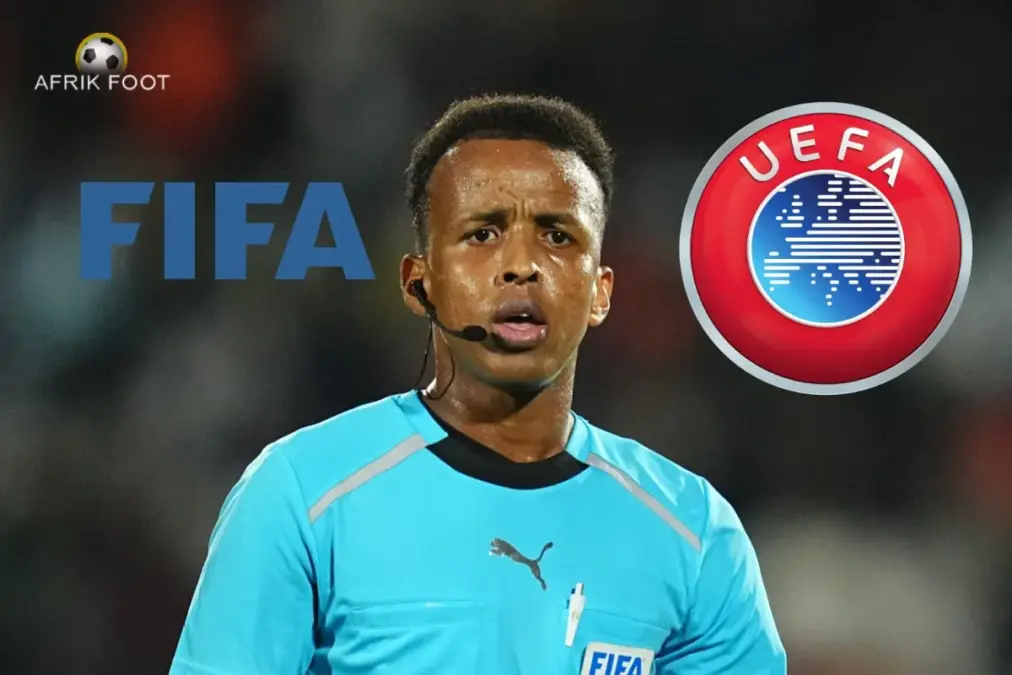
Somali referee Omar Artan will take charge of Wednesday’s UEFA Super Cup between Paris Saint-Germain and Aston Villa in Salzburg, Austria, becoming the first non-European official to referee the competition.
His appointment is a landmark moment for African football, coming after he was controversially prevented from refereeing at the World Cup. It also carries wider significance because it has been made during an increasingly public dispute between UEFA and FIFA.
Artan had been selected by FIFA to officiate at the World Cup and travelled to Miami before the tournament began. However, United States authorities ultimately refused him entry after a lengthy interrogation.
The US initially referred to “concerns related to checks”, before American officials spoke of alleged links between Artan and members of terrorist organisations. The referee rejected those allegations.
FIFA confirmed that Artan would not take part in the World Cup, while saying it was unable to intervene in US immigration procedures. The controversy quickly moved beyond football. When Artan returned to Mogadishu, he was welcomed as a hero in Somalia despite having lost the biggest assignment of his career.
Only days later, UEFA announced that he would referee the Super Cup. Artan is one of the most highly regarded African referees of his generation, having been named the Confederation of African Football’s best men’s referee in 2025. He has also already officiated in some of the continent’s biggest matches.
That record has provided UEFA with a strong sporting justification for its decision. Artan has the experience and ability required for a fixture of this importance. His appointment can therefore be seen both as recognition of an African official’s standing and as an expression of solidarity after his exclusion from the World Cup.
The symbolism is strengthened by the fact that UEFA and CAF signed a protocol at the end of April aimed at deepening co-operation, including through development programmes and the exchange of expertise.
However, it would be simplistic to view the decision solely as a humanitarian gesture. Artan’s appointment comes as football faces a serious institutional crisis.
UEFA has been in open conflict with FIFA president Gianni Infantino for several weeks. A proposal to bring private investors into the ownership of the World Cup’s commercial rights was abandoned after provoking widespread opposition among several confederations.
On Monday, UEFA, Concacaf and the Asian Football Confederation hardened their criticism of FIFA’s leadership. They accused the governing body of having broken trust and called, among other measures, for an independent review of the process. The possibility of boycotting FIFA competitions has even been raised.
Against that backdrop, giving Artan such a prominent international platform is inevitably also a message. Only weeks after FIFA had been forced to accept his absence from the World Cup because of a US decision it said it could not control, UEFA has given him precisely the opportunity that tournament denied him: a historic first on the international stage.
The gesture is significant for Artan, but it is also politically astute for UEFA. By placing him at the centre of one of European football’s major occasions, the organisation can present itself as defending the universal character of the sport. It can also imply that a referee should not lose a professional opportunity because of circumstances unrelated to his work on the pitch.
In UEFA’s image battle with Infantino, the symbolism is particularly powerful.
Artan’s case also exposes the divisions within the global game. UEFA moved closer to CAF in the spring, but that partnership does not mean the two confederations share the same political position regarding FIFA.
CAF has continued to support Infantino. In April, all 54 of its member associations unanimously backed his re-election as FIFA president for the 2027-31 term.
At the end of July, the African governing body had not closed the door on the disputed proposal concerning the commercialisation of World Cup rights. Instead, it said it wanted to examine and assess the plan. After the proposal was withdrawn, CAF’s executive committee last week “reaffirmed unanimously its support” for Infantino.
CAF is not the only confederation to back him, with CONMEBOL also publicly supporting the FIFA president. But the African body has clearly remained aligned with FIFA, unlike the emerging alliance formed by UEFA, the AFC and Concacaf.
So is Omar Artan primarily a symbol of African pride? Yes. But his appointment has also become part of a confrontation that extends far beyond the referee himself.
Artan deserves to have his moment celebrated for his journey and his ability. Yet by giving him this stage at the precise moment it is challenging FIFA, UEFA has also carried out a carefully calculated political act.
By Auguste Blanchet
Convinced that Hakim Ziyech and Youcef Belaili are misunderstood geniuses, Blanchet says Senegal’s 2002 and Ghana’s 2010 World Cup campaigns inspired him during his youth. He now shares his passion for African football.
-
 Ismaila Sarr faces three-way decision over Crystal Palace future Oct 25, 2026
 -
Arokodare hints at salary demand as Ajax consider permanent transfer Oct 25, 2026
-
Gervinho backs FC Barcelona to beat Real Madrid in October Clasico Oct 25, 2026
-
Amine Gouiri was wanted by Tottenham at Roberto De Zerbi’s request Oct 25, 2026



-
AFCON 2025: Fixtures, Results, Scores and Standings Jan 18, 2026
-
Match hero Taiwo Awoniyi reflects on team effort after Chelsea triumph May 5, 2026
-
Leadership and long-term vision key to rescuing Zamalek and inspiring Egyptian football – Hany Abou Rida Nov 5, 2025
-
South African giants Orlando Pirates set to lose influential forward Monnapule Saleng Mar 19, 2025




-
Barcelona v Real Madrid: Catalans backed at 1.65 to win October Clasico Oct 23, 2026
-
Barcelona and Real Madrid meet in pivotal 265th Clasico Oct 23, 2026
-
PSG v Barcelona: fiery attacks set up Champions League classic at Parc des Princes Oct 18, 2026
-
Champions League: PSG beat Barcelona as Liverpool complete comeback against Villarreal Oct 20, 2026