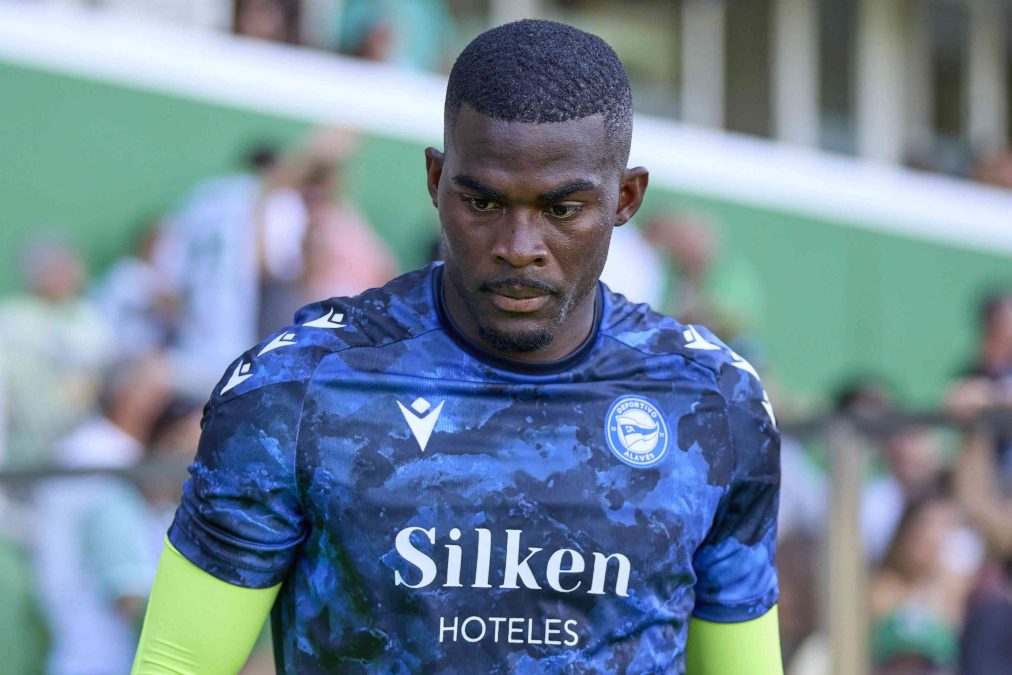
Jesus Owono could face a lengthy sporting suspension and potential criminal proceedings after the death of Tenerife forward Jesus de Miguel following a collision in Monday’s Liga 2 match against Andorra.
The incident occurred at the Estadio Heliodoro Rodriguez Lopez during the 12th round of the competition. In the final moments of stoppage time, with the score 2-2, De Miguel ran on to a through ball and headed towards goal. Andorra goalkeeper Owono left his penalty area in an attempt to intercept it, but collided heavily with the Tenerife player in midfield.
Owono was shown a straight red card for the challenge and the match was abandoned. The fixture was cancelled several hours later.
De Miguel suffered a cardiac arrest and was resuscitated in the ambulance before being taken to Nuestra Senora de Candelaria Hospital. The 30-year-old Spaniard’s neurological condition deteriorated overnight on Tuesday 3 November and he died at about 09:00 Paris time.
Clubs, players and other football figures have offered their condolences to De Miguel’s family. According to Marca, Owono, who plays for the Equatorial Guinea national team, is “deeply affected”. He had initially intended to contact members of De Miguel’s family to offer his condolences, but the death has further complicated an already difficult situation.
The goalkeeper has also faced a wave of abuse on social media, including being labelled an “assassin”. Comments on his profile have since been disabled.
The homicides unit of the Santa Cruz de Tenerife National Police is investigating the circumstances of the death, while a forensic institute has carried out an autopsy.
Possible criminal proceedings
Brazilian outlet Trivela spoke to Renan Gandolfi, a criminal law professor, about the potential consequences for Owono.
Gandolfi said the opening of an investigation was standard procedure following a violent death and did not, by itself, mean that an offence had been committed. Owono could theoretically face a criminal trial, but only if the evidence was referred to a judge who decided there were indications of a criminal act.
Investigators will establish what happened using the forensic doctor’s assessment, expert reports, video footage, clinical records and testimony from the referee, players and medical staff. The autopsy will be important in determining the medical link between the collision and De Miguel’s cardiac arrest.
“Football is a contact sport and athletes accept risks inherent in competition, but that does not justify every type of conduct or remove responsibility when the permitted risk is exceeded,” Gandolfi said.
He added that the distinction between “intention and negligence” would be crucial. “There is no evidence allowing Jesus Owono to be accused of intending to cause harm,” he said.
In his match report, referee Manuel Hernandez described the incident as “the use of excessive force while the ball was being contested”, the stated reason for Owono’s dismissal.
Owono may be questioned by the authorities in the presence of a lawyer. An investigating judge will decide whether there are grounds for a criminal case; if there is insufficient evidence of an offence, the investigation should be closed.
Sporting sanction
The Royal Spanish Football Federation (RFEF) will begin disciplinary proceedings for dangerous play or violent conduct. Article 102 allows for a suspension of between one and 12 matches, with the disciplinary body deciding the punishment. The maximum suspension is considered likely.
If an investigating judge finds evidence of an offence and prosecutors pursue a charge of negligent homicide, Owono could be tried under Article 142 of the Spanish Criminal Code. That provision distinguishes between serious and less serious negligence.
A conviction for homicide through less serious negligence carries a fine of between three and 18 months. Serious negligence carries a prison sentence of one to four years, with Owono able to appeal after the judgment.
Gandolfi said such cases “usually take months or even years”. He added that the medical cause of De Miguel’s death was not yet known and would “weigh on the attribution of responsibility”. Owono is expected to be protected by his club until the investigations conclude, to prevent reprisals when he returns after serving any sporting suspension.
-
 Jesus Owono faces sporting and legal investigation after death of Jesus de Miguel Nov 4, 2026
-
Issa Doumbia’s goal gives Sporting Champions League victory over Shakhtar Donetsk Nov 4, 2026
-
Kaizer Chiefs striker Flavio Silva earns Guinea-Bissau call-up for Morocco qualifiers Nov 4, 2026
-
Richards Bay set to reappoint former coach Pitso Dladla Nov 4, 2026

-
AFCON 2025: Fixtures, Results, Scores and Standings Jan 18, 2026
-
Match hero Taiwo Awoniyi reflects on team effort after Chelsea triumph May 5, 2026
-
Leadership and long-term vision key to rescuing Zamalek and inspiring Egyptian football – Hany Abou Rida Nov 5, 2025
-
South African giants Orlando Pirates set to lose influential forward Monnapule Saleng Mar 19, 2025




-
Barcelona host Aston Villa in Champions League meeting at Spotify Camp Nou Nov 2, 2026
-
AEK Athens v Real Madrid: Champions League date, kick-off time and viewing details Nov 2, 2026
-
Villarreal host unbeaten PSG in first European meeting Nov 2, 2026
-
Le Havre AC host Paris Saint-Germain as Ligue 1 leaders seek another win Oct 28, 2026