Cabo Verde
COSAFA
Côte d’Ivoire
Countries
DR Congo
Featured Stories
FIFA World Cup
Ghana
Latest News
Morocco
Senegal
South Africa
WAFU A
WAFU B
Zonal Bodies
From Dakar to Accra: Sub-Saharan giants set sights on World Cup shake-up in North America
Morocco’s spellbinding march to the semifinals at Qatar 2022 raised the bar to dizzying new heights for African football, marking the first time a side from the continent had ever penetrated the final four of a World Cup.
Even reaching the last eight was historic in its own right – the Atlas Lions becoming only the fourth African nation to do so, joining Cameroon, Senegal and Ghana in a select club.
For decades, North Africa has set the standard for the continent. Egypt sit atop the Africa Cup of Nations roll of honour with a record seven titles, while Morocco, Tunisia and Algeria occupy three of the top five spots in the all-time African qualification charts for the World Cup.
Now, with the global showpiece set to kick off on June 11 across the United States, Mexico and Canada, the spotlight shifts south of the Sahara – to a clutch of nations determined to redraw the continent’s pecking order.
Senegal: burning with a sense of injustice
World Cup Appearances: Four — 2002, 2018, 2022, 2026
Best finish: Quarterfinals
Overall record: P12 W5 D3 L4 F16 A17
FIFA ranking: 14
Prediction: Eliminated at quarterfinal stage
The Lions of Teranga arrive in North America with grievances still simmering. Stripped of the AFCON crown earlier this year after the Confederation of African Football ruled that their mid-match walk-off had voided January’s final – handing the title and a 3-0 victory to Morocco – Senegal head into the World Cup with a point to prove and an axe to grind.
The expectation on their shoulders may now exceed even Morocco’s. Squad depth is their calling card, but the star wattage is equally formidable. Sadio Mané remains the most recognisable face of Senegalese football, but the spine running through Pape Gueye, Edouard Mendy and skipper Kalidou Koulibaly would walk into virtually any squad at the tournament.
All three are French-born – a quirk laden with significance given that fate has handed Senegal an opening Group I clash with France in New York on June 16, a rematch of sorts with the country whose defending champions they famously toppled 1-0 on their tournament debut back in 2002.
Head coach Pape Bouna Thiaw, who moved to France aged 17, is relishing the showdown. “It’s always a pleasure to play against France. It’s a country we know well,” he said. His belief in his squad’s ceiling is unwavering: “If I lose even a second of my belief that I can win the World Cup with Senegal, I will step down.” Iraq and Norway complete Group I.
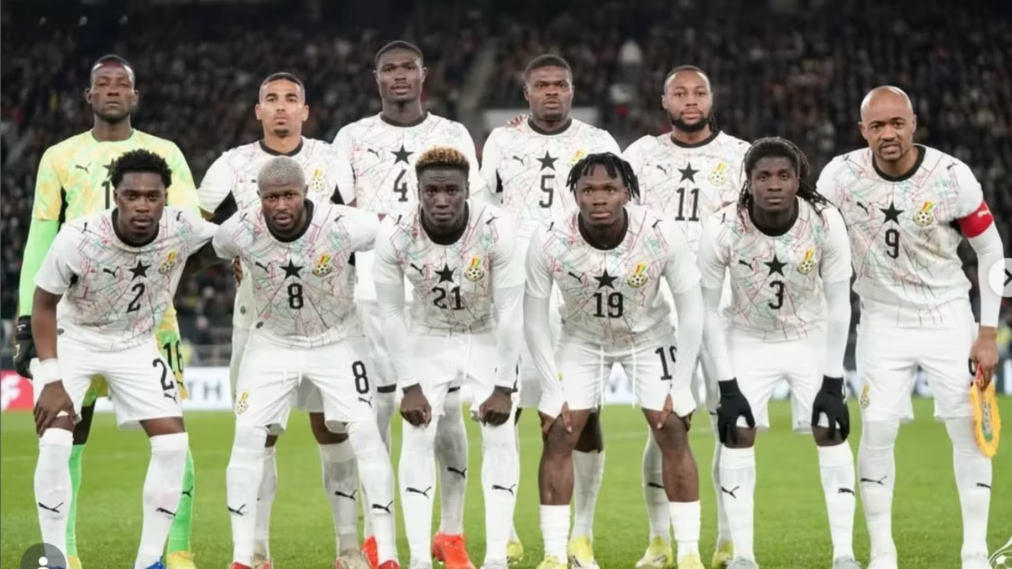
Ghana: a fresh face in the dugout
World Cup Appearances: Five — 2006, 2010, 2014, 2022, 2026
Best finish: Quarterfinals
Overall record: P15 W5 D3 L7 F18 A23
FIFA ranking: 74
Prediction: Eliminated at quarterfinal stage
The Black Stars have been near-permanent fixtures since their 2006 debut, missing only one finals, and reached the last eight at Germany 2010 – only the third African nation to do so.
Their build-up to this edition, however, has been anything but smooth. A late-doors managerial overhaul saw veteran Portuguese tactician Carlos Queiroz drafted in to replace Otto Addo, whose tenure unravelled after Ghana failed to qualify for the most recent AFCON and were hammered in four high-profile outings across November and March.
For Queiroz, 73, this represents a fifth consecutive World Cup as a head coach — a remarkable feat for a man whose CV also boasts spells at Real Madrid and a stint as Sir Alex Ferguson’s right-hand man at Manchester United, plus previous African assignments with South Africa and Egypt.
Group L appears the unforgiving “group of death”, pitching Ghana against Panama, England and Croatia, but with Manchester City forward Antoine Semenyo spearheading the attack, the Black Stars are bullish. “I think that this country has a huge, enormous potential. This is a country of footballers,” Queiroz declared.
The major fly in the ointment is the absence of injured Tottenham forward Mohammed Kudus, the team’s talisman during the qualification campaign.
Ivory Coast: rebuilt and reinvigorated
World Cup Appearances: Four — 2006, 2010, 2014, 2026
Best finish: Group Stage
Overall record: P9 W3 D1 L5 F13 A14
FIFA ranking: 34
Prediction: Eliminated at quarterfinal stage
A 12-year exile from the global stage ends in earnest for the Elephants, who have spent that period quietly reconstructing themselves following the retirements of Yaya Touré and Didier Drogba. Two AFCON titles in that span signal that the rebuild has been a roaring success.
The attacking unit, fronted by teenage sensation Yan Diomandé alongside Simon Adingra and Manchester United’s Amad Diallo, will dictate just how far they can go.
Head coach Emerse Faé, who famously stepped up from assistant midway through the home AFCON two years ago and steered his nation to the title from the brink of group-stage elimination, is dreaming big.
“I believe Ivory Coast has the potential to achieve something exceptional – why not aim for the final?” Faé said. Curaçao, Ecuador and former world champions Germany await them in the group stage.
Cape Verde: the fairytale debutants
World Cup Appearances: One — 2026
Best finish: N/A
Overall record: N/A
FIFA ranking: 69
Prediction: Eliminated at group stage
Among the most romantic stories of the entire tournament. With a population of roughly 600,000, the islanders are the third-smallest nation ever to reach a World Cup finals. Their AFCON debut came only in 2013, yet they reached the quarterfinals at the first time of asking and repeated the trick in 2023.
Powered largely by their European-based diaspora, the Blue Sharks face a brutal group draw against Uruguay, Saudi Arabia and reigning European champions Spain. Their architect-in-chief is Bubista, named African Coach of the Year in 2025, who insists belief was the decisive ingredient.
“We’ve always been aware of our talent but we haven’t always believed that it could take us much further than we had achieved up to that point,” he said. “Therefore, it took courage to face any opponent. The first step in our success was truly believing in our potential. In other words, we changed the players’ mindset.”
South Africa: backed by domestic champions
World Cup Appearances: Four — 1998, 2002, 2010, 2026
Best finish: Group stage
Overall record: P9 W2 D4 L3 F11 A16
FIFA ranking: 60
Prediction: Eliminated at round of 32 stage
A 16-year wait for a return to the world stage ends for Bafana Bafana, who have endured a slump since hosting the 2010 finals. This time, however, they arrive buoyed by a domestic scene that has rarely looked healthier.
Mamelodi Sundowns are the freshly-minted African Champions League winners and contribute eight players to Hugo Broos’s 26-man squad. Another eight come from Orlando Pirates, who pipped Sundowns to the domestic league title by a single point.
Belgian-born coach Broos is delighted with the timing. “We can say that we have players of the best teams of the season. Those guys have much experience at a high level,” he said.
He also acknowledged the psychological lift of the continental crown: “I’m certainly happy that Sundowns won the Champions League, because I was afraid that if they should lose, I would get players who would be very disappointed. So now they all have that boost of confidence, and that helps a lot.”
South Africa are housed in the tournament’s second “group of death” alongside the Czech Republic, South Korea and co-hosts Mexico – whom they meet in the tournament’s curtain-raiser.
DR Congo: a generation rewarded
World Cup Appearances: Two — 1974, 2026
Best finish: Group stage
Overall record: P3 W0 D0 L3 F0 A14
FIFA ranking: 46
Prediction: Eliminated at quarterfinal stage
The Leopards’ only previous appearance came as Zaire at the 1974 finals in West Germany, when they earned the distinction of becoming the first sub-Saharan African nation to grace the World Cup.
That maiden adventure included a chastening 9-0 hammering by Yugoslavia, but the landscape — for both the continent and Africa’s second-largest country — looks vastly different five decades on.
Their FIFA ranking now eclipses that of three of the other five sub-Saharan qualifiers, although booking their ticket was anything but straightforward. The Congolese had to navigate two playoffs to get there — overcoming Cameroon and Nigeria on the African route, before squeezing past Jamaica in extra time of an intercontinental playoff.
The squad is dominated by European-born talent — players raised in Belgium, France or Switzerland — plus the London-born Aaron Wan-Bissaka, previously in England’s reckoning before injury denied him a senior cap. French boss Sébastien Desabre framed the moment poignantly. “We are extremely proud because a whole generation hasn’t been able to see its national team in the World Cup but now they will see them there,” he said.
The verdict from south of the Sahara
The bar set by Morocco in Qatar lingers as both inspiration and burden. Senegal, with their squad depth, their seething sense of grievance and their box-office matchup against France, look the likeliest of the sub-Saharan contingent to push deepest.
Ghana and Ivory Coast carry the firepower to threaten the knockout rounds, while DR Congo’s resurgence may yet produce one of the tournament’s stories.
For Cape Verde, simply being present is a triumph — but as Bubista’s mindset shift has shown, belief can take a side anywhere. South Africa, leaning on a domestic generation enjoying its finest hour, will hope to bridge the 16-year drought with something memorable.
Whether any can match Morocco’s trailblazing run remains the great unknown — but Africa, south of the Sahara, has rarely arrived at a World Cup with such varied and intriguing weapons in its armoury.
-
 Raja Casablanca begin CAF Confederation Cup campaign away to El Kanemi Warriors Oct 17, 2026
 -
MC Alger face Enugu Rangers in African Champions League qualifying tie Oct 17, 2026
-
Africa Cup of Nations set for possible return to two-year cycle Oct 17, 2026
-
Yassir Zabiri attracts Premier League interest after scoring seven goals Oct 17, 2026


-
AFCON 2025: Fixtures, Results, Scores and Standings Jan 18, 2026
-
Match hero Taiwo Awoniyi reflects on team effort after Chelsea triumph May 5, 2026
-
Leadership and long-term vision key to rescuing Zamalek and inspiring Egyptian football – Hany Abou Rida Nov 5, 2025
-
South African giants Orlando Pirates set to lose influential forward Monnapule Saleng Mar 19, 2025




-
Real Betis v Barcelona: kick-off time, TV details and match preview Oct 16, 2026
-
Roma v Real Madrid: home side tipped to score first in Champions League clash Oct 12, 2026
-
Atletico Madrid v Manchester United: probable line-ups for Champions League clash Oct 12, 2026
-
Celta Vigo v Juventus: Probable line-ups for Europa League encounter Oct 14, 2026