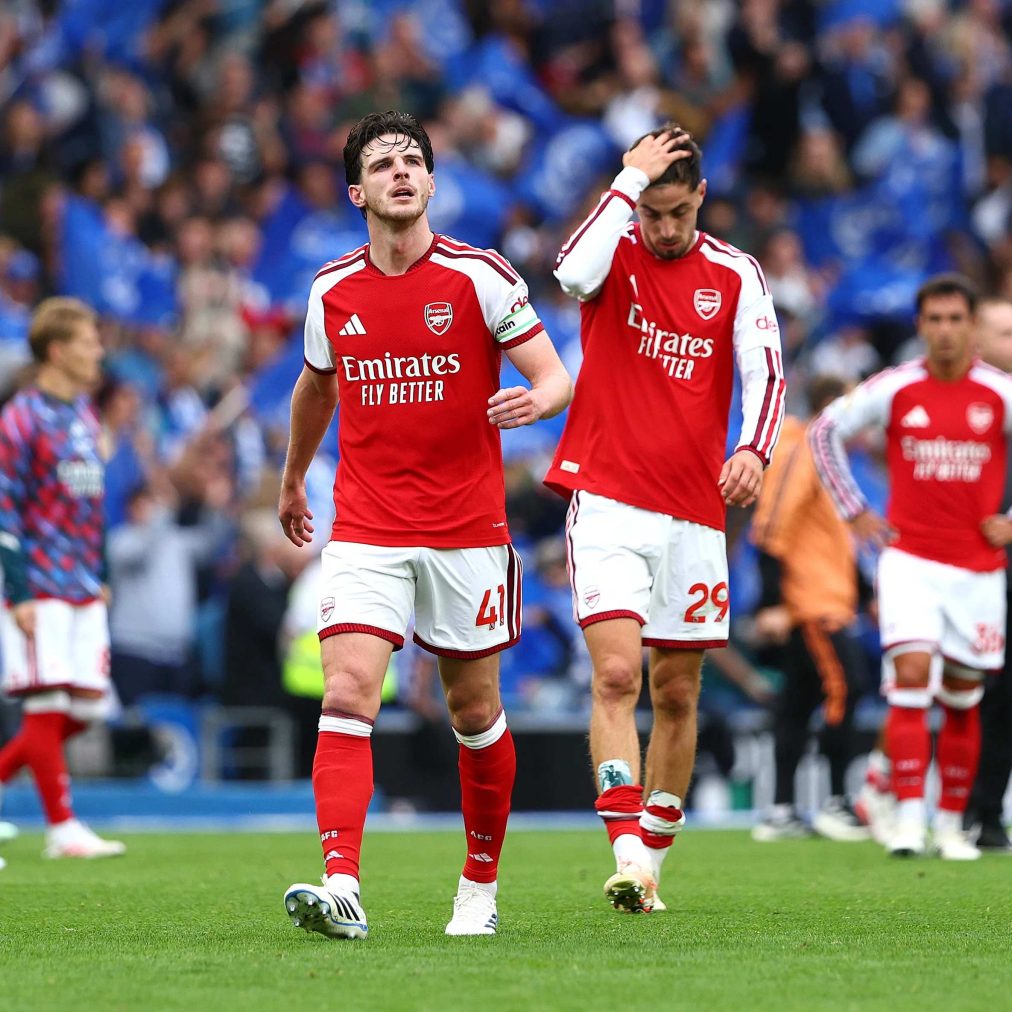
Mikel Arteta’s new tactical approach at Arsenal faces an early test after a 3-0 defeat by Brighton revealed weaknesses in a system designed to give the Premier League champions greater flexibility in possession.
The loss ended Arsenal’s perfect start to the season and was more significant than a routine setback. It showed how attempts to add new attacking solutions can also leave the team vulnerable when opponents disrupt its preferred build-up structure.
Arteta has reshaped Arsenal since taking charge in December 2019. His first priority was to restore confidence and defensive stability, an approach that included using a back five and helped deliver the FA Cup in his first season. The team later developed a possession-based attacking identity, built around short passing, rotations and the energy of younger players, particularly from 2022 onwards.
The latest evolution is intended to prevent Arsenal becoming predictable. During possession, the team can form a 3-1-6, with Declan Rice dropping into a back three alongside Ezri Konsa and Gabriel Magalhaes, while Myles Lewis-Skelly operates as the lone pivot. Riccardo Calafiori, Ben White and Martin Odegaard can also move into deeper positions, allowing Arsenal to switch between structures such as 3-2 and 4-1.
Rice’s ability to pass under pressure and carry the ball makes him useful in the deeper role, while Lewis-Skelly is trusted to link defence and attack. The young midfielder has shown composure in tight spaces, the ability to evade opponents and a willingness to play forward. His performances in the position even attracted the attention of England manager Thomas Tuchel, who sought to replicate aspects of Arteta’s idea during the international break. Elliot Anderson was used in a role similar to Rice’s within a back three.
Against Brighton, however, Lewis-Skelly was absent from the pivot position and Bruno Guimaraes filled the role instead. Brighton, managed by Fabian Hurzeler, pressed with intensity but also varied their approach, sometimes retreating before applying man-to-man pressure at the right moment.
That denied Arsenal the time and space needed to build patiently. Players were forced into hurried decisions and misplaced passes, while Brighton closed down the ball carrier and removed obvious passing options. “Brighton were really good,” Arteta admitted after the defeat. He said the problem had been visible from Arsenal’s first throw-in and that his side had repeatedly put itself in difficult situations. Moving the ball more quickly, he added, was one of the main lessons.
Arteta has previously adapted successfully. Manchester City used a 4-2-4 defensive structure in last season’s League Cup final, while Enzo Maresca employed a similar plan in this season’s Community Shield. Arsenal found better answers on that occasion.
The response to Brighton will show whether the latest changes require refinement rather than abandonment. Arsenal’s attacking rotations, especially on the right, can create overloads through Kai Havertz, White, Bukayo Saka, Rice and Odegaard, but they also demand defensive balance when possession is lost.
For Arteta, the defeat is an early warning: to remain at the top, Arsenal must find a way to change their approach when opponents succeed in neutralising their usual one.
-
 Moroccan stars En-Nesyri and Bounou set for Saudi Pro League showdown Oct 9, 2026
 -
Chelsea eye €50m move for Barcelona defender Jules Kounde Oct 9, 2026
-
Pierre-Emerick Aubameyang targets comeback after knee surgery Oct 9, 2026
-
Ghana forward Christopher Bonsu Baah scores as Al Qadsiah destroy poor Al Kholood 5-0 Oct 9, 2026


-
AFCON 2025: Fixtures, Results, Scores and Standings Jan 18, 2026
-
Match hero Taiwo Awoniyi reflects on team effort after Chelsea triumph May 5, 2026
-
Leadership and long-term vision key to rescuing Zamalek and inspiring Egyptian football – Hany Abou Rida Nov 5, 2025
-
South African giants Orlando Pirates set to lose influential forward Monnapule Saleng Mar 19, 2025




-
Croatia face Spain with Nations League hopes on the line in Split Oct 5, 2026
-
France v Belgium: Probable line-ups for Nations League clash Oct 3, 2026
-
Morocco coach Mohamed Ouahbi refuses to single out player after Mali draw Oct 4, 2026
-
Manchester United host winless Tottenham in Premier League clash Oct 7, 2026