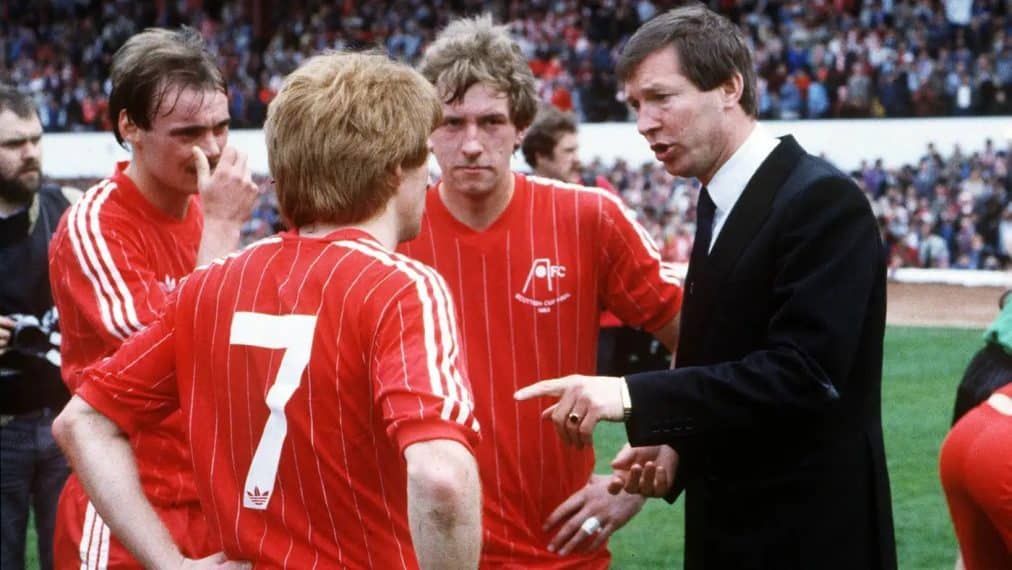
Alex Ferguson’s move from Aberdeen to Manchester United in November 1986 ended one of the most successful periods in the Scottish club’s history – and began a 26-year reign that would make him one of football’s greatest managers.
Ferguson had spent eight years transforming Aberdeen, leading the club to three Scottish league titles, four Scottish Cups, the European Cup Winners’ Cup and the European Super Cup. He had also broken the long-standing dominance of Rangers and Celtic.
For Aberdeen supporters, his departure was therefore a shock. One fan told BBC Scotland’s Reporting Scotland: “It is a sad thing for Aberdeen. I think he is making a mistake, and I think he will regret it in years to come.”
Four decades later, the decision is viewed in a different light.
The champagne that revealed the deal
On 6 November 1986, BBC Scotland sports journalist and broadcaster Roddy Forsyth was sent to Aberdeen to investigate reports that Ferguson was close to becoming Manchester United manager.
The flight from Glasgow was packed with journalists, although most were travelling to cover the aftermath of the Sumburgh disaster, in which 43 people were killed when a Chinook helicopter crashed in the Shetland Islands.
Forsyth eventually discovered Ferguson meeting Manchester United chairman Martin Edwards at an airport hotel. After asking reception to speak to “Mr Edwards from Manchester”, he was told Edwards was in the restaurant.
“I heard some voices and followed them,” Forsyth recalled. “There I found Martin Edwards and Alex Ferguson. I asked him directly: ‘Are you the new Manchester United manager?’ He said: ‘Yes.’”
A bottle of champagne on the table confirmed the significance of the meeting. Ferguson poured Forsyth a glass, and the journalist congratulated him before contacting the BBC newsroom.
“It was one of those days you never forget throughout your career or your life,” Forsyth said. “The Sumburgh disaster led the main news, while Alex Ferguson led the sports news.”
Aberdeen lose their manager and his assistant
Ian Donald, Aberdeen’s vice-chairman at the time, described the departure as “a devastating blow”.
“It happened incredibly quickly, almost overnight,” he said in 1986. “Until yesterday morning we probably had the best management team in Britain, and now we are losing both of them together.”
Ferguson’s assistant moved with him to Manchester United, leaving Aberdeen without the management partnership that had helped establish the club’s golden era.
Former Aberdeen captain Willie Miller said players were left uncertain by the change. Ferguson’s fierce temper and demanding methods were central to his approach, although Miller acknowledged that some of those methods would not be accepted in the modern game.
“Things like that would not pass without comment now,” he said. “I do not think today’s players would accept anything like cups being thrown in dressing rooms.”
Miller added that Ferguson wanted not only to win trophies, but to win them in a distinctive way. He admitted the squad was deeply disappointed by the decision, even though the choice was ultimately Ferguson’s.
Ferguson later said Manchester United was the only club that could have persuaded him to leave Aberdeen.
“I left what could be regarded as the most secure job in British football, with a lifetime contract at Aberdeen,” he said. “There was only one club that could tempt me away, and that was the only club I had always wanted to join.”
After difficult first two seasons at Old Trafford, Ferguson won 38 trophies in 26 years, including 13 Premier League titles, two Champions League titles, five FA Cups and four League Cups. For Aberdeen fans, the pain of losing him was real – but the greater question became what might have happened had he stayed.
-
 Xabi Alonso backs Wesley Fofana despite inconsistent performances at Chelsea Nov 6, 2026
-
Barcelona closely monitor Jesse Bisiwu’s progress as youngster awaits first-team opportunity Nov 6, 2026
-
Paris Brunner decision now in Monaco striker’s hands, says DR Congo boss Sebastien Desabre Nov 6, 2026
-
Morocco: Ouahbi weighs four options to replace injured Ounahi as number 10 Nov 6, 2026




-
AFCON 2025: Fixtures, Results, Scores and Standings Jan 18, 2026
-
Match hero Taiwo Awoniyi reflects on team effort after Chelsea triumph May 5, 2026
-
Leadership and long-term vision key to rescuing Zamalek and inspiring Egyptian football – Hany Abou Rida Nov 5, 2025
-
South African giants Orlando Pirates set to lose influential forward Monnapule Saleng Mar 19, 2025




-
Barcelona host Aston Villa in Champions League meeting at Spotify Camp Nou Nov 2, 2026
-
AEK Athens v Real Madrid: Champions League date, kick-off time and viewing details Nov 2, 2026
-
Villarreal host unbeaten PSG in first European meeting Nov 2, 2026
-
Real Sociedad and Lyon name probable line-ups for Europa League meeting Nov 3, 2026