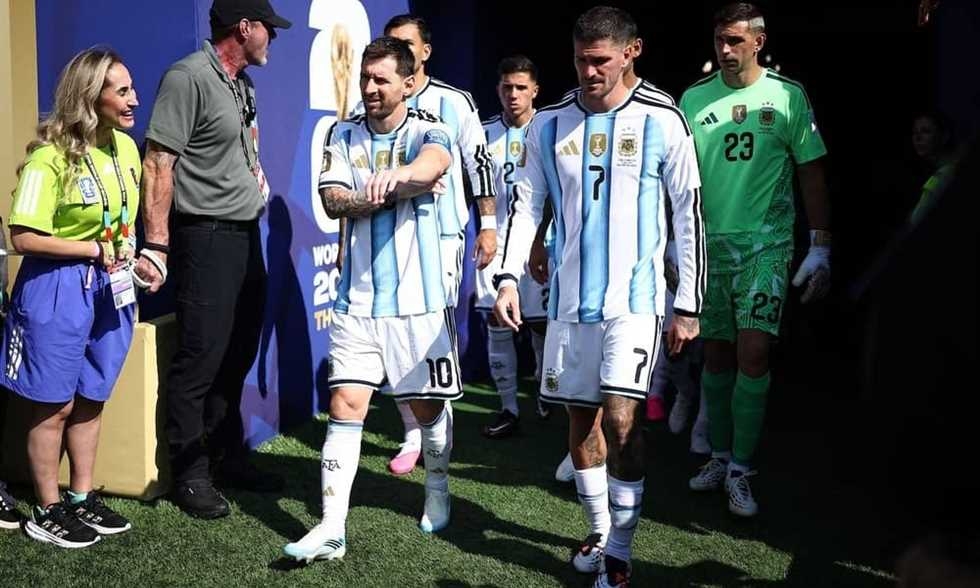
Argentina were the most targeted team on social media during the 2026 World Cup, despite reaching the final, where they lost 1-0 to Spain.
A report by Argentine outlet TyC Sports said England, Spain, Brazil and Norway were the next most heavily attacked teams online. The main criticism aimed at Argentina centred on alleged refereeing assistance, much of it accompanied by xenophobic abuse.
Argentina’s players ranked fourth for individual abuse, behind those from France, England and Portugal. Racism was the most common form of attack, particularly against players of African heritage, although the identity of the tournament’s most targeted player was not disclosed.
Xenophobic abuse focused mainly on South Africa, Argentina and England, with discussions involving immigration, national identity and the make-up of teams.
Argentina were also among the countries responsible for such abuse and led the number of racist messages posted. Europe recorded the highest overall number of attacks by region, followed by South America.
The strongest threats were directed at referees, who were also the main victims of “doxxing” attempts – the publication of personal information to encourage further harassment. Suspicion over alleged corruption and match manipulation was identified as the motivation.
FIFA reports scale of online abuse
FIFA has published figures from its Social Media Protection Service during the 2026 World Cup. More than 17 million posts and comments relating to the tournament were analysed, with 240,000 classified as abusive after human review.
Racist abuse accounted for 20% of all classified abuse, excluding content placed in the general abuse category. Threats of violence made up 14%, while xenophobic content appeared in 12% – more than one in every 10 abusive posts and comments.
Across the tournament, the proportion of content verified as racist was higher than the 11% recorded during the group stage.
The service’s moderation tool automatically scanned 60.7 million user comments across FIFA’s official platforms and the channels of participating member associations. Of those, 9.2 million messages – 15% of all interactions – were blocked before reaching the public because they were identified as harmful or clearly inauthentic, including bot-like behaviour and spam.
More than 17.1 million posts and comments were analysed during this year’s men’s World Cup, fewer than the approximately 20 million recorded at Qatar 2022. FIFA said the increase in reported figures compared with the Qatar tournament was partly linked to technological improvements.
The artificial intelligence moderation tool increased the number of posts and comments scanned from 13.7 million in 2022 to 60.7 million in 2026. Human analysts reviewed 477,000 items, up slightly from 434,000 in Qatar.
Improved AI accuracy meant more content was intercepted automatically, making the protection service more effective.
A total of 2,905 accounts exceeded the threshold for a criminal investigation, with 786 referred to law-enforcement authorities. Of those, 232 posted highly dangerous material containing threats deemed to pose a genuine security risk and were prioritised for investigation.
The service also took action to protect referees from sustained cyber abuse, including doxxing involving the release of private and personal information.
-
 Bayern Munich consider Jules Kounde as Sacha Boey replacement Oct 10, 2026
 -
Charlotte linked with former Everton midfielder Abdoulaye Doucoure Oct 10, 2026
-
Football betting tips for 10 October: Olise backed to score as Bayern face Augsburg Oct 10, 2026
-
Mayoyo backs Moses Mabhida Stadium as neutral setting for MTN8 final Oct 10, 2026



-
AFCON 2025: Fixtures, Results, Scores and Standings Jan 18, 2026
-
Match hero Taiwo Awoniyi reflects on team effort after Chelsea triumph May 5, 2026
-
Leadership and long-term vision key to rescuing Zamalek and inspiring Egyptian football – Hany Abou Rida Nov 5, 2025
-
South African giants Orlando Pirates set to lose influential forward Monnapule Saleng Mar 19, 2025




-
Croatia face Spain with Nations League hopes on the line in Split Oct 5, 2026
-
France v Belgium: Probable line-ups for Nations League clash Oct 3, 2026
-
Manchester United host winless Tottenham in Premier League clash Oct 7, 2026
-
Morocco coach Mohamed Ouahbi refuses to single out player after Mali draw Oct 4, 2026