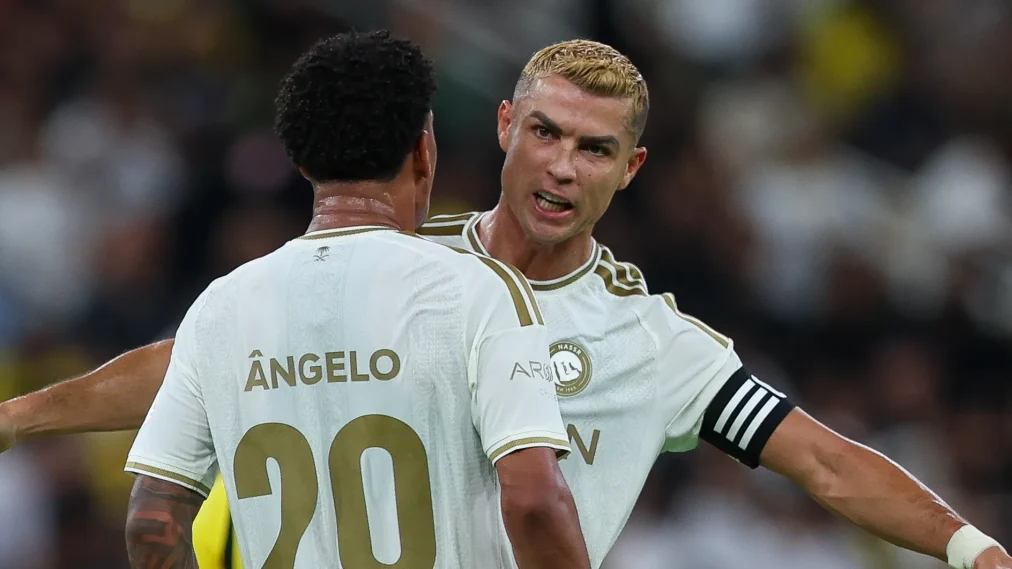
Cristiano Ronaldo’s role at Al-Nassr is under renewed scrutiny after the Portuguese captain was unable to make the difference in the 2-1 defeat by Al-Ittihad in the fifth round of the Saudi Pro League.
The result came in one of the most important matches of Al-Nassr’s season so far, with Ronaldo facing strong criticism after failing to score or produce the decisive contribution expected from one of the world’s most prominent forwards.
Questions about the 40-year-old’s performance have gone beyond his lack of a goal. Some critics are now asking whether Ronaldo can still provide Al-Nassr with the level of influence the team requires, particularly as his age increases and the demands of modern football continue to evolve.
That does not alter the fact that Ronaldo remains one of the most dangerous finishers in the game. Inside the penalty area, he continues to excel at taking advantage of half-chances and turning limited opportunities into goals.
His experience is also a major asset in matches where the smallest details can decide the outcome. Few players have spent as long operating under pressure at the highest level, and Al-Nassr still have a forward capable of deciding a game if he receives the ball in the right positions.
The main concern, however, relates to what happens when Al-Nassr do not have possession.
Modern football increasingly requires every player to contribute to the press, move intelligently and close passing lanes. Those responsibilities have become more difficult for Ronaldo as he has grown older, particularly when a team attempts to defend aggressively from the front.
If Al-Nassr want to press high up the pitch, they must cover the areas that Ronaldo may no longer be able to defend in the same way he did earlier in his career. His position within the pressing structure can therefore become a weakness that opponents are able to target.
High pressing only works when the players involved move together. If one member of the front line cannot apply pressure with the same intensity, an opponent may find it easier to escape and build an attack. That can leave the rest of Al-Nassr’s players facing larger spaces and having to make greater efforts to compensate.
The issue is not necessarily that Ronaldo can no longer change matches. Rather, the way Al-Nassr use him has become more important than ever.
If the club want Ronaldo primarily as a penalty-box striker who can convert chances, the team may need to be organised around that particular strength instead of asking him to perform duties that do not suit his current physical capabilities.
For that reason, describing Ronaldo as a “burden” requires some qualification. He could become a burden in a system built on relentless high pressing, but he remains a hugely dangerous weapon if Al-Nassr can deliver the ball to the areas where he is most effective.
The central challenge now facing Ange Postecoglou is to find a balance: maximise Ronaldo’s ability as a decisive striker without allowing his presence to damage the team’s defensive shape.
If the manager can find that solution, Ronaldo may regain his influence while Al-Nassr retain their attacking approach.
-
 Mahmoud Jihad denies fear of injury after early exit in Zamalek match Oct 21, 2026
 -
Rulani Mokwena targets all titles as Pyramids extend winning run to 11 games Oct 21, 2026
-
Champions League: Wiliete SC to report Steve Komphela-Beto Bianchi incident to CAF Oct 21, 2026
-
Alexandre Santos appointed Petro de Luanda head coach on 18-month deal Oct 21, 2026



-
AFCON 2025: Fixtures, Results, Scores and Standings Jan 18, 2026
-
Match hero Taiwo Awoniyi reflects on team effort after Chelsea triumph May 5, 2026
-
Leadership and long-term vision key to rescuing Zamalek and inspiring Egyptian football – Hany Abou Rida Nov 5, 2025
-
South African giants Orlando Pirates set to lose influential forward Monnapule Saleng Mar 19, 2025




-
PSG v Barcelona: fiery attacks set up Champions League classic at Parc des Princes Oct 18, 2026
-
Champions League: PSG beat Barcelona as Liverpool complete comeback against Villarreal Oct 20, 2026
-
Real Betis v Barcelona: kick-off time, TV details and match preview Oct 16, 2026
-
Porto v PSV: predicted line-ups for Champions League league-phase clash Oct 19, 2026