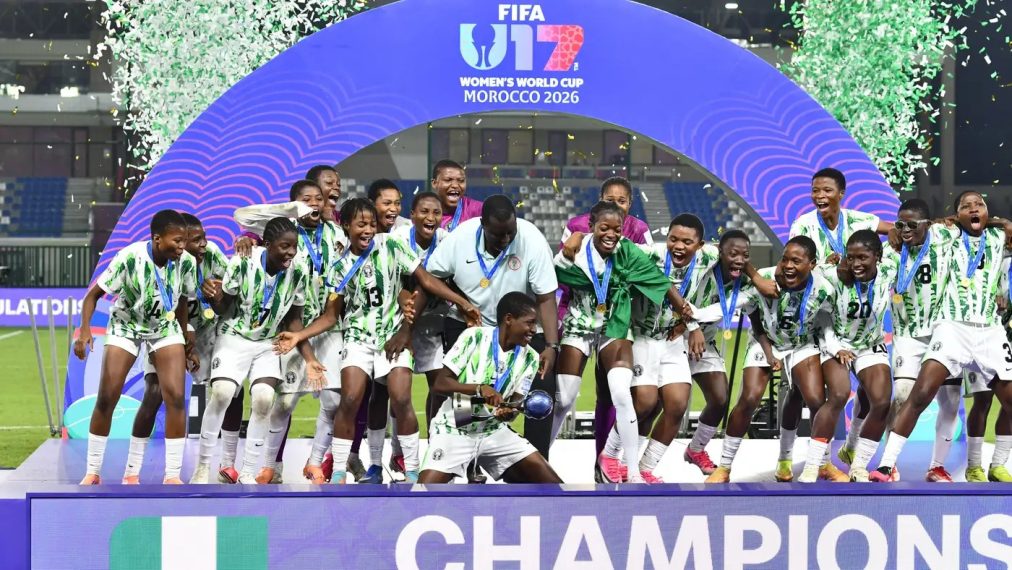
Nigeria won the FIFA U-17 Women’s World Cup for the first time by beating Japan 2-1 in Saturday’s final in Rabat, while hosts Morocco used the tournament to further test their readiness for the 2030 World Cup.
The competition provided another opportunity to assess Morocco’s stadiums, training facilities, accommodation, transport systems, medical services and logistical arrangements ahead of the tournament it will co-host with Spain and Portugal.
According to Spanish newspaper Sport, the event was significant beyond the result on the pitch. Morocco was able to examine how it manages visiting teams and delegations, while also evaluating the way its venues and operational systems function during an international tournament.
Morocco is scheduled to host five consecutive editions of the FIFA U-17 Women’s World Cup from 2025 to 2029. The country was the first in Africa to stage the competition, which featured 24 nations and 52 matches.
Nigeria secured victory in the final through goals from Owo Bashiru in the 39th minute and Oluwobobi Omegiako two minutes after half-time. Japan’s Fuki Ito reduced the deficit in the 80th minute, but her side could not find an equaliser.
Omegiako was named the tournament’s best player. Nigeria’s success also made the country the first African nation to win a women’s World Cup at any level.
Mohammed VI complex central to Morocco’s plans
Morocco based much of its tournament operation around the Mohammed VI Football Complex near Rabat. The site includes training pitches, accommodation, medical facilities and areas where teams can prepare, helping to limit travel and simplify the organisation of the competition.
The final had originally been scheduled for Prince Moulay Abdellah Stadium. However, FIFA announced on 28 October that the match would instead be played at the Mohammed VI complex, keeping the final phase of the tournament at one location.
The approach reflects Morocco’s wider strategy of using integrated sports facilities to host international events, bringing together accommodation, training, medical and organisational services in one setting.
The Mohammed VI Football Complex opened in December 2019. It covers approximately 29 hectares and cost about $90m to build.
Morocco’s wider sporting network includes stadiums, training centres, hotels, medical facilities and an academy system, all forming part of a strategy to develop football and increase the country’s capacity to host teams, clubs and major competitions.
Those investments have coincided with improved results for Morocco’s national teams. The senior side reached the semi-finals of the 2022 World Cup in Qatar, becoming the first African team to achieve that feat, while Morocco’s youth team won the 2025 FIFA U-20 World Cup.
Hosting the U-17 Women’s World Cup five times in succession will allow Morocco to repeatedly review its arrangements for accommodation, transport, security, delegation management, venue coordination and match operations.
FIFA president Gianni Infantino has praised Morocco’s ability to stage major sporting events on several occasions. He also congratulated Nigeria on its historic triumph and expressed his appreciation to the host country after the final.
The 2030 World Cup will present a considerably larger challenge, involving more teams, spectators and stadiums, as well as travel between three host nations. Morocco is continuing to use international youth tournaments to build experience and test the readiness of its infrastructure and organisational systems.
-
 Algeria may change goalkeeper options after Ramdane family bereavement Nov 8, 2026
-
Morocco concern grows as Brahim Diaz starts 11th straight Real Madrid game on bench Nov 8, 2026
-
Benin v Central African Republic: Guepards seek third unbeaten game in 2027 Africa Cup of Nations qualifying Nov 8, 2026
-
Nicolas Jackson continues Aston Villa scoring run in thrilling 4-4 draw with Manchester United Nov 8, 2026



-
AFCON 2025: Fixtures, Results, Scores and Standings Jan 18, 2026
-
Match hero Taiwo Awoniyi reflects on team effort after Chelsea triumph May 5, 2026
-
Leadership and long-term vision key to rescuing Zamalek and inspiring Egyptian football – Hany Abou Rida Nov 5, 2025
-
South African giants Orlando Pirates set to lose influential forward Monnapule Saleng Mar 19, 2025




-
Barcelona host Aston Villa in Champions League meeting at Spotify Camp Nou Nov 2, 2026
-
AEK Athens v Real Madrid: Champions League date, kick-off time and viewing details Nov 2, 2026
-
Manchester United host Aston Villa as both sides seek a Premier League lift Nov 6, 2026
-
Villarreal host unbeaten PSG in first European meeting Nov 2, 2026