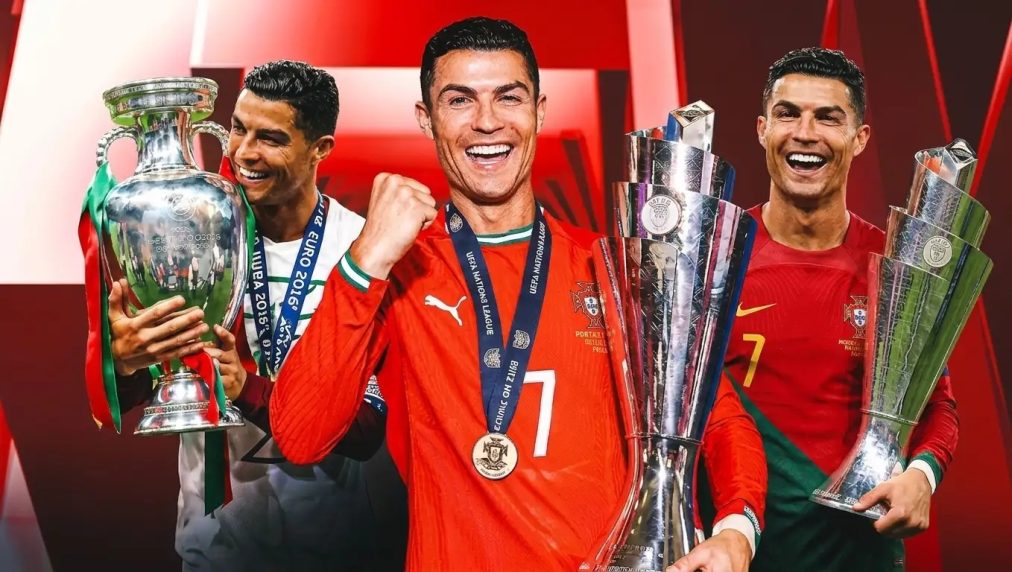
Cristiano Ronaldo has announced his retirement from international football with Portugal, bringing an end to a 23-year career that transformed the country from an occasional contender into a European champion and a two-time UEFA Nations League winner.
The decision came weeks after a disagreement with Portugal manager Jorge Jesus led Ronaldo to leave the squad during the previous international break. Despite wanting to continue playing for his country and pursue a 1,000th career goal, Ronaldo chose to announce his retirement on Thursday, even though Jesus had been preparing to include him in the squad due to be named tomorrow.
Ronaldo’s international career began in August 2003, when he was 18 years and six months old. His performances for Sporting Lisbon had already attracted attention, and he subsequently joined Manchester United.
Brazilian manager Luiz Felipe Scolari, then in charge of Portugal, selected the teenager despite the strength of the country’s established players. Ronaldo made his first appearance immediately after being called up, featuring in a friendly against Kazakhstan.
He was then included in Portugal’s preparations for Euro 2004, where he scored his first international goal in the opening match against Greece. Portugal lost the final to Greece, but the tournament confirmed the arrival of a major new talent alongside the team’s leading figure at the time, Luis Figo.
Portugal before Ronaldo
Before Ronaldo’s emergence, Portugal were regarded as a skilful and entertaining side rather than one of world football’s leading powers, alongside teams such as Brazil, Argentina, Germany and Italy.
The “Brazil of Europe” had produced outstanding individual players, but their appearances at major tournaments were sporadic. Before Ronaldo’s era, Portugal had reached only three World Cups: 1966, 1986 and 2002.
Their greatest achievement came in England in 1966, when Eusebio inspired them to third place. Portugal exited the group stage at the 1986 World Cup in Mexico and the 2002 tournament in South Korea and Japan.
They had also appeared at only three European Championships before 2003: 1984, 1996 and 2000. Although they reached the semi-finals in 1984 and repeated that feat at Euro 2000 with Figo’s “golden generation”, they had won no major international trophy.
During Ronaldo’s 23 years with the national team, Portugal qualified for six successive World Cups and appeared at every European Championship. They won Euro 2016 and two UEFA Nations League titles, while reaching a best-ever third place in the FIFA rankings after their European triumph. They fell outside the top 10 only once during Ronaldo’s international career, ranking 11th in 2008.
Ronaldo leaves as Portugal’s most-capped player, with 234 appearances, and their leading scorer with 146 goals. He also created 45 goals, scored in six different World Cups, holds the European Championship record with 14 goals and is Portugal’s leading World Cup scorer with 11.
His insistence that Portugal should aim to win trophies, rather than simply qualify for tournaments, changed the national team’s mentality. Former players and clubs thanked him in farewell messages, saying he had inspired them to pursue achievements once considered impossible.
Portugal’s next listed UEFA Nations League – Path 1 fixture is against Denmark on 14 November 2026. Ronaldo’s influence, however, is expected to remain for generations. Portugal’s economy minister, Manuel Castro Almeida, said: “Many people know Portugal only because of Cristiano Ronaldo,” adding that his importance extended far beyond football and represented a major economic and cultural value to the country.
-
 Oumar Solet chooses Cote d’Ivoire for November qualifiers Nov 5, 2026
-
Algeria name two newcomers for Togo qualifiers as Zidane and Ait-Nouri omitted Nov 5, 2026
-
Bayer Leverkusen rule out January exit for Algeria international Ibrahim Maza Nov 5, 2026
-
Birmingham City tracking Rosenborg striker Amin Chiakha Nov 5, 2026


-
AFCON 2025: Fixtures, Results, Scores and Standings Jan 18, 2026
-
Match hero Taiwo Awoniyi reflects on team effort after Chelsea triumph May 5, 2026
-
Leadership and long-term vision key to rescuing Zamalek and inspiring Egyptian football – Hany Abou Rida Nov 5, 2025
-
South African giants Orlando Pirates set to lose influential forward Monnapule Saleng Mar 19, 2025




-
Barcelona host Aston Villa in Champions League meeting at Spotify Camp Nou Nov 2, 2026
-
AEK Athens v Real Madrid: Champions League date, kick-off time and viewing details Nov 2, 2026
-
Villarreal host unbeaten PSG in first European meeting Nov 2, 2026
-
Real Sociedad and Lyon name probable line-ups for Europa League meeting Nov 3, 2026