How Mourinho’s Real Madrid return is putting his tactical ideas back in the spotlight
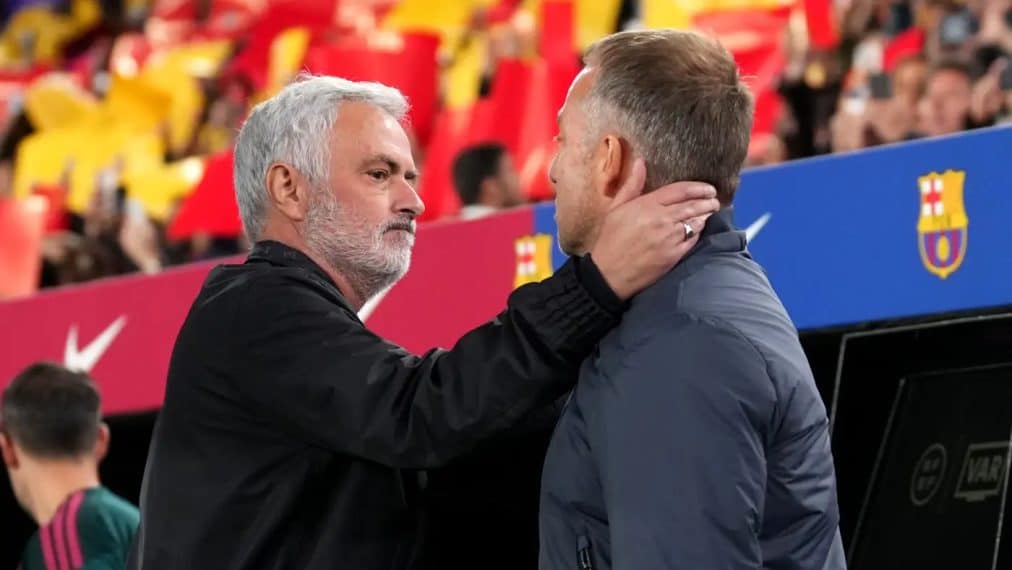
For years, Barcelona supporters used the word “Traductor” – Spanish for “translator” – to mock Jose Mourinho, recalling the start of his career as an interpreter for Sir Bobby Robson.
But that early role tells only a small part of the story. Mourinho went on to become one of football’s most successful managers, leading Porto to two European triumphs and winning major honours in England, Italy and Spain. His reputation was built on hard work, persistence, tactical reading and an ability to manage the most difficult situations.
Real Madrid’s 2-1 victory over Barcelona in the latest El Clasico offered another example of those qualities and renewed debate about a coaching philosophy that has not always received the recognition it deserves.
Real Madrid began with a 4-4-2 formation in the absence of the suspended Vinicius Junior. Federico Valverde played at right-back, Bernardo Silva partnered Aurelien Tchouameni in midfield, and Arda Guler and Yan Diomande operated on the flanks. Jude Bellingham played alongside Kylian Mbappe in attack.
As he has often done in major matches, Mourinho assigned one of his most energetic players to track a key opponent. Bernardo Silva was given the task of following Pedri, limiting the Spanish midfielder’s influence despite the difficulty of the assignment.
Real Madrid also exploited Barcelona’s high press and the tendency of its players to crowd around the ball. By drawing their opponents towards one side, Carlo Ancelotti’s team could switch play quickly into the space left on the opposite flank. Dribbles and long passes were used to move the ball from right to left, particularly when Marc Cucurella moved behind Lamine Yamal.
That approach exposed the space behind Barcelona’s advanced defensive line and punished the attacking style associated with Hansi Flick.
After the match, Mourinho departed from his usual reluctance to discuss detailed tactics publicly. He explained that Real Madrid’s midfielders repeatedly moving into deeper positions had made it especially difficult for Barcelona to defend. His comments may have been analysis, but they also showed how he uses press conferences as an extension of his work on the pitch – and perhaps highlighted issues other teams could target.
Mourinho’s broader methods can be harder to define than those of coaches with fixed patterns, carefully prescribed roles and a consistent style. Rather than follow a rigid model, he adapts to his players, his team and the demands of each match.
A BBC report linked him to “tactical periodisation”, the training philosophy developed by Portuguese coach Vitor Frade. It treats technical, tactical, physical and psychological elements as connected rather than separate. Mourinho encountered those ideas while working with Robson at Porto in the mid-1990s, when Frade was also part of the coaching staff. The approach draws on psychology, sociology, neuroscience and systems theory.
Its central belief is that players use all their abilities simultaneously while making decisions during matches. Training, therefore, prepares them to solve problems rather than repeat movements that may not suit every situation.
The Athletic reported that, after Mourinho took charge of Real Madrid this season, training sessions became shorter and more intense, with the ball used continuously, including in physical conditioning.
Mourinho belongs to a school that accepts football’s disorder instead of trying to remove it. Since 2019-2025 he has generally managed clubs with more modest ambitions, winning only the Europa Conference League with Roma in 2022 after Manchester United’s League Cup and Europa League double in 2017.
Yet modern football’s growing use of man-to-man pressing has made matches less predictable. Pre-planned attacking structures are harder to execute when the ball-carrier is immediately challenged.
That may favour Mourinho. His teams are prepared to respond when matches move beyond the original plan, using players’ different qualities to find solutions. Against Barcelona, Mbappe attacked the last defensive line, Bellingham combined strength with skill, while Bernardo Silva slowed the game under pressure before progressing the ball.
Mourinho’s career has repeatedly returned to familiar settings. He began at Benfica, returned there in September 2025 after about 25 years, won two successive Premier League titles with Chelsea before returning six years later for a third, and is now back at Santiago Bernabeu 13 years after his first spell ended.
His latest return could offer more than another chapter in his career. As controlling matches becomes increasingly difficult, football may be giving Mourinho another opportunity to show that the man once dismissed as a “translator” has a philosophy well suited to the modern game.
-
 Ismael Saibari scores and assists as Bayern Munich thrash Magdeburg 6-1 in German Cup Oct 29, 2026
-
Morocco’s Chams-Eddine Talbi scores as Sunderland beat Brentford in EFL Cup Oct 29, 2026
-
Fasil Ketema vs Bahardar: Hosts seek first goals as visitors bring stronger recent form Oct 29, 2026
-
Ethiopia Bunna vs Adama Kenema: Early-season test brings contrasting form to Addis Ababa Oct 29, 2026


-
AFCON 2025: Fixtures, Results, Scores and Standings Jan 18, 2026
-
Match hero Taiwo Awoniyi reflects on team effort after Chelsea triumph May 5, 2026
-
Leadership and long-term vision key to rescuing Zamalek and inspiring Egyptian football – Hany Abou Rida Nov 5, 2025
-
South African giants Orlando Pirates set to lose influential forward Monnapule Saleng Mar 19, 2025




-
Barcelona v Real Madrid: Catalans backed at 1.65 to win October Clasico Oct 23, 2026
-
Barcelona and Real Madrid meet in pivotal 265th Clasico Oct 23, 2026
-
Sevilla FC v Osasuna: probable line-ups for Monday’s La Liga meeting Oct 25, 2026
-
Inter Milan v Fiorentina: probable line-ups for San Siro clash Oct 24, 2026