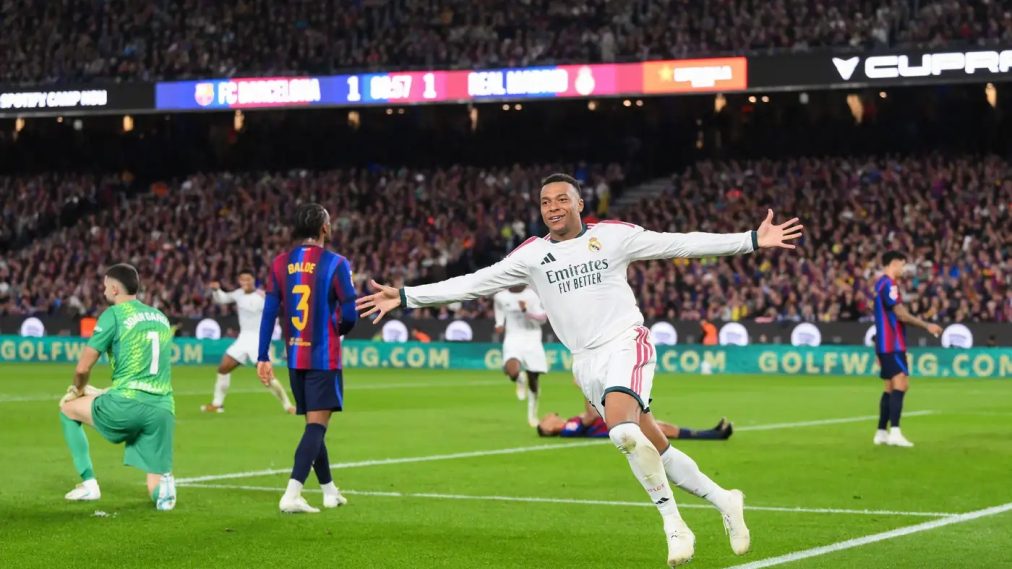
Barcelona’s commitment to Hansi Flick’s attacking football has brought two successive La Liga titles, two Spanish Super Cups and a Copa del Rey, but the team’s high defensive line continues to expose a familiar weakness against elite opponents.
Atletico Madrid, who visit Barcelona in a La Liga title contest on 08 November 2026, have repeatedly exploited the space behind Barcelona’s advanced full-backs and centre-backs since Flick took charge. The fixture is scheduled for 10 days’ time.
The pattern has become increasingly recognisable. Barcelona concede late, often while protecting a lead, after a long or diagonal pass breaks their defensive line. A forward then races through the central space before finishing or supplying a team-mate.
Atletico have repeatedly found the answer
The first major example came at Montjuic in the 18th round of the 2024-2025 season, when the sides were level at 1-1 in the 96th minute. That result would have kept Barcelona top, but Flick’s team continued to push for a winner.
Diego Simeone’s side took advantage. Nahuel Molina was left unmarked on the right and sent a low cross towards the far post. Inigo Martinez and Pau Cubarsi could not intercept, allowing Alexander Sørloth to score with one touch past Inaki Pena and send Atletico into the lead at the end of 2024.
The same vulnerability appeared in the first leg of the 2025 Copa del Rey semi-final on 25 February 2025. Barcelona led 4-2 after 75 minutes and 4-3 in the 93rd, with their defence positioned almost on the halfway line. A long ball released Samuel Lino on the left, and he crossed for Sørloth to equalise at 4-4 against Wojciech Szczesny.
“It happened to us in the league, and now it has happened again. We have to be careful, learn how to keep possession and not push our defensive line so high in the final minutes,” Pedri said afterwards.
The warning went unheeded. In the first leg of the 2025-2026 Copa del Rey semi-final on 13 February 2026, Atletico won 4-0 at the Wanda Metropolitano. Ademola Lookman and Julian Alvarez scored the third and fourth goals after wide deliveries and runs through the middle.
The trend continued in that season’s Champions League quarter-final. With the score 0-0 in the 44th minute, Alvarez released Giuliano Simeone, whose run led to Cubarsi being sent off before he scored from the resulting free-kick. After half-time, Sørloth headed in Matteo Ruggeri’s cross from the left as Barcelona’s defence dropped towards goalkeeper Joan Garcia.
In the second leg, Barcelona led 2-0 early on, but Atletico reduced the deficit in the 30th minute through another counter-attack. Marcos Llorente crossed for Lookman in a move that appeared to belong to the final stages of a match.
The problem extends beyond Atletico
Paris Saint-Germain also benefited in the Champions League group stage. Barcelona were level at 1-1 in the 90th minute before losing 2-1 when Vitinha found Achraf Hakimi on the right, whose cross was converted by Goncalo Ramos.
The most damaging example came against Inter Milan in the second leg of the 2024-2025 Champions League semi-final. Barcelona scored what seemed to be the goal that would take them to the final in the 88th minute, but while pressing for more in the 93rd, Marcus Thuram found Denzel Dumfries. He went beyond Gerard Martin and crossed for Acerbi to make it 3-3, sending Inter into the final.
Flick has attributed such incidents to lapses in concentration or tiredness, including after the latest Clasico. Unlike Pep Guardiola and Luis Enrique, who introduced greater safety measures within Barcelona’s attacking principles, Flick has continued to apply the approach with few concessions.
Its success depends on every player making the right tactical and technical decisions and avoiding individual mistakes. In modern football, that level of perfection cannot be guaranteed.
-
 Cote d’Ivoire U23 name 32-player squad for CAN preparation camp Oct 28, 2026
-
Sundowns, Al Ahly and Mazembe miss out as CAF Champions League hierarchy is shaken Oct 28, 2026
-
PSG eye winter move for Algeria youngster Ibrahim Maza after Kvaratskhelia injury Oct 28, 2026
-
Transfer news: PSG and Bayer Leverkusen battle for Ibrahim Maza Oct 28, 2026




-
AFCON 2025: Fixtures, Results, Scores and Standings Jan 18, 2026
-
Match hero Taiwo Awoniyi reflects on team effort after Chelsea triumph May 5, 2026
-
Leadership and long-term vision key to rescuing Zamalek and inspiring Egyptian football – Hany Abou Rida Nov 5, 2025
-
South African giants Orlando Pirates set to lose influential forward Monnapule Saleng Mar 19, 2025




-
Barcelona v Real Madrid: Catalans backed at 1.65 to win October Clasico Oct 23, 2026
-
Barcelona and Real Madrid meet in pivotal 265th Clasico Oct 23, 2026
-
Sevilla FC v Osasuna: probable line-ups for Monday’s La Liga meeting Oct 25, 2026
-
Inter Milan v Fiorentina: probable line-ups for San Siro clash Oct 24, 2026