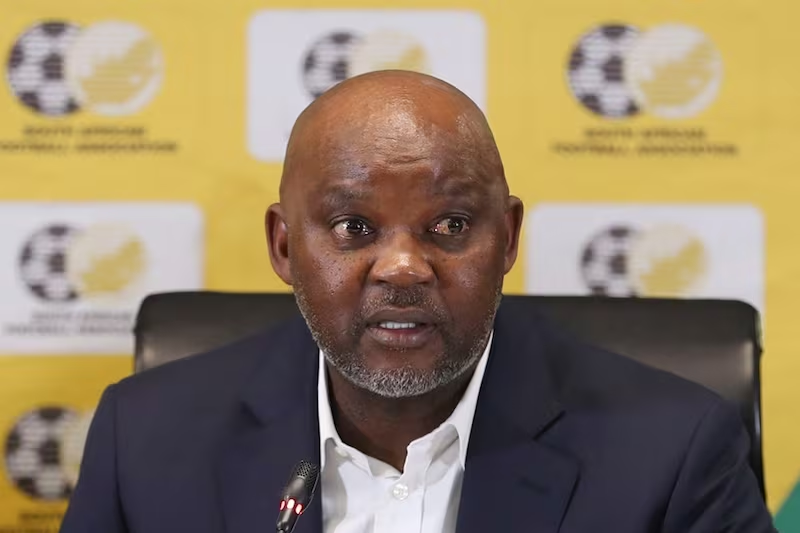
South Africa’s failure to finalise Pitso Mosimane’s appointment as Bafana Bafana coach is wasting valuable preparation time, with qualification for the 2027 Africa Cup of Nations due to begin in September.
The South African Football Association (Safa) endorsed Mosimane’s appointment on 8 August, but 23 days later it remains locked in protracted discussions with his representatives over the composition of his backroom staff.
The delay is difficult to understand given Mosimane’s record and the urgency of the work ahead. International managers are generally allowed room to select the staff they believe can help them succeed, while Musi Matlaba and Kabelo Rangoaga have been among Mosimane’s most trusted assistants throughout his career.
The pair helped him achieve success in previous roles and were part of the coaching team that worked with him to transform Bafana Bafana from limited also-rans into a more competitive and progressive side.
Mosimane’s appointment was recommended by Safa’s technical committees before being endorsed by the organisation’s national executive committee, its highest decision-making body. Yet negotiations over the finer details of the new set-up continue to move back and forth.
The impasse comes at a time when South Africa should already be preparing for the start of the road to the 2027 Afcon. It is difficult to believe that finances are the cause of the deadlock, with Safa having benefited substantially from the financial windfall generated by the World Cup.
Mosimane is regarded as one of South Africa’s greatest coaches. Those who argue that he failed during his previous spell in charge of Bafana Bafana overlook the body of work he has produced since then.
He first established his credentials by helping turn SuperSport United into a force to be reckoned with before taking charge of Mamelodi Sundowns. Under his leadership, the club’s distinctive yellow side helped reshape Bafana Bafana’s identity, moving them away from pedestrian performances and towards a more ambitious and exciting style.
Matlaba and Rangoaga assisted Mosimane in that work, making the current uncertainty over the backroom team even more frustrating.
Mosimane’s achievements at Sundowns also prompted Al Ahly to appoint him, with the Egyptian club seeking a coach capable of reviving a team that was struggling before his arrival. He left with the club restored to a strong and healthy position.
The contrast with other nations’ decisions after the 2026 Fifa World Cup is stark. France acted quickly after losing the third-place play-off to England. The 2018 champions understood that Didier Deschamps’ 14-year reign was coming to an end, with Boys II Men’s End of the Road providing an apt soundtrack for the conclusion of the former 1998 captain’s time in charge of Les Bleus.
Zinedine Zidane, the two-goal hero of France’s first World Cup triumph on home soil in 1998, was promptly selected to lead the national team into its next era.
Tunisia, by contrast, endured a chaotic qualification campaign in which five coaches were involved. After qualifying, they dismissed Sabri Lamouchi and replaced him with Herve Renard. When Renard could not prevent a group-stage exit, the Tunisian Football Federation moved quickly to appoint Moein Chaabani and begin the process of rebuilding the Eagles of Carthage.
Germany also acted decisively after Julian Nagelsmann stepped down following a group-stage collapse, replacing him with Jurgen Klopp.
Patrick Vieira has likewise returned to management after Senegal appointed him as the new coach of the Teranga Lions. He succeeded Pape Thiaw after Senegal’s last-32 elimination, with the former 2002 quarter-finalists opting for a clear change of direction.
Zidane, Chaabani, Klopp and Vieira have all been given four-year contracts running until the 2030 World Cup.
Safa’s continued hesitation stands in sharp contrast. Mosimane and his team need to begin work immediately. The longer the dispute continues, the more time South Africa loses before its next major qualifying campaign.
What is meant to happen will happen. If it does not, those responsible will be held accountable. Conspiracy theories are already circulating that Safa’s delay may be influenced by forces elsewhere.
Given the lack of progress, it is easy to understand why.
-
 Algeria women hit Central African Republic for eight in Olympic qualifying Oct 10, 2026
 -
Morocco women start Eric Blahic era with comeback win over Uzbekistan Oct 10, 2026
-
M’Baye Niang explains decision to join USL Dunkerque Oct 10, 2026
-
Morocco’s Atlas Lionesses beat Uzbekistan 3-1 as Jraidi nets hat-trick Oct 10, 2026




-
AFCON 2025: Fixtures, Results, Scores and Standings Jan 18, 2026
-
Match hero Taiwo Awoniyi reflects on team effort after Chelsea triumph May 5, 2026
-
Leadership and long-term vision key to rescuing Zamalek and inspiring Egyptian football – Hany Abou Rida Nov 5, 2025
-
South African giants Orlando Pirates set to lose influential forward Monnapule Saleng Mar 19, 2025




-
Croatia face Spain with Nations League hopes on the line in Split Oct 5, 2026
-
France v Belgium: Probable line-ups for Nations League clash Oct 3, 2026
-
Morocco coach Mohamed Ouahbi refuses to single out player after Mali draw Oct 4, 2026
-
Manchester United host winless Tottenham in Premier League clash Oct 7, 2026