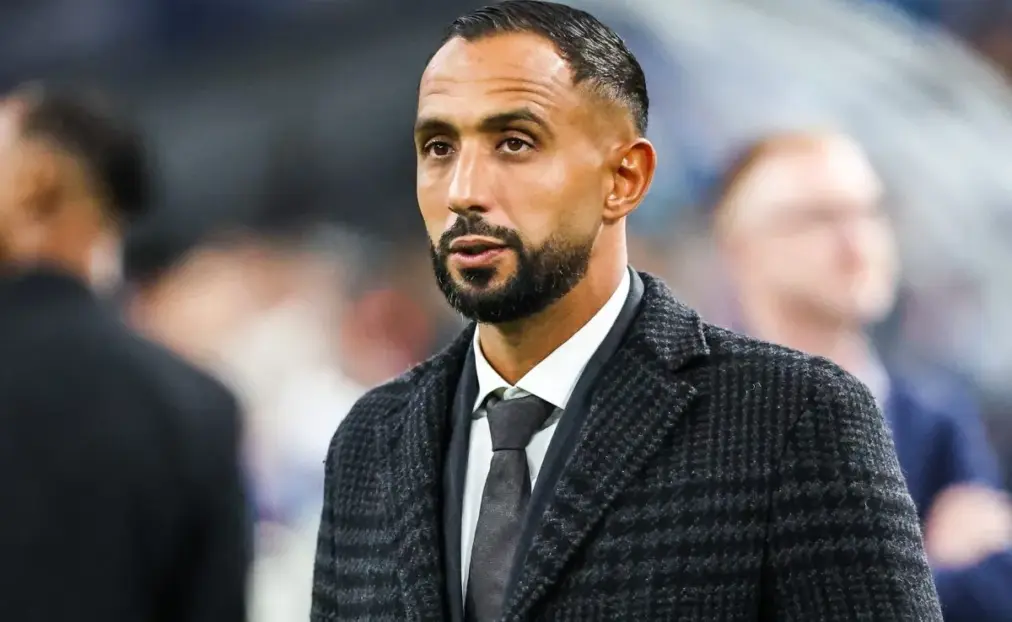
Mehdi Benatia has ruled out taking on a new executive position for now, weakening suggestions that the former Morocco captain could eventually succeed Fouzi Lekjaa as president of the Federation royale marocaine de football (FRMF).
Lekjaa remains firmly established at the head of Moroccan football, although his name is regularly linked with ambitions beyond the federation, including possible political roles. That has inevitably led to discussion about who might follow him in the longer term.
Benatia, who left Olympique de Marseille after three seasons, was asked by France Football about his plans for the future. The 39-year-old said his immediate priority was to take a break rather than return to football administration.
“Director, agent, it is not planned in the immediate future,” he said.
Benatia wants to spend time with his family, step back from the demands of the game and continue following football closely. He has not completely ruled out working as a consultant, but does not currently intend to begin another executive project.
“I had approaches from Saudi Arabia and England, but I am not ready to start another project,” he added.
His comments mean that, like Houssine Kharja, Benatia is not considered an option for the FRMF presidency at present. Kharja, another former captain of the Lions de l’Atlas, recently played down suggestions that he could be involved in the succession.
Benatia’s profile had appeared credible as part of a long-term discussion about the future leadership of Moroccan football. He remains closely connected to Morocco, captained the national team and is one of the most prominent figures in the country’s football landscape.
He also gained significant experience away from the pitch during his time at Marseille. Benatia initially served as a sporting adviser before becoming sporting director, giving him a role in the club’s recruitment and wider sporting strategy.
His spell at Olympique de Marseille divided opinion. Some supporters welcomed his determination to restructure the club, his direct communication style and several important signings. Others criticised his extensive media presence and what they viewed as an occasionally awkward approach to handling players.
He was also seen by some as bearing part of the responsibility for the difficult conclusion to Roberto De Zerbi’s tenure. Marseille has traditionally been a challenging environment to stabilise, and Benatia’s time there ensured he remained a highly debated figure among supporters and observers.
That strong leadership style, together with his desire to have a direct influence on sporting construction, helped fuel speculation that he might one day take on an important position within Moroccan football.
For now, however, Benatia’s position is clear: he wants time away from the pressure of a senior football role and is not preparing to take up another leadership position.
The succession to Lekjaa, therefore, remains a matter for the future.
-
 CAF Champions League: 16-year-old Bamba Souhalio rescues ASEC Mimosas in Fes Oct 18, 2026
 -
Swehly SC take first-leg lead over Esperance de Tunis in CAF Champions League Oct 18, 2026
-
CAF Champions League: Colombe Sportive take 2-0 first-leg lead at Teungueth FC Rufisque Oct 18, 2026
-
CAF Champions League: Late ASEC Mimosas equaliser frustrates MAS Fes as Esperance lose in Libya Oct 18, 2026




-
AFCON 2025: Fixtures, Results, Scores and Standings Jan 18, 2026
-
Match hero Taiwo Awoniyi reflects on team effort after Chelsea triumph May 5, 2026
-
Leadership and long-term vision key to rescuing Zamalek and inspiring Egyptian football – Hany Abou Rida Nov 5, 2025
-
South African giants Orlando Pirates set to lose influential forward Monnapule Saleng Mar 19, 2025




-
Real Betis v Barcelona: kick-off time, TV details and match preview Oct 16, 2026
-
Morocco to face New Zealand as FIFA U-17 Women’s World Cup kicks off in Rabat Oct 16, 2026
-
Roma v Real Madrid: home side tipped to score first in Champions League clash Oct 12, 2026
-
Atletico Madrid v Manchester United: probable line-ups for Champions League clash Oct 12, 2026