Morocco star Ismail Saibari trades childhood walking challenge for stardom
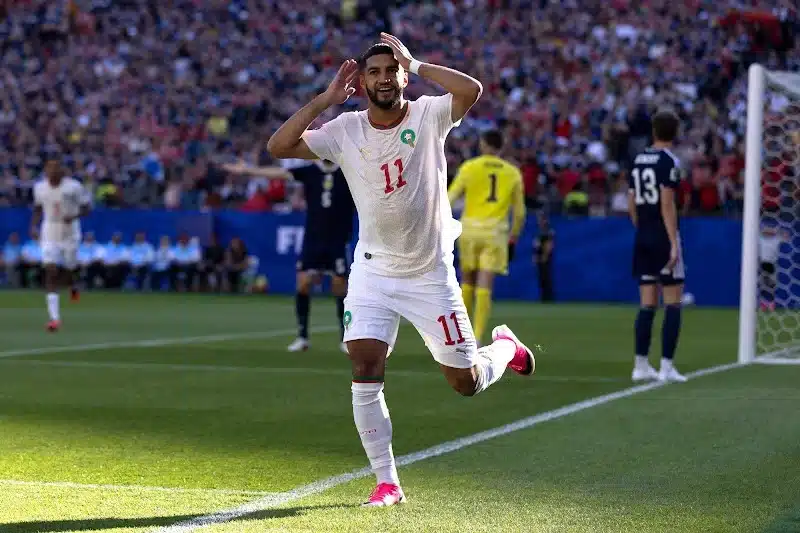
Morocco international Ismail Saibari has revealed the extraordinary journey that shaped his rise to becoming one of the standout performers at the 2026 FIFA World Cup, overcoming a childhood condition that once left doctors doubting whether he would ever walk again.
The Moroccan attacker, who has been in inspired form in North America, was born with a congenital foot deformity that severely affected his mobility at an early age. According to Saibari, medical professionals had warned his family that his condition could prevent him from walking normally in the future.
“My feet were bowed inwards, and I used walking aids. The doctor told my father that I might not be able to walk for the rest of my life,” he revealed in an interview with Swedish broadcaster Vänström.
Despite the bleak prognosis, Saibari underwent a long and demanding treatment process, relying on specialized mobility aids during his early development. He credits both faith and family support for helping him through those difficult years.
“But I am a Muslim, and I trust in God. My mother prayed for me. I just wanted a normal life, not necessarily to be a football player. But thank God, I have normal feet and a healthy body,” he added.
His challenges did not end there. As his football journey progressed, Saïbari faced another setback when Belgian club Anderlecht reportedly released him due to concerns over weight gain. Rather than halting his progress, the setback became a turning point, pushing him to rebuild his career with greater discipline and determination.
Born in Terrassa, Spain, and later moving to Belgium at the age of six, Saïbari’s football education took him through several youth systems, including Beerschot, Anderlecht, Mechelen, and Genk, before he eventually joined PSV Eindhoven in 2020. It was in the Netherlands that his talent fully emerged, with his technical ability and attacking intelligence earning him a key role at the club.
His consistent performances eventually attracted wider attention, with reports linking him to major European clubs, including German giants Bayern Munich, following his impressive output in the Eredivisie.
At international level, Saïbari has become one of Morocco’s most influential players at the World Cup, delivering decisive contributions in their campaign in the United States. Operating in a flexible attacking role under coach Mohamed Wahbi, he has been deployed as a false nine, playmaker, and winger depending on tactical demands.
That versatility has paid off, with Saïbari scoring twice so far in the tournament — a delicate lob against Brazil in a 1–1 draw and a composed finish against Scotland in a 1–0 victory — helping Morocco secure valuable points in Group play.
His performances have placed him in contention for a historic achievement, as he aims to become the first African player to score in all three group-stage matches of a World Cup. He is also closing in on Morocco’s all-time single-tournament scoring record, currently held by Youssef En-Nesyri, who netted three goals in the 2022 edition.
Despite not being a natural centre-forward, Saïbari’s adaptation into a central attacking role has been praised by the coaching staff, who have built their system around the creative strengths of their attacking midfielders.
Coach Mohamed Ouahbi previously explained the tactical shift: “The idea of using Saïbari in his current position came about when I took over. I wanted to implement my principles with the best players available.”
He added that the system was designed to maximise fluidity in attack while maintaining balance across the team, a strategy that has so far proven effective in Morocco’s strong tournament run.
Saïbari himself has embraced the moment, describing the World Cup as the highlight of his career.
“It’s the most beautiful moment of my career because playing in the World Cup with your national team is everyone’s dream,” he said. “But the most important thing is to go as far as possible.”
His rise has also been shaped by success at club level with PSV Eindhoven, where he has developed into a consistent attacking force, registering an impressive return of goals and assists that solidified his reputation in European football.
With continued interest from top clubs and a starring role on the world stage, Saïbari’s story has become one of resilience, transformation, and breakthrough success — from a childhood marked by medical uncertainty to leading Morocco’s charge at the World Cup.
-
 Raja Casablanca players threaten contract termination amid signing bonus row Oct 15, 2026
 -
Ligue Europa: Herve Koffi starts for Union Saint-Gilloise against Real Sociedad Oct 15, 2026
-
Abdelhak Benchikha warns Ittihad Tangier fans against unrealistic title expectations Oct 15, 2026
-
Botola Pro: Wydad goalkeeper Mehdi Benabid handed two-match ban Oct 15, 2026



-
AFCON 2025: Fixtures, Results, Scores and Standings Jan 18, 2026
-
Match hero Taiwo Awoniyi reflects on team effort after Chelsea triumph May 5, 2026
-
Leadership and long-term vision key to rescuing Zamalek and inspiring Egyptian football – Hany Abou Rida Nov 5, 2025
-
South African giants Orlando Pirates set to lose influential forward Monnapule Saleng Mar 19, 2025




-
Roma v Real Madrid: home side tipped to score first in Champions League clash Oct 12, 2026
-
Atletico Madrid v Manchester United: probable line-ups for Champions League clash Oct 12, 2026
-
Celta Vigo v Juventus: Probable line-ups for Europa League encounter Oct 14, 2026
-
Arsenal backed to edge out Lille in Champions League clash Oct 11, 2026