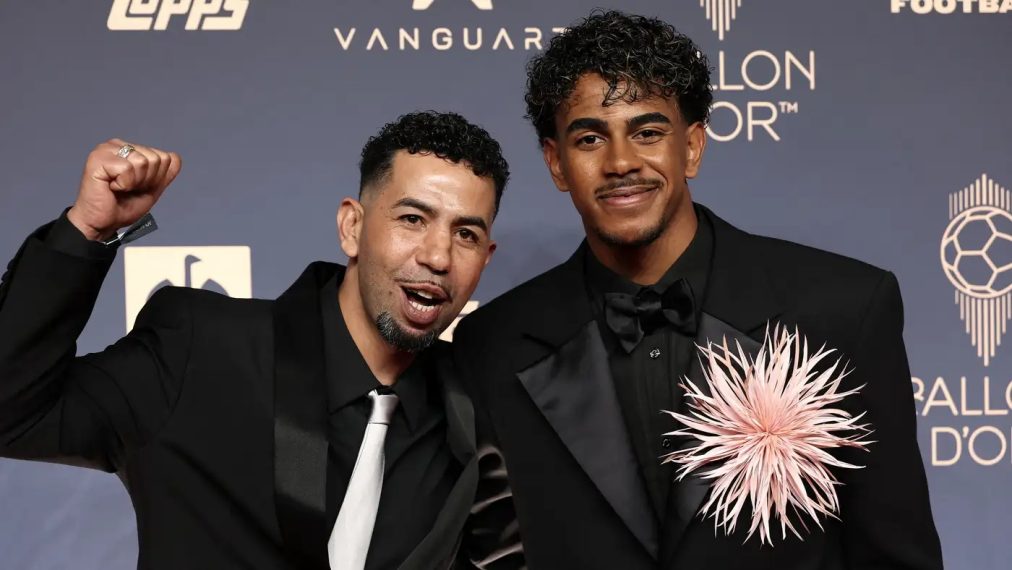
Mounir Nasraoui, the father of Barcelona forward Lamine Yamal, has questioned the voting process after his son finished third in the Ballon d’Or behind winner Harry Kane and Real Madrid’s Kylian Mbappe.
In outspoken comments, Nasraoui accused parts of the Spanish voting system of favouring Mbappe because he plays for Real Madrid.
Speaking to prominent journalist Jota Jordi, Nasraoui said he was shocked that Mbappe had received enough support to take second place. He also questioned the criteria used by the Spanish representative for France Football, AS director Jose Felix Diaz.
Nasraoui directly challenged those who voted for the France international.
“I hope that one day I see one of those who voted for Mbappe on television, because I would like to speak to him,” he said. “And you too, my friend, the Mbappe fan.”
He then suggested that the Real Madrid shirt had influenced some voters, in what amounted to a clear accusation of bias.
“This only happens here in Spain,” Nasraoui said. “If the best player in the world plays for Real Madrid, then vote for the national team! I am not saying that – it is an award for a player, not a team. We are in the 21st century, man!”
His comments have prompted renewed debate in football over whether a player’s club can affect how voters assess their performances in the Ballon d’Or.
The controversy has also revived wider questions over the neutrality of the award’s voting process. Nasraoui’s criticism focused on the support received by Mbappe in Spain, but the voting patterns cited in the discussion suggest that national preferences may not be limited to one country.
Argentina voted for Lionel Messi, France backed Mbappe and England selected Kane. Georgia, meanwhile, voted for its own star, Khvicha Kvaratskhelia.
Those choices have added to doubts over the extent to which national allegiance influences the voting, rather than the individual performances of the players being assessed.
Nasraoui’s remarks were directed at the ranking that placed Yamal third, despite his belief that the Barcelona forward deserved greater recognition. His criticism has made the relationship between club identity, nationality and individual awards the central issue surrounding this year’s Ballon d’Or vote.
-
 Wadi Degla coach Mostafa Shabita reveals tactics behind victory over Zamalek Nov 3, 2026
-
Al Ahly must maintain winning mentality after Al Mokawloon win – Hussein Ammouta Nov 3, 2026
-
PSL is Africa’s best-organised football league, says Cyril Ramaphosa Nov 3, 2026
-
Guinea coach Duarte prioritises wins over performances after Bafana Bafana defeat Nov 3, 2026


-
AFCON 2025: Fixtures, Results, Scores and Standings Jan 18, 2026
-
Match hero Taiwo Awoniyi reflects on team effort after Chelsea triumph May 5, 2026
-
Leadership and long-term vision key to rescuing Zamalek and inspiring Egyptian football – Hany Abou Rida Nov 5, 2025
-
South African giants Orlando Pirates set to lose influential forward Monnapule Saleng Mar 19, 2025




-
Barcelona host Aston Villa in Champions League meeting at Spotify Camp Nou Nov 2, 2026
-
Le Havre AC host Paris Saint-Germain as Ligue 1 leaders seek another win Oct 28, 2026
-
DRC’s Leopardeaux beat Oman 2-0 to reach FIFA U15 World Cup quarter-finals Oct 29, 2026
-
Villarreal host unbeaten PSG in first European meeting Nov 2, 2026