World Cup 2026: Hossam Hassan’s protest revives links to Jose Mourinho’s infamous touchline gesture

Egypt head coach Hossam Hassan became one of the most talked-about figures of the World Cup after his animated crossed-arms gesture during his side’s dramatic 3-2 defeat to Argentina, with many initially believing he was reporting a racist incident.
Instead, the moment had nothing to do with discrimination.
It was a calculated protest against the officiating, one that quickly drew comparisons with one of José Mourinho’s most iconic acts of defiance on the touchline.
Egypt’s hopes of reaching the quarter-finals ended in heartbreaking fashion after surrendering a two-goal lead to the defending champions in the Round of 16.
Yet the match’s biggest talking point after the final whistle was Hassan’s decision to raise his forearms into an “X” shape in full view of television cameras.
The gesture immediately fuelled speculation because FIFA recently adopted the crossed-arms signal as the official way for players and coaches to report racist abuse during matches. Social media was awash with claims that Egypt had been subjected to discrimination before the true explanation emerged.
Hassan’s protest aimed at referee, not racism
The mystery was cleared up by Egypt team director Ibrahim Hassan, the coach’s twin brother, who insisted the gesture was directed solely at the match officials.
According to Ibrahim, emotions boiled over after Argentina scored what Egypt believed was a highly contentious third goal. Hossam Hassan confronted French referee François Letexier, accusing the official of repeatedly making decisions against his side.
Ibrahim claimed the referee ignored Egypt’s protests and threatened the national team coach during the exchange.
In response, Hossam deliberately used FIFA’s approved crossed-arms signal as an official protest to highlight what Egypt viewed as a serious injustice rather than an allegation of racism.
The situation escalated further when Letexier cautioned the Egypt coach with a yellow card. Ibrahim argued that the punishment contradicted FIFA’s own guidance, maintaining that the gesture is intended as an official means of reporting violations during matches.
He also alleged the referee continued to intimidate Hassan after showing the caution, suggesting he was attempting to create grounds to dismiss the Egypt boss amid mounting tensions on the touchline.
The Mourinho comparison
For many observers, Hassan’s actions immediately evoked memories of Mourinho’s famous protest while in charge of Inter Milan in 2010.
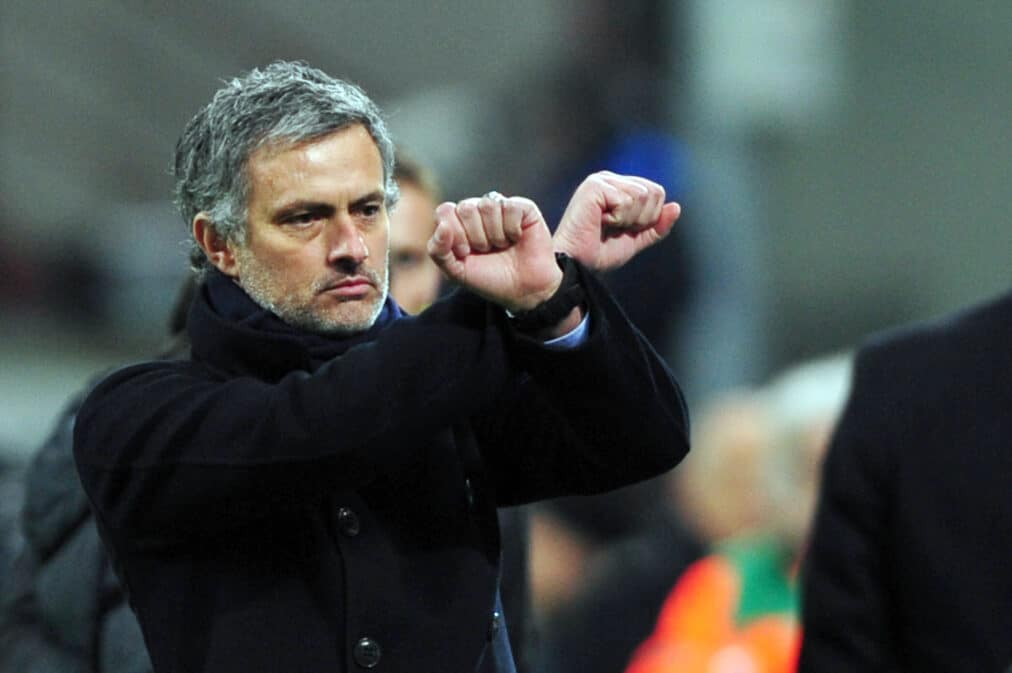
During a heated Serie A encounter, the Portuguese manager clasped his wrists together in a handcuff gesture after two Inter players had been sent off, symbolically accusing officials of restricting and unfairly targeting his team.
The image became one of the defining moments of Mourinho’s career, reinforcing his reputation as a manager willing to publicly challenge referees when he believed his side had been wronged.
Like Hassan’s protest in the World Cup, Mourinho’s gesture divided opinion across football.
Supporters viewed it as a passionate defence of his players, while critics accused him of encouraging conspiracy theories surrounding officiating. Italian newspaper La Repubblica argued at the time that many had hoped Mourinho would bring greater maturity to Italian football but instead believed he had taken the game backwards.
The fallout was significant, with Mourinho receiving a €40,000 fine and a three-match suspension.
Another iconic image born from controversy
Although the circumstances differed, both managers used highly symbolic gestures to express frustration with refereeing decisions rather than relying solely on verbal confrontations.
For Mourinho, it was the handcuff signal. For Hossam Hassan, it was FIFA’s crossed-arms gesture, a symbol whose official purpose led many viewers to misinterpret the incident before Egypt explained its true meaning.
While Argentina progressed after completing a remarkable comeback, Hassan’s protest ensured the controversy surrounding the officiating continued long after the final whistle.
-
 PSG beat Barcelona 4-2 in Champions League thriller Oct 21, 2026
 -
Morocco beaten by Germany but remain in contention at U17 Women’s World Cup Oct 21, 2026
-
Cloudflare Error 522: Connection to origin server timed out Oct 21, 2026
-
Champions League: Napoli edge Bodø/Glimt 4-3 in thrilling contest Oct 20, 2026




-
AFCON 2025: Fixtures, Results, Scores and Standings Jan 18, 2026
-
Match hero Taiwo Awoniyi reflects on team effort after Chelsea triumph May 5, 2026
-
Leadership and long-term vision key to rescuing Zamalek and inspiring Egyptian football – Hany Abou Rida Nov 5, 2025
-
South African giants Orlando Pirates set to lose influential forward Monnapule Saleng Mar 19, 2025




-
PSG v Barcelona: fiery attacks set up Champions League classic at Parc des Princes Oct 18, 2026
-
Real Betis v Barcelona: kick-off time, TV details and match preview Oct 16, 2026
-
Porto v PSV: predicted line-ups for Champions League league-phase clash Oct 19, 2026
-
Morocco face Germany with top spot in Women’s Under-17 World Cup Group A at stake Oct 20, 2026