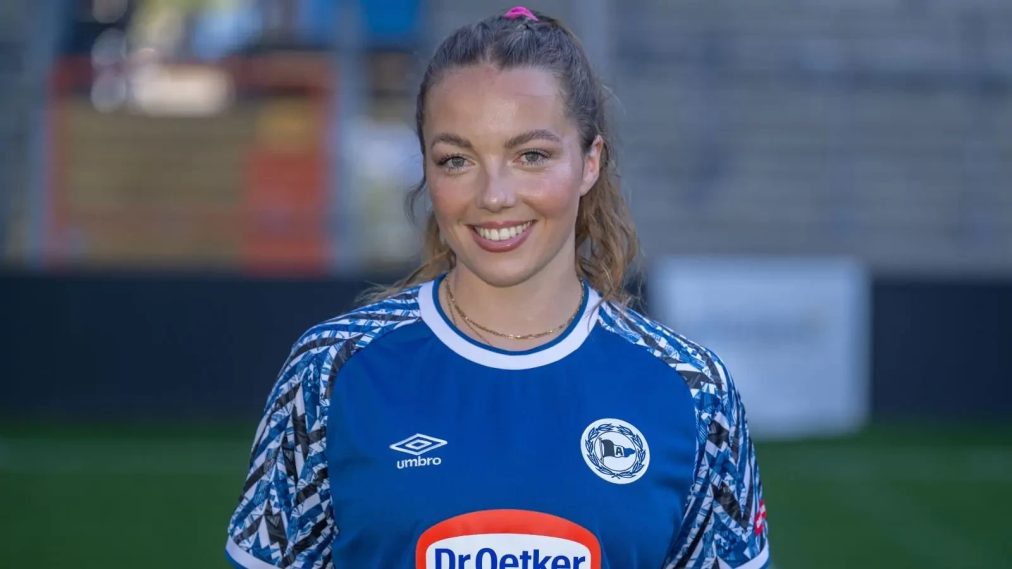
Arminia Bielefeld striker Sophia Thiemann says experienced mentors are essential to helping women’s football develop, both in Germany and around the world.
The 30-year-old was speaking during a media round-table event involving Arminia Bielefeld and South African club Kaizer Chiefs Ladies.
Thiemann was asked by moderator and SABC Sport analyst Indira Albuquerque about the influence of her former coach, Annabel Jager. The former Germany international worked with the team from 2023 until the end of the 2025/26 season.
Jager’s experience at the highest level of the game gave Thiemann an opportunity to learn from someone who had reached one of football’s biggest stages.
“I have had the privilege to play with her, before she was my coach I was a player on her team and of course playing for the German National team is the ultimate goal you wanna achieve as a football player, not only for Germany but for any country,” Thiemann said.
“I did not achieve that goal which is fine but having been able to play or be coached by someone who has is of course very interesting and the experience and anything you can learn from her or from someone who has played on that highest level is really great.”
Women’s football has attracted significantly greater attention in recent years. The 2023 FIFA Women’s World Cup generated a media engagement audience of 2 billion, according to Nielsen Sport.
Thiemann also reflected on her own path into football and the challenge of establishing a sense of belonging in a sport where she initially stood out.
She had played handball before moving with her family to another country, where she began playing football after being inspired by her brother.
“When I first started playing football, I used to play handball before and then we moved to a different country and then I started playing football because my brother was playing,” she said.
At first, Thiemann questioned whether she had a place in the game because she was playing alongside boys.
“There was always a question of whether I belonged there or not, of course because everyone was obviously male, it was kind of an odd feeling to start off there but when we got to play and they started to appreciate what I was able to do.”
Rather than waiting for others to decide whether she belonged, Thiemann said she eventually adopted a different mindset.
“I didn’t even answer the question of ‘Do I feel I belonged?’ I just told myself that I belonged. So, I think that is the key point when it comes to the belonging issue, when you stop asking yourself do I belong I think you already do.”
-
 Kaizer Chiefs close to Khanyisa Mayo return after injury lay-off Oct 4, 2026
 -
Orlando Pirates face early league test after MTN8 final schedule change Oct 4, 2026
-
Raja begin Botola campaign with victory over Renaissance Zemamra Oct 4, 2026
-
MAS Fes move top of Botola after beating Hassania Agadir Oct 4, 2026




-
AFCON 2025: Fixtures, Results, Scores and Standings Jan 18, 2026
-
Match hero Taiwo Awoniyi reflects on team effort after Chelsea triumph May 5, 2026
-
Leadership and long-term vision key to rescuing Zamalek and inspiring Egyptian football – Hany Abou Rida Nov 5, 2025
-
South African giants Orlando Pirates set to lose influential forward Monnapule Saleng Mar 19, 2025




-
AFCON 2027 Qualifiers: McCarthy warns South Africa to expect tough test against Eritrea Sep 29, 2026
-
Denmark v Portugal: Nations League kick-off time, TV channel and match prediction Sep 29, 2026
-
South Sudan vs Egypt: Where to watch AFCON 2027 qualifier Sep 29, 2026
-
Egypt lose defender Mohamed Abdel Moneim for South Sudan AFCON qualifier Sep 27, 2026