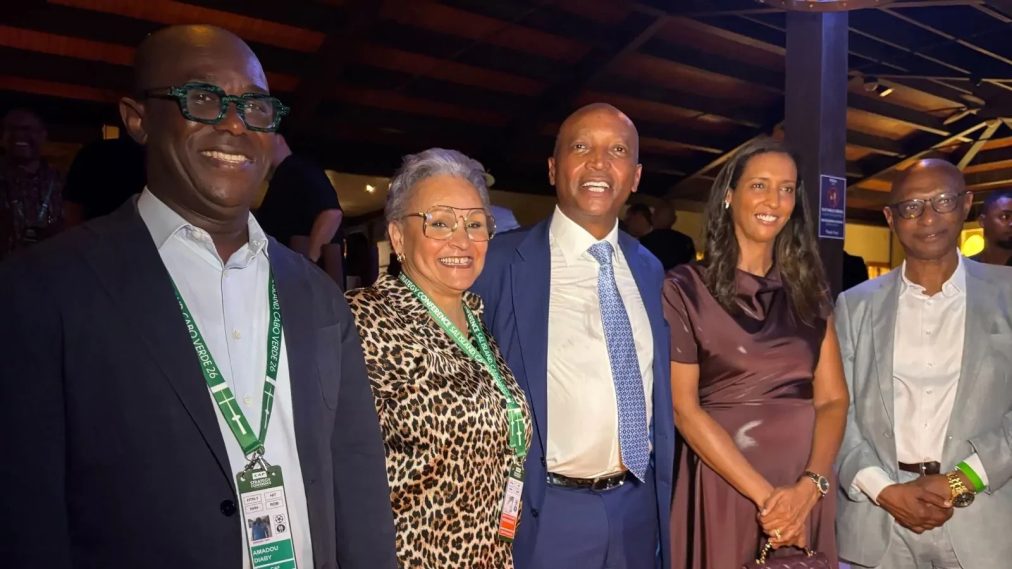
Coaches from the Council of the Southern African Member Associations (COSAFA) have welcomed the Confederation of African Football (CAF) strategy conference on Sal Island in Cape Verde, saying it could help African nations build on their progress at the 2026 FIFA World Cup.
The meeting, hosted by CAF President Patrice Motsepe and his leadership team, is being viewed as an important step towards ensuring African teams are better prepared for the 2030 tournament.
Namibia head coach Colin Benjamin said the conference provided an opportunity for coaches to share ideas and consider how the continent can become more competitive internationally.
“Of course strengths strategically where the continent is going, I’m personally such a big fan of what is happening, what our CAF president has been trying to do with us as a continent to be able to come to a place where we are able to compete and not only participate,” Benjamin said.
“And it was very, very obvious at the World Cup what happened there with African teams. I think we are at a good place and here being with colleagues, exchanging ideas, views, objectives, it’s really, really a good experience and I think everybody takes something from this.”
Recent Africa Cup of Nations tournaments have suggested that the difference between the continent’s leading sides and its smaller nations is narrowing. The trend has also been evident in the PAMOJA AFCON qualification matches, which have produced several surprising results.
Nigeria’s defeat by Guinea-Bissau and Ghana’s home loss to Gambia were among the results that highlighted the changing balance of power.
Benjamin is familiar with what can be achieved by a smaller nation. He previously guided Namibia, known as the Brave Warriors, to AFCON qualification, including a surprise victory over Cameroon.
“You know, I think generally for us in the technical department or tactically, there’s always room for improvement and now you also see that there’s an influx of players that receive their development in Europe playing for African nations that has raised the bar,” he added.
“But at the same time it’s also very interesting to see how smaller nations like our nation, for example, don’t have the luxury of having players playing at the highest level in Europe but still have to compete against some of the power houses.”
The conference is expected to examine how nations can improve their coaching, tactics, training and preparation, particularly when facing more established opponents.
“What methods is it that we can apply? What tactics is it that we can apply? How should we train our players, how should we prepare our teams,” Benjamin said.
“So, those are some of the topics that I’m looking forward to. Another topic that’s also of interest for me is the stadium issue.”
Benjamin said infrastructure requirements could place a significant burden on smaller associations, which are sometimes forced to stage home matches outside their own countries.
“We understand for example that yes we want to raise the bar but it’s making it also so difficult for smaller nations like us to literally play away games all the time,” he said.
“So, it’s gonna be interesting views and discussions and hopefully we all go out with something positive from it and take back to our countries and teams.”
-
 CAS hearing takes fresh turn as Morocco raise alleged second report from AFCON final Oct 8, 2026
 -
Egyptian forward Ramadan Sobhi uncertain about future after four-year doping ban Oct 8, 2026
-
Morocco’s Mehdi Benatia emerges as candidate for AC Milan sporting director role Oct 8, 2026
-
Orlando Pirates linked with Burkina Faso striker Djibril Ouattara Oct 8, 2026


-
AFCON 2025: Fixtures, Results, Scores and Standings Jan 18, 2026
-
Match hero Taiwo Awoniyi reflects on team effort after Chelsea triumph May 5, 2026
-
Leadership and long-term vision key to rescuing Zamalek and inspiring Egyptian football – Hany Abou Rida Nov 5, 2025
-
South African giants Orlando Pirates set to lose influential forward Monnapule Saleng Mar 19, 2025




-
Croatia face Spain with Nations League hopes on the line in Split Oct 5, 2026
-
France v Belgium: Probable line-ups for Nations League clash Oct 3, 2026
-
Morocco coach Mohamed Ouahbi refuses to single out player after Mali draw Oct 4, 2026
-
Noussair Mazraoui leaves Morocco squad early after injury Oct 2, 2026