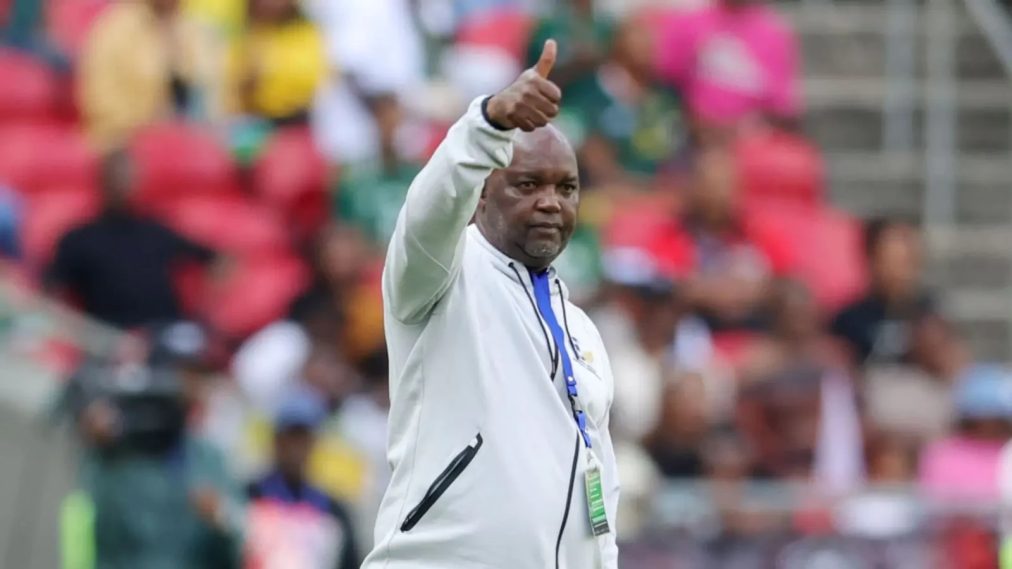
Bafana Bafana head coach Pitso Mosimane says he will undertake a detailed review of the FIFA Technical Study Group’s report on the 2026 FIFA World Cup as South Africa looks to learn from its campaign.
Mosimane spoke exclusively to SABC Sport after the CAF Strategy Conference in Santa Maria, Sal Island, Cape Verde, where he said he was encouraged by the discussions and analysis presented.
The conference was organised by CAF to assess the performances of the record 10 African representatives at the World Cup and to begin shaping the continent’s approach to the 2030 tournament.
The review was led by FIFA Chief of Global Football Development Arsene Wenger. FIFA Team Lead for Football Performance Analysis Aaron Ackerman and former Ghanaian national team head coach Otto Addo, who is also a member of the FIFA Technical Study Group, assisted him.
Mosimane said the report had provided coaches with valuable areas for further work, particularly in the final third.
“The report highlighted many aspects of Bafana’s game during the World Cup, and our box entries was especially lacking but some of the other aspects we were not too bad in. All of this has been great for us coaches to go back and learn from these lessons,” he said.
The study found that nine of Africa’s 10 teams progressed to the knockout stage, giving the continent the best progression rate of any confederation at the tournament.
However, it also pointed to narrow differences between the African sides and the leading teams in several key areas. Those included chance creation, counter-pressing, the ability to maintain a presence in the penalty area and managing the closing stages of matches.
The conference also included a panel discussion involving coaches who took part in the World Cup: Mohamed Ouahbi of Morocco, Emre Fae of Ivory Coast, Sebastien Desabre of Democratic Republic of Congo and Pedro “Bubista” Brito of Cape Verde.
A further focus of the event was the relationship between national football associations and their technical teams. Mosimane said the issue of football administrators interfering in coaching decisions remains one of the major challenges facing African football, particularly for nations competing at the Africa Cup of Nations (AFCONS) and the World Cup.
He said the matter featured prominently during the feedback session and the discussions about how Africa should prepare for the 2030 World Cup.
“Certain ideas were discussed to see how much better FIFA’s contribution in Africa can be. The coach of Cote d’Ivoire was also brave enough to bring up the fact that federations have to provide more support and give more patience to their coaches,” Mosimane said.
-
 University of Pretoria coach Michael Loftman hails Gladwin Shitolo’s leadership Oct 11, 2026
 -
Youssef En-Nesyri explains why he did not celebrate against ‘brother’ Yassine Bounou Oct 11, 2026
-
Football betting tips: Mercado goalscorer among three picks for 11 October Oct 11, 2026
-
Bandırmaspor set asking price for Senegal prospect Amidou Badji Oct 11, 2026




-
AFCON 2025: Fixtures, Results, Scores and Standings Jan 18, 2026
-
Match hero Taiwo Awoniyi reflects on team effort after Chelsea triumph May 5, 2026
-
Leadership and long-term vision key to rescuing Zamalek and inspiring Egyptian football – Hany Abou Rida Nov 5, 2025
-
South African giants Orlando Pirates set to lose influential forward Monnapule Saleng Mar 19, 2025




-
Croatia face Spain with Nations League hopes on the line in Split Oct 5, 2026
-
Manchester United host winless Tottenham in Premier League clash Oct 7, 2026
-
Morocco coach Mohamed Ouahbi refuses to single out player after Mali draw Oct 4, 2026
-
Lens v Lyon: Can the in-form visitors extend their unbeaten Ligue 1 run? Oct 6, 2026