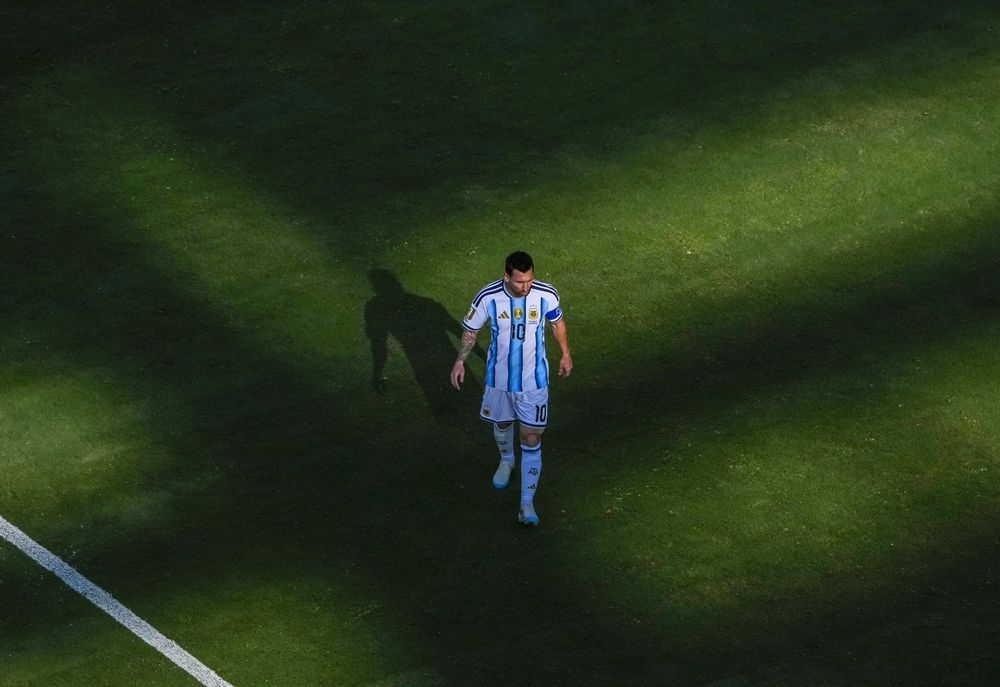
When 85,000 supporters gather at Estadio Monumental on Tuesday, Argentina will say goodbye to Lionel Messi as he prepares to wear the national team shirt for the final time in Buenos Aires.
The crowd is expected to sing Muchachos, Ahora Nos Volvimos a Ilusionar, the anthem written by Fernando Romero. Its words honour Argentina, Diego Maradona, Messi and the young soldiers who died in the Malvinas conflict, bringing together four decades of national grief, hope and celebration.
For Messi, the occasion will complete a journey that began when the boy from Rosario left Argentina for Catalonia at the turn of the millennium. He departed with no guarantees, but possessed a natural ability that made the ball appear to be part of him.
For much of his international career, Messi’s greatest burden was not worldwide expectation but the longing of his own country. In Argentina, greatness is judged not only by trophies but by emotional connection.
Diego Maradona had embodied a defiant, fiery kind of sporting religion. Messi represented something quieter: an understated, almost private perfection. For years, many in Buenos Aires questioned whether that was enough.
The defeats were painful. Argentina lost to Germany in the 2014 World Cup final in Rio, before suffering consecutive Copa America final defeats by Chile on penalties in 2015 and 2016.
The second of those losses, in East Rutherford, proved especially damaging. Messi was overcome by grief and criticism and announced that his Argentina career was over. His retirement lasted only weeks, however. The attraction of the national-team shirt and the sense of an incomplete story brought him back.
Taking permanent ownership of the captain’s armband changed the way Messi was viewed. He remained the same player, but became an unquestionable leader, guiding a rebuilding Argentina side through difficult South American qualifying matches.
In 2017, he secured Argentina’s place at the 2018 World Cup with a famous hat-trick in Quito, played at altitude. Under Lionel Scaloni, the team then entered its most successful period.
Messi won his first major senior international trophy when Argentina defeated Brazil in the 2021 Copa America final at the Maracana, ending a 28-year wait for silverware.
The defining achievement followed at Lusail Stadium in Qatar. Messi scored twice against France in the 2022 World Cup final, widely regarded as the greatest final ever played, to deliver Argentina’s third World Cup and place him alongside Maradona.
Another Copa America title in 2024 completed the transformation of years of disappointment into an era of unprecedented success.
Messi leaves with 207 caps, 125 goals and 68 assists. He is South America’s leading international goalscorer, Argentina’s record appearance-maker and the only player to score in every round of a single World Cup.
For the final act against Benin, he will be accompanied by Angel Di Maria, Nicolas Otamendi and Rodrigo De Paul, teammates who helped turn national anxiety into joy.
Messi departs with no unfinished business. His legacy extends beyond medals and records: millions of children will continue to play football wearing his name, inspired by the boy from Rosario who reached the summit without losing his humility.
-
 Algeria face must-win Egypt clash for 2027 U20 Africa Cup of Nations place Oct 6, 2026
 -
Argentina expected to start Lionel Messi against Benin in Buenos Aires friendly Oct 6, 2026
-
Riyad Mahrez: Rais M’Bolhi played key role in Al-Shamal transfer Oct 5, 2026
-
Filipe Luís hails Senegal midfielder Lamine Camara as ‘the future of football’ Oct 5, 2026




-
AFCON 2025: Fixtures, Results, Scores and Standings Jan 18, 2026
-
Match hero Taiwo Awoniyi reflects on team effort after Chelsea triumph May 5, 2026
-
Leadership and long-term vision key to rescuing Zamalek and inspiring Egyptian football – Hany Abou Rida Nov 5, 2025
-
South African giants Orlando Pirates set to lose influential forward Monnapule Saleng Mar 19, 2025




-
AFCON 2027 Qualifiers: McCarthy warns South Africa to expect tough test against Eritrea Sep 29, 2026
-
Denmark v Portugal: Nations League kick-off time, TV channel and match prediction Sep 29, 2026
-
South Sudan vs Egypt: Where to watch AFCON 2027 qualifier Sep 29, 2026
-
France v Belgium: Probable line-ups for Nations League clash Oct 3, 2026