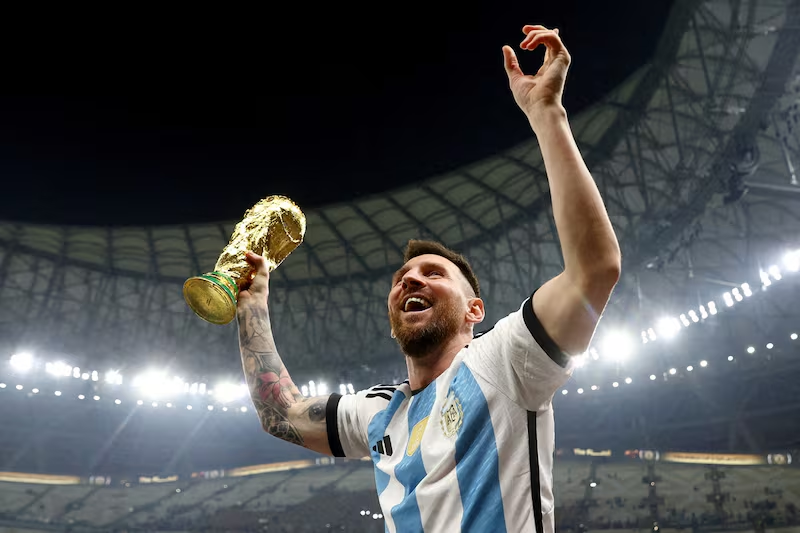
When Lionel Messi plays his final match for Argentina against Benin at Buenos Aires’ Monumental stadium on Tuesday, it will close an international career that began with officials struggling even to identify him.
Over more than two decades, Messi’s relationship with Argentina developed from uncertainty and suspicion into one of the strongest bonds between a footballer and a nation.
“He went through so many moments that they’re really very different eras. At first he suffered enormously with the national team. He truly endured it,” Argentine journalist and author Sergio Levinsky, who wrote Messi and Everything Else, told Reuters.
Messi moved to Barcelona as a teenager, where Spain attempted to convince him to play for them. Meanwhile, Argentina’s football authorities were barely aware of the Rosario-born talent.
At the 2003 Under-17 World Cup in Finland, Spain defeated Argentina 3-2 after extra time in the semi-finals. Levinsky said Cesc Fabregas, who scored twice and was Messi’s team-mate at Barcelona’s La Masia academy, told Argentine delegates after the match: “You lost to us because we’ve got your best player at Barcelona and he’s a genius.”
Argentina youth coach Hugo Tocalli described a similar exchange at the Ole Summit last month, recalling that Spain’s head chef told him Argentina needed “a kid who plays in Barcelona” if they were to win the tournament.
From “Leonardo” to “Mecci”
The search for the teenager proved unexpectedly complicated. Argentine Football Association (AFA) employee Omar Souto located the Messi family in Spain using a Rosario telephone directory, but asked for “Leonardo”.
“His name isn’t Leonardo, it’s Lionel,” Souto was told, according to the documentary Messi: The Forgotten Tape.
Even the written communication caused confusion. Levinsky said the AFA sent Barcelona a fax enquiring about a player called “Mecci”, spelling his surname with two “c”s because officials thought he might be Italian.
Messi eventually made his first appearances in Argentina’s blue and white strip in two under-20 friendlies in 2004. Doubts, however, remained.
He started on the bench as Argentina lost their opening match at the 2005 Under-20 World Cup in the Netherlands. Levinsky said there was “strong resistance” to selecting a player who had not played in Argentina and that Messi had to overcome suspicions that he was a foreigner because he lived in Spain.
He was later criticised for not matching his Barcelona performances internationally and some supporters called him “pecho frio”, suggesting he lacked passion.
A 2011 World Cup qualifier against Colombia marked a shift. Messi helped Argentina recover from a goal down in difficult conditions, despite being exhausted and vomiting.
“He was exhausted, even vomiting, and he ended up winning,” Levinsky said. “It was the first time fans saw him differently.”
That connection deepened after Messi briefly retired following Argentina’s penalty shootout defeat by Chile in the 2016 Copa America final. Argentines publicly urged him to return rather than blaming him for their losses.
Under Lionel Scaloni, Messi became the clear leader of a new generation, guiding Argentina to two Copa America titles and the 2022 World Cup. His increasingly vocal captaincy prompted comparisons with Diego Maradona, although Levinsky said the argument over which player was greater overlooked their different eras.
“It is Messi and Maradona,” he said. “They were both geniuses in different eras.”
Levinsky believes Argentina’s love for Messi took longer to form than its affection for Maradona. It grew around a player raised and developed largely abroad, but whose connection with supporters strengthened over time.
“Messi was like suddenly finding out you have an 18-year-old son,” he said. “You have to start loving him without having known he existed. It was a love under construction.”
-
 Moroccan tactician Jamal Sellami set for Al-Fateh coaching job Oct 5, 2026
 -
Ghana’s Rahim Ibrahim vows to repay Slovan Bratislava’s trust after contract extension Oct 5, 2026
-
Lyle Foster frozen out: Have Bafana Bafana moved on under Pitso Mosimane? Oct 5, 2026
-
Slovan Bratislava extend contract of Ghana midfielder Rahim Ibrahim until 2030 Oct 5, 2026


-
AFCON 2025: Fixtures, Results, Scores and Standings Jan 18, 2026
-
Match hero Taiwo Awoniyi reflects on team effort after Chelsea triumph May 5, 2026
-
Leadership and long-term vision key to rescuing Zamalek and inspiring Egyptian football – Hany Abou Rida Nov 5, 2025
-
South African giants Orlando Pirates set to lose influential forward Monnapule Saleng Mar 19, 2025




-
AFCON 2027 Qualifiers: McCarthy warns South Africa to expect tough test against Eritrea Sep 29, 2026
-
Denmark v Portugal: Nations League kick-off time, TV channel and match prediction Sep 29, 2026
-
South Sudan vs Egypt: Where to watch AFCON 2027 qualifier Sep 29, 2026
-
AFCON 2027 qualifiers: Manchester United injury crisis deepens as Noussair Mazraoui hobbles off in Morocco win Sep 30, 2026