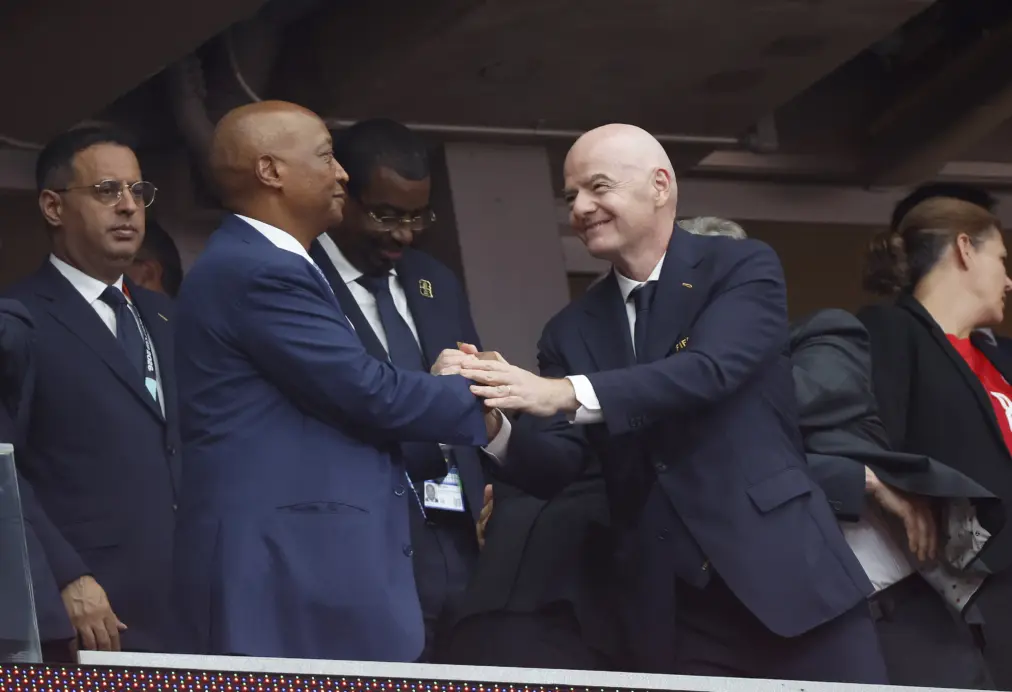
African football faces a difficult choice over Gianni Infantino’s plan to create a commercial arm of FIFA, with the Confederation of African Football (CAF) set to examine the proposal next week despite an open revolt in Europe.
Unlike the other confederations, which have categorically rejected the project, CAF has confirmed that its executive committee will consider it. The decision has placed Africa in an increasingly isolated position within the debate over FIFA’s proposed new commercial structure.
The plan would create a FIFA-owned commercial subsidiary open to private investors. Each federation that joined could receive substantial additional funding, estimated at about $20m.
For smaller federations, that prospect is difficult to dismiss. Said Ali Said Athouman, president of the Comoros Football Federation, told L’Equipe that African associations often operate under financial pressures that are unfamiliar to the biggest European and African nations.
He argued that Africa should not reject the proposal before examining it properly.
“If I had been European, I might not have had this idea. But I live in a different reality,” Athouman said.
His comments reflect the competing pressures facing many African football bodies. Additional funding could have a transformative effect on domestic football and help federations that struggle to meet basic costs. But the proposed investment also raises concerns about independence and the possible influence of commercial interests over sporting decisions.
Athouman acknowledged those dangers. “What we gain in funding, we could lose in autonomy,” he warned.
He is concerned that governments could reduce or withdraw existing subsidies on the assumption that federations would now have enough money. He also fears that private investors could eventually seek to influence sporting decisions in line with their own commercial priorities.
The Comoros president has therefore not closed the door on Infantino’s proposal, but neither has he committed Africa to supporting it. He said he would also be willing to listen to counter-proposals from European football.
That position captures the dilemma confronting African federations: they may be offered a financial package capable of changing the prospects of football in their countries, but accepting it could mean surrendering part of their autonomy to investors whose principal interests are commercial.
Money is not the only concern. Corruption and poor governance across the continent could also lead to some of the funds being diverted from their intended purpose.
As a result, African football does not want either to follow Infantino blindly or automatically adopt UEFA’s position. Instead, it is seeking guarantees over how the scheme would operate and how its money would be protected.
For smaller federations, refusing $20m may appear straightforward in principle. In practice, that decision becomes much harder when they are struggling to pay salaries.
The CAF executive committee’s examination next week could therefore become an important step in determining whether Africa supports the FIFA project, rejects it or seeks changes before making a commitment.
By Louis Mukoma Fargues
-
 Three football bets to consider on 18 October: goals, corners and half-time stalemate Oct 18, 2026
 -
VAR introduction to Betway Premiership could face further delays Oct 18, 2026
-
Ghana’s Black Maidens ready to take on Norway as Joe Nana Adarkwa targets winning World Cup start Oct 18, 2026
-
Lamine Yamal hailed as world’s best player after Barcelona win Oct 17, 2026




-
AFCON 2025: Fixtures, Results, Scores and Standings Jan 18, 2026
-
Match hero Taiwo Awoniyi reflects on team effort after Chelsea triumph May 5, 2026
-
Leadership and long-term vision key to rescuing Zamalek and inspiring Egyptian football – Hany Abou Rida Nov 5, 2025
-
South African giants Orlando Pirates set to lose influential forward Monnapule Saleng Mar 19, 2025




-
Real Betis v Barcelona: kick-off time, TV details and match preview Oct 16, 2026
-
Morocco to face New Zealand as FIFA U-17 Women’s World Cup kicks off in Rabat Oct 16, 2026
-
Roma v Real Madrid: home side tipped to score first in Champions League clash Oct 12, 2026
-
Atletico Madrid v Manchester United: probable line-ups for Champions League clash Oct 12, 2026