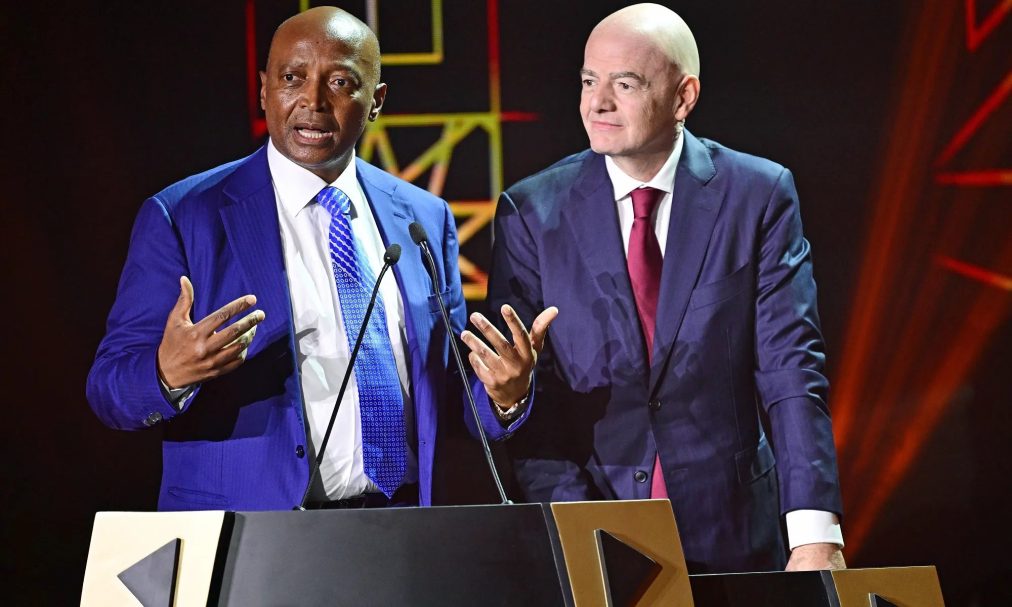
The Confederation of African Football (CAF) has publicly backed Gianni Infantino unanimously for re-election as FIFA president in 2027, but Claude Le Roy says that position does not reflect the views of all African federations.
Speaking on After Foot on RMC, the former international manager questioned the image of a united African bloc behind the Italian-Swiss administrator.
On 8 October, at a strategic conference held in Cape Verde, CAF president Patrice Motsepe reiterated that all 54 African federations offered “unanimous and unconditional support” to Infantino.
The declaration was significant because Africa accounts for 54 of FIFA’s 211 member associations, giving it more than a quarter of the available votes. That makes the continent an important source of support for Infantino, whose position has faced increasing criticism in Europe and North America in recent months.
Le Roy, who has maintained close relationships with many figures in African football over several decades, said a number of African officials did not share the collective position announced by CAF.
His comments directly challenged the governing body’s presentation of complete unity. The claim had already been questioned in May, when journalist Romain Molina reported in an investigation for Sport News Africa that several federations and one regional union had neither approved nor signed a letter supporting Infantino, despite the impression created by CAF’s official communication.
Le Roy’s account does not establish how many federations may ultimately vote against Infantino. It does, however, suggest that CAF’s institutional endorsement may not necessarily determine the individual choices made by its members in the ballot.
The former manager of Cameroon, Senegal, Ghana and the Democratic Republic of the Congo also discussed another important issue facing African football: the frequency of the Africa Cup of Nations.
CAF previously decided to stage the tournament every four years, but recently said it was considering a return to a biennial competition. That change of direction has raised questions about the organisation’s governance.
Le Roy said he had spoken personally to Motsepe about the matter and had argued strongly in favour of retaining a tournament every two years.
“We absolutely have to keep it every two years, because an Africa Cup of Nations every two years means training grounds, regional development and renovated hospitals,” he said. “It means an enormous amount for the African continent.”
With five months remaining before the FIFA presidential election, Le Roy’s comments raise questions over how many of Africa’s 54 federations will actually support Infantino when voting takes place.
-
 Claude Le Roy challenges CAF’s claim of unanimous support for Infantino Oct 16, 2026
 -
Newcastle United v Aston Villa: Nicolas Jackson prominent in weekend betting tips Oct 16, 2026
-
Bayern Munich seek response against RB Leipzig after frustrating week Oct 16, 2026
-
Strasbourg v Paris Saint-Germain: Can the champions extend their winning run? Oct 16, 2026



-
AFCON 2025: Fixtures, Results, Scores and Standings Jan 18, 2026
-
Match hero Taiwo Awoniyi reflects on team effort after Chelsea triumph May 5, 2026
-
Leadership and long-term vision key to rescuing Zamalek and inspiring Egyptian football – Hany Abou Rida Nov 5, 2025
-
South African giants Orlando Pirates set to lose influential forward Monnapule Saleng Mar 19, 2025




-
Roma v Real Madrid: home side tipped to score first in Champions League clash Oct 12, 2026
-
Atletico Madrid v Manchester United: probable line-ups for Champions League clash Oct 12, 2026
-
Celta Vigo v Juventus: Probable line-ups for Europa League encounter Oct 14, 2026
-
Arsenal backed to edge out Lille in Champions League clash Oct 11, 2026