CAF records historic financial boost as interclub investment hits USD 48 million per season
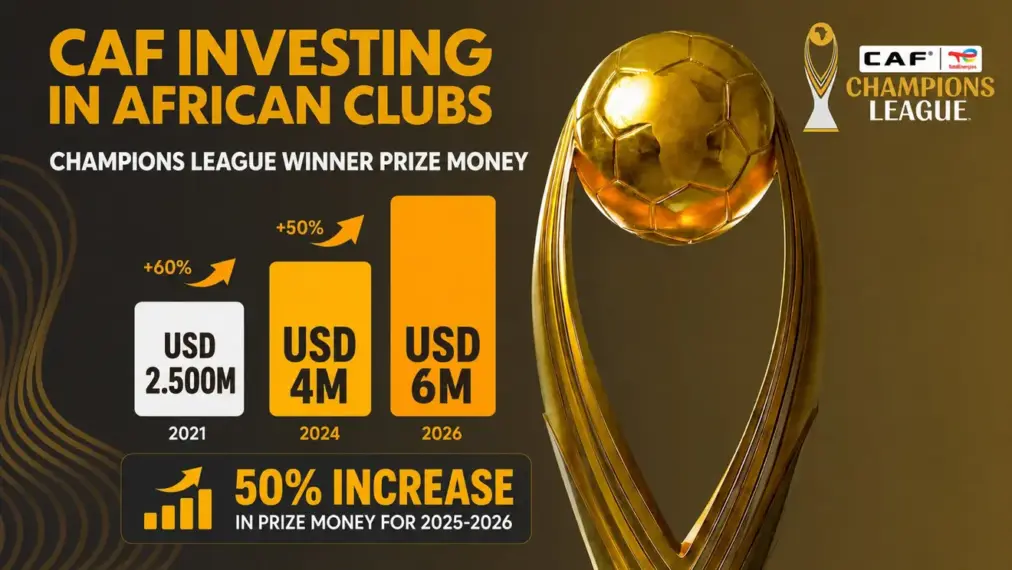
The winner of the TotalEnergies CAF Champions League final between AS FAR and Mamelodi Sundowns will earn a record USD 6 million, a significant rise from just under USD 4 million five years ago.
This sharp increase reflects the sustained expansion of investment by the Confederation Africaine de Football in African club football over the past five years, underlining a broader strategy to elevate the commercial appeal and global competitiveness of its interclub competitions.
CAF’s total funding for interclub tournaments has surged from USD 19 million in 2021 to USD 48 million in 2026—an increase of 153% since Dr Patrice Motsepe assumed the presidency.
The governing body says the growth is part of a long-term transformation programme aimed at strengthening the financial sustainability of African clubs, improving competitiveness, and increasing global visibility for continental competitions.
Alongside the Champions League increase, the winners of the TotalEnergies CAF Confederation Cup will now receive USD 4 million, with enhanced prize money distributed across all stages of both competitions.
CAF has also introduced solidarity payments to support clubs participating in the preliminary rounds, helping to offset travel, accommodation, and operational costs. Initially set at USD 50,000 per club during the 2024/25 season, this figure has doubled to USD 100,000 in the current campaign.
These financial reforms have already contributed to record participation levels, with 62 clubs entering the CAF Champions League and 58 clubs competing in the Confederation Cup this season—both all-time highs.
Total prize money for clubs reaching the Champions League group stage and beyond now stands at USD 19.6 million, while the Confederation Cup prize pool has risen to USD 11.9 million.
CAF says the increased investment has strengthened competitiveness across its interclub competitions, improved club professionalism, and attracted stronger commercial partnerships and broadcast visibility worldwide. The reforms are also designed to create long-term economic opportunities for clubs, players, sponsors, and broadcasters, positioning African club football on a more sustainable growth path
-
 Yan Diomande scores stunning goal as Real Madrid beat RB Leipzig 4-1 Oct 22, 2026
 -
Champions League: Real Madrid and Como win as Bayern Munich and Arsenal draw Oct 22, 2026
-
Inter Milan hold off Shakhtar Donetsk to claim first Champions League win Oct 22, 2026
-
Morocco make futsal history with fourth straight Africa Cup of Nations title Oct 22, 2026



-
AFCON 2025: Fixtures, Results, Scores and Standings Jan 18, 2026
-
Match hero Taiwo Awoniyi reflects on team effort after Chelsea triumph May 5, 2026
-
Leadership and long-term vision key to rescuing Zamalek and inspiring Egyptian football – Hany Abou Rida Nov 5, 2025
-
South African giants Orlando Pirates set to lose influential forward Monnapule Saleng Mar 19, 2025




-
PSG v Barcelona: fiery attacks set up Champions League classic at Parc des Princes Oct 18, 2026
-
Champions League: PSG beat Barcelona as Liverpool complete comeback against Villarreal Oct 20, 2026
-
Real Betis v Barcelona: kick-off time, TV details and match preview Oct 16, 2026
-
PSG beat Barcelona 4-2 in Champions League thriller Oct 21, 2026