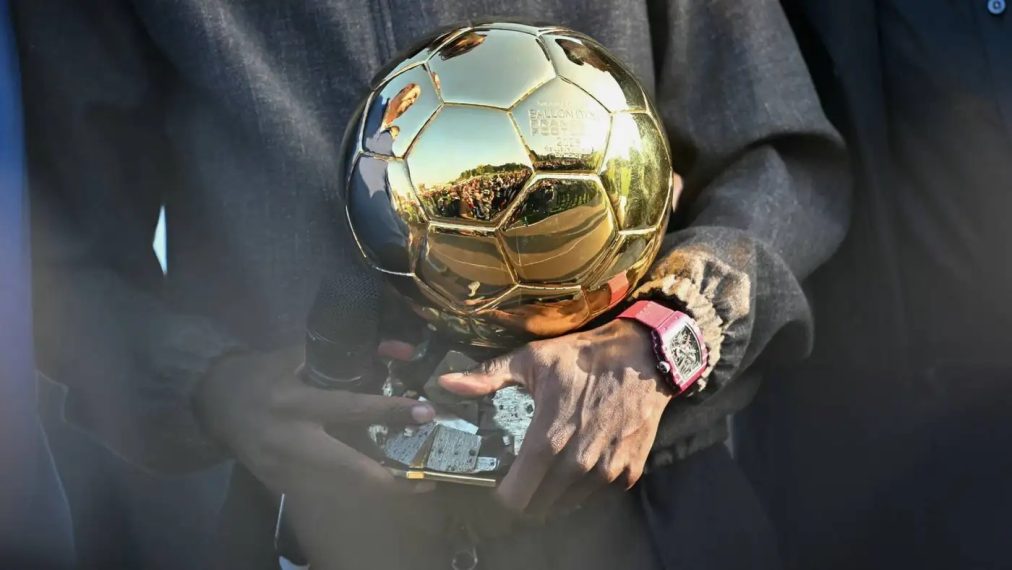
The 70th Ballon d’Or ceremony will take place in London on Monday, 26 October 2026, with the event broadcast on DAZN and streamed live through Kooora. The ceremony begins at 21:00 Saudi Arabia time and 22:00 UAE time.
The 2026 edition will be the fifth in the award’s history to assess players over a complete football season rather than a calendar year. The official assessment period runs from 3 August 2025 to 19 July 2026.
The ceremony, being held in the British capital for the first time, will reveal the successor to Ousmane Dembele, who won the 69th edition in 2025.
Alongside the men’s Ballon d’Or, the event will include awards for the world’s best goalkeeper, recognised by the Yashin Trophy, the best young player through the Kopa Trophy, the best manager and the best club. Further awards will also honour leading performers from the season.
What is the Ballon d’Or?
Organised by French magazine France Football since 1956, the Ballon d’Or is widely regarded as football’s leading individual award. The idea was created by sports writers Gabriel Hanot and Jacques Ferran, with the winner originally selected by a vote among specialist journalists.
Initially known as the European Footballer of the Year, the award was restricted to European players. That rule prevented players such as Pele and Diego Maradona from winning it. In 1995, eligibility was extended to players of every nationality who were playing for European clubs. George Weah became the first non-European winner that year.
The award became fully international in 2007, when players from every league became eligible and national-team captains and coaches joined journalists in the voting process. France Football later partnered with FIFA from 2010 to 2015, combining the awards under the name FIFA Ballon d’Or. The agreement ended in 2016, when France Football restored the Ballon d’Or and FIFA launched The Best.
In 2022, the magazine changed the judging period from the calendar year to the full European football season. The voting panel was also revised to include one journalist from each of the top 100 nations in the FIFA rankings. In 2024, France Football began a partnership with UEFA, while retaining control of the Ballon d’Or trademark and voting system.
The Ballon d’Or record holders
Lionel Messi leads the all-time standings with eight wins, achieved in 2009, 2010, 2011, 2012, 2015, 2019, 2021 and 2023. Cristiano Ronaldo is second with five victories, in 2008, 2013, 2014, 2016 and 2017.
Johan Cruyff, Michel Platini and Marco van Basten each won three times. Franz Beckenbauer, Ronaldo, Alfredo Di Stefano, Kevin Keegan and Karl-Heinz Rummenigge each claimed the award twice.
The complete record of first-, second- and third-place finishes is:
– Lionel Messi: first 8, second 5 (2008, 2013, 2014, 2016, 2017), third 1 (2007). – Cristiano Ronaldo: first 5, second 6 (2007, 2009, 2011, 2012, 2015, 2018), third 1 (2019). – Michel Platini: first 3 (1983, 1984, 1985), third 2 (1977, 1980). – Johan Cruyff: first 3 (1971, 1973, 1974), third 1 (1975). – Marco van Basten: first 3 (1988, 1989, 1992). – Franz Beckenbauer: first 2 (1972, 1976), second 2 (1974, 1975), third 1 (1966). – Ronaldo: first 2 (1997, 2002), second 1 (1996), third 1 (1998). – Alfredo Di Stefano: first 2 (1957, 1959), second 1 (1956). – Kevin Keegan: first 2 (1978, 1979), second 1 (1977). – Karl-Heinz Rummenigge: first 2 (1980, 1981), second 1 (1979).
Players with one victory include Luis Suarez (1960), Eusebio (1965), Bobby Charlton (1966), Raymond Kopa (1958), Gerd Muller (1970), Zinedine Zidane (1998), Gianni Rivera (1969), Ruud Gullit (1987), Lothar Matthaus (1990), Roberto Baggio (1993), Hristo Stoichkov (1994), Andriy Shevchenko (2004), George Best (1968), Allan Simonsen (1977), Ronaldinho (2005), Stanley Matthews (1956), Omar Sivori (1961), Josef Masopust (1962), Lev Yashin (1963), Denis Law (1964), Florian Albert (1967), Oleg Blokhin (1975), Paolo Rossi (1982), Igor Belanov (1986), Jean-Pierre Papin (1991), George Weah (1995), Matthias Sammer (1996), Rivaldo (1999), Luis Figo (2000), Michael Owen (2001), Pavel Nedved (2003), Fabio Cannavaro (2006), Kaka (2007), Luka Modric (2018), Karim Benzema (2022), Rodri (2024) and Ousmane Dembele (2025).
-
 Botswana name squad for Uganda double-header in 2027 AFCON qualifiers Oct 26, 2026
-
Negelle Arsi edge Adama Kenema 1-0 as P. Eboussi decides Ethiopia Premier League clash Oct 26, 2026
-
Kedus Giorgis 2-2 Sheger Ketema: Abdo and Fikru strikes earn thrilling Ethiopia Premier League draw Oct 26, 2026
-
Ghana President John Mahama backs Ethiopia’s 2028 AFCON bid after inspecting Bahir Dar Stadium Oct 26, 2026



-
AFCON 2025: Fixtures, Results, Scores and Standings Jan 18, 2026
-
Match hero Taiwo Awoniyi reflects on team effort after Chelsea triumph May 5, 2026
-
Leadership and long-term vision key to rescuing Zamalek and inspiring Egyptian football – Hany Abou Rida Nov 5, 2025
-
South African giants Orlando Pirates set to lose influential forward Monnapule Saleng Mar 19, 2025




-
Barcelona v Real Madrid: Catalans backed at 1.65 to win October Clasico Oct 23, 2026
-
Barcelona and Real Madrid meet in pivotal 265th Clasico Oct 23, 2026
-
Champions League: PSG beat Barcelona as Liverpool complete comeback against Villarreal Oct 20, 2026
-
Inter Milan v Fiorentina: probable line-ups for San Siro clash Oct 24, 2026