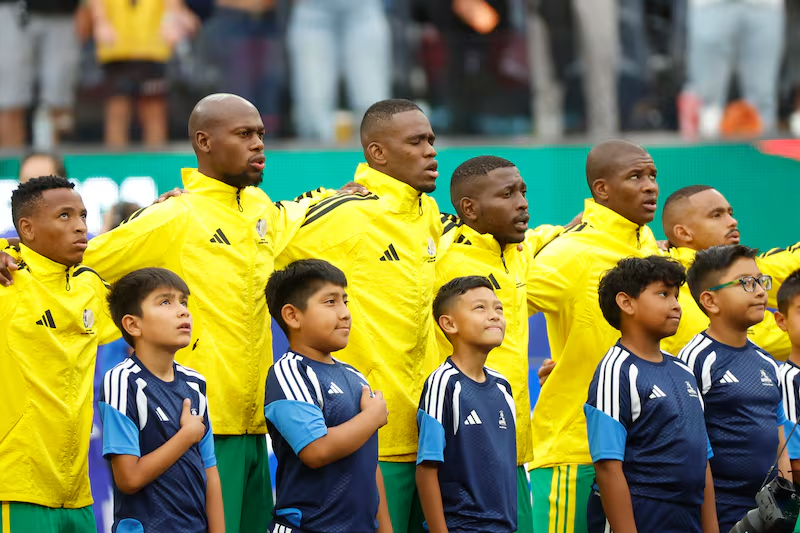
The SA Football Players Union (Safpu) believes Bafana players should receive 50% of the bonus South Africa’s national team is set to generate from the 2026 Fifa World Cup.
The union is challenging the distribution model proposed by the SA Football Association (Safa), which is due to receive $12m (R191m) for Bafana’s participation at the tournament in North America.
Under the current arrangement, 20% of the money would go to the coaching staff, 30% to the players and the remaining 50% would be retained by Safa.
Safpu secretary-general Nhlanhla Shabalala says that split does not fairly reflect the contribution made by the players, who he says carried out the “hard yards” during the showpiece event.
“The discussion in the 21st century must be such that whatever we bring, 50% of that money must be enjoyed by the people who did the hard labour. I think 50% is very fair.”
Shabalala acknowledged that Safa has responsibilities to support the wider development of football, but argued that players should not be left with only a minority share of the money generated by their performances.
“We know there are many responsibilities that the money has to cater for, including football growth. But the discussion cannot be that ‘I’m bringing all the money, but I’m getting 30% and the rest of the money goes elsewhere’.
“Then I’m just working to develop things that are not a part of my responsibility. The playing field must be level when it comes to this. It’s exploitation, this thing we are talking about, where you are still given the low-lying fruits.”
The union also questioned whether the players had been given a complete explanation of what their proposed 30% allocation would actually mean once tax obligations had been applied.
Shabalala said the players could be left with as little as R1m in their bank accounts after international and local taxes were deducted. He argued that players and those negotiating on their behalf should insist on a different arrangement.
“The players are not negotiators by nature. When you tell me that I’m going to get R2.5m as a bonus, you need to explain all the advantages and disadvantages of that because right now we’re talking international tax that must be imposed on that money,” said Shabalala.
“So, if you look at this R2.5m holistically, the likelihood is that players will be very lucky if R1m reaches their bank accounts.
“Now, if players knew and had this information before the negotiations, holistically providing them with all the information, I don’t think they would have agreed to R2.5m.
“We believe that sometimes these engagements are not taking place in good faith because not all the information is received and understood by the players, better yet, the committee that goes and engages with Safa.
“With Safa, we believe they have not been truly transparent in terms of the pros and cons of whatever has to happen to the tournament prize money.”
Shabalala’s comments come ahead of this weekend’s Safa presidential election, in which Safpu is supporting Sandile Zungu against incumbent Danny Jordaan.
The union says its backing for Zungu is based on a desire for change and new ideas at the association. Shabalala believes the current operating model is no longer effective and that Zungu would offer an alternative approach.
“The stance that we are taking is that we need change at Safa. The model they’ve been moving with is really not operative and Zungu is offering an alternative.
“Zungu has performed well at AmaZulu,” said Shabalala. “He has turned it into a formidable team, he’s a strong businessman and he’s also strong on issues of governance, which we believe he will bring because that’s one of the key letdowns for Safa.
“Sometimes these fresh ideas that we need come from people like Zungu. People might want to look at his profile and want to discredit him, but look at how things are deteriorating with Safa. We need innovative minds.
“We need people who will put players first and actually ensure that the game has dignity, footballers are respected and remunerated, and that women footballers are respected and professionalised,” said Shabalala.
-
 Senegal and Morocco adopt contrasting strategies ahead of CAN 2025 final hearing Oct 8, 2026
 -
Senegal v Morocco: CAS hearing over 2025 Africa Cup of Nations final set for Thursday Oct 8, 2026
-
ALG: Riyad Mahrez bids farewell to Al-Ahli Oct 8, 2026
-
ALG: Noufel Khacef leaves CR Belouizdad for Al-Ahly Benghazi Oct 8, 2026



-
AFCON 2025: Fixtures, Results, Scores and Standings Jan 18, 2026
-
Match hero Taiwo Awoniyi reflects on team effort after Chelsea triumph May 5, 2026
-
Leadership and long-term vision key to rescuing Zamalek and inspiring Egyptian football – Hany Abou Rida Nov 5, 2025
-
South African giants Orlando Pirates set to lose influential forward Monnapule Saleng Mar 19, 2025




-
Croatia face Spain with Nations League hopes on the line in Split Oct 5, 2026
-
France v Belgium: Probable line-ups for Nations League clash Oct 3, 2026
-
Morocco coach Mohamed Ouahbi refuses to single out player after Mali draw Oct 4, 2026
-
Noussair Mazraoui leaves Morocco squad early after injury Oct 2, 2026