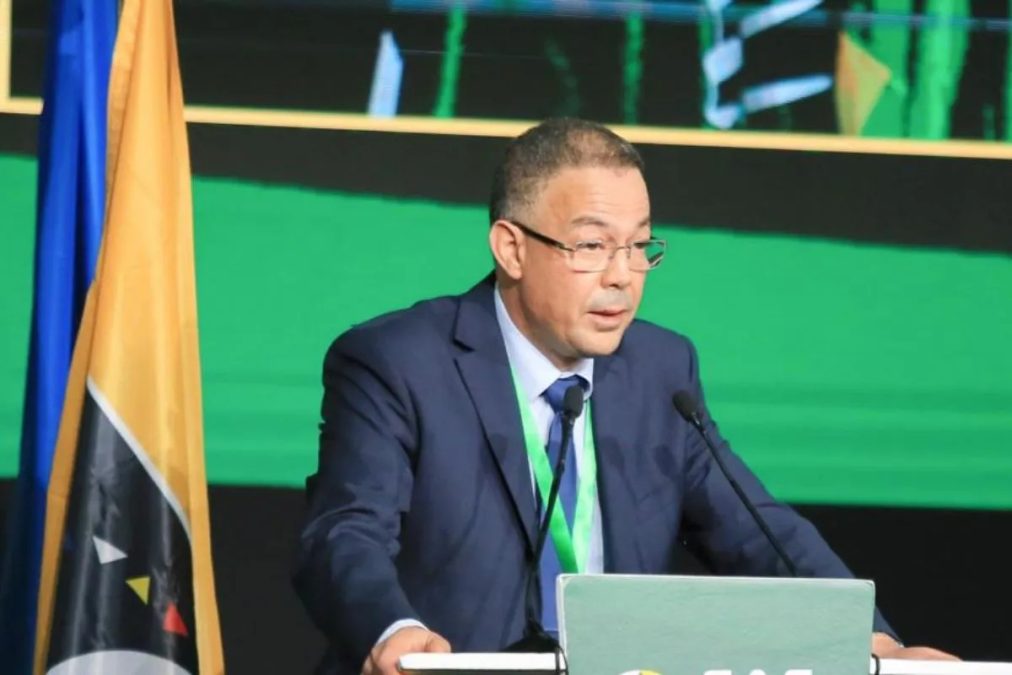
Fouzi Lekjaa is expected to remain president of the Royal Moroccan Football Federation (FRMF) after being appointed Morocco’s new minister of Economy, Finance and Public Performance.
Lekjaa, who had served as delegated minister responsible for the Budget since 2021, was given the new role on Friday as part of the country’s new government.
The appointment underlines the growing confidence placed in him by King Mohammed VI and marks another step in the rise of a figure whose influence now extends across Morocco’s sporting, political and economic spheres.
Despite the increased demands of his ministerial position, Lekjaa is not expected to leave his role in Moroccan football. According to journalist Izem Anass, he will continue as president of the FRMF.
His expanded responsibilities could instead allow him to bring together his political and sporting influence ahead of the 2030 World Cup, which Morocco will co-host with Spain and Portugal.
A central objective for the Moroccan government is to stage the final of the tournament. The country’s bid is based around the Grand Stade Hassan II, currently under construction in Benslimane, near Casablanca.
That stadium is competing with the Santiago Bernabeu in Madrid to host the final. FIFA has not yet announced its decision.
Lekjaa’s responsibilities also extend to the international game. The 56-year-old is first vice-president of the Confederation of African Football (CAF), while also serving as chairman of the CAF finance committee.
He is vice-president of the committee responsible for organising inter-club competitions and managing the club licensing system. In addition, he is a member of the FIFA Council.
His growing role in government follows a 12-year period in which he has become a central figure in Moroccan football. His work in the sport has been credited with helping place Morocco on the world football map, while also making him an important figure in the country’s soft-power strategy.
The decision to retain him at the head of the FRMF means he will continue to oversee Moroccan football while taking charge of the country’s economic and financial affairs.
It also leaves him in position to play a key part in preparations for the 2030 World Cup, including Morocco’s ambition to host the tournament’s final.
-
 Fouzi Lekjaa to remain at FRMF despite promotion to Moroccan finance minister Oct 16, 2026
 -
CAF Confederation Cup: AS Douanes vs CR Belouizdad postponed following CAS directive Oct 16, 2026
-
Barcelona identify Bournemouth striker Eli Junior Kroupi as 2027 target Oct 16, 2026
-
Chelsea close in on Strasbourg winger Gessime Yassine Oct 16, 2026



-
AFCON 2025: Fixtures, Results, Scores and Standings Jan 18, 2026
-
Match hero Taiwo Awoniyi reflects on team effort after Chelsea triumph May 5, 2026
-
Leadership and long-term vision key to rescuing Zamalek and inspiring Egyptian football – Hany Abou Rida Nov 5, 2025
-
South African giants Orlando Pirates set to lose influential forward Monnapule Saleng Mar 19, 2025




-
Real Betis v Barcelona: kick-off time, TV details and match preview Oct 16, 2026
-
Roma v Real Madrid: home side tipped to score first in Champions League clash Oct 12, 2026
-
Atletico Madrid v Manchester United: probable line-ups for Champions League clash Oct 12, 2026
-
Celta Vigo v Juventus: Probable line-ups for Europa League encounter Oct 14, 2026