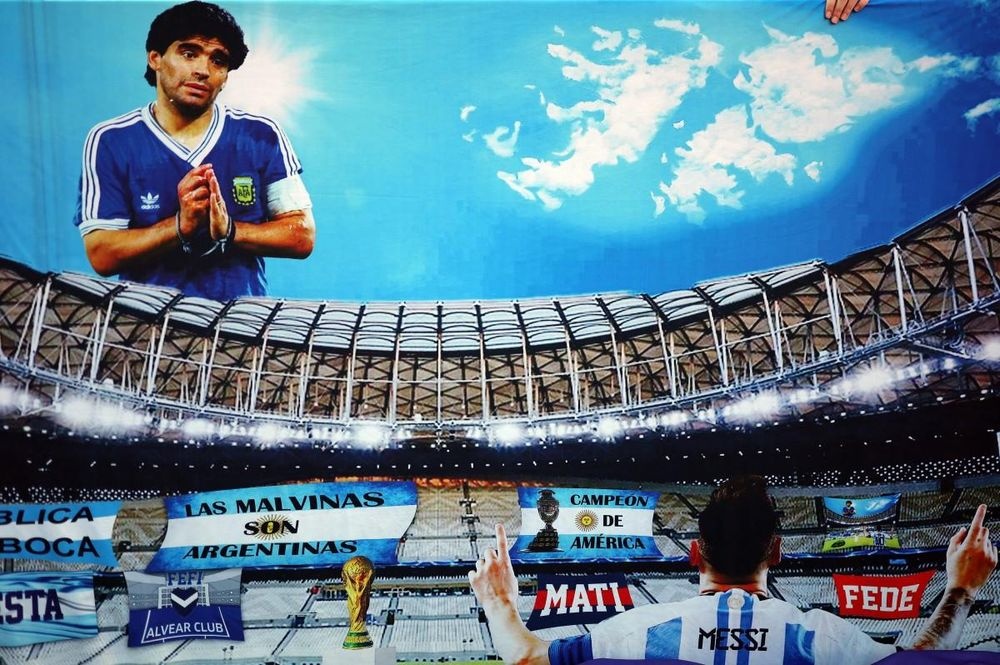
As Lionel Messi and Cristiano Ronaldo approach the end of their international careers, Diego Maradona remains the greatest footballer ever for many fans who grew up watching him, writes Rodney Reiners.
Messi’s international retirement ended an extraordinary career in emotional fashion, with the 39-year-old Argentina captain receiving a farewell in front of more than 85 000 supporters in Buenos Aires.
Ronaldo, 41, was experiencing a contrasting moment with Portugal after leaving the national camp following a dispute with the coach. Their differing circumstances have renewed debate about where the two modern greats sit in football history.
For me, however, both would have to wait behind Maradona.
That is not an attempt to dismiss Messi or Ronaldo. The choice between generations is shaped by when and how people experienced the game. Those who watched Messi or Ronaldo grow up with their achievements will naturally attach greater importance to them, just as people who saw Maradona in the 1980s are influenced by his performances, his cultural impact and the era in which they took place.
My own football education began without television. In a working-class neighbourhood affected by apartheid, children gathered at local homes, paid a few cents and watched films on old projector reels. While some preferred Bruce Lee or John Wayne, football-mad youngsters went elsewhere to watch international and English games.
Television arrived in South Africa in 1976. Two years later, I watched my first World Cup final on a black-and-white set and saw Argentina’s Mario Kempes. His brilliance, though, ultimately led towards the player who became my footballing god: Maradona.
Garrincha, Pele, Johan Cruyff, Franz Beckenbauer, Ronaldo Luis Nazario de Lima, Lothar Matthaus, Zinedine Zidane, Thierry Henry, Messi and Ronaldo all belong among football’s greats. Maradona, though, had a unique ability to make people feel something.
As football became more tactical and physical, he combined technique, imagination and personality in ways opponents struggled to contain. His balance and low centre of gravity allowed him to absorb challenges, change direction, burst through gaps and remain on his feet.
He could control an entire match: demanding possession, carrying the ball forward, creating opportunities, scoring and drawing several defenders to open space for team-mates.
The 1986 Fifa World Cup remains the clearest example. Maradona almost single-handedly inspired Argentina to victory. He had a similar effect at Napoli, transforming the club into a force in Italian football. Napoli had never won Serie A before his arrival, but lifted the title in 1987 and 1990, as well as other major honours. In Naples, he became a symbol of hope, pride and identity.
Maradona was also less polished and more openly human than many modern sporting icons. He showed emotion, challenged authority and acknowledged his flaws. His imperfections made him relatable and demonstrated that greatness did not require perfection.
Messi’s quiet brilliance and Ronaldo’s discipline, ambition and confidence appeal powerfully to today’s generation, particularly in an age of social media and personal branding. Maradona represented something different: extraordinary talent combined with a common-man identity, shaped by poverty, triumph and unpredictability.
In 2017, Liverpool’s John Barnes gave me a three-word answer when I asked him at Cape Town’s Kelvin Grove Club to name football’s greatest player: “Maradona, Maradona, Maradona.”
For Baby Boomers, the past remains part of the present. In the words of Highlander: “There can be only one.”
Maradona.
-
 Lens and Sporting CP set for Champions League meeting at Stade Bollaert-Delelis Oct 12, 2026
 -
Four Raja players threaten to leave amid disputes over Rogerio Matias’ policy Oct 12, 2026
-
Mehdi Benatia faces competition from four other candidates for AC Milan job Oct 12, 2026
-
Morocco midfielder Amine Harit scores as Marseille end losing run with win at Troyes Oct 12, 2026



-
AFCON 2025: Fixtures, Results, Scores and Standings Jan 18, 2026
-
Match hero Taiwo Awoniyi reflects on team effort after Chelsea triumph May 5, 2026
-
Leadership and long-term vision key to rescuing Zamalek and inspiring Egyptian football – Hany Abou Rida Nov 5, 2025
-
South African giants Orlando Pirates set to lose influential forward Monnapule Saleng Mar 19, 2025




-
Croatia face Spain with Nations League hopes on the line in Split Oct 5, 2026
-
Manchester United host winless Tottenham in Premier League clash Oct 7, 2026
-
Real Madrid fitness update: Valverde a doubt for Villarreal as Kylian Mbappe returns Oct 8, 2026
-
Lens v Lyon: Can the in-form visitors extend their unbeaten Ligue 1 run? Oct 6, 2026