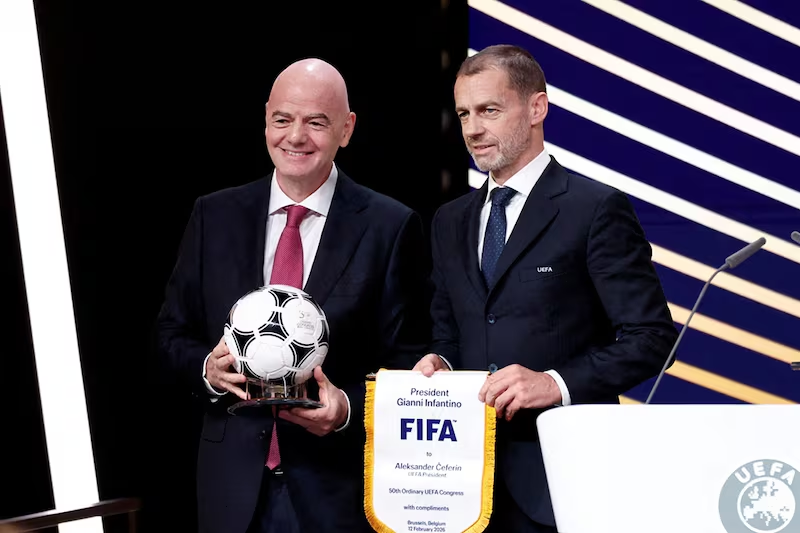
FIFA has accused UEFA of running a “misinformation campaign” designed to influence its presidential election as it urged a US court to reject a legal request linked to an abandoned commercial investment plan.
UEFA last month asked a federal court in the United States to obtain documents and testimony for a proposed criminal complaint in Switzerland against FIFA president Gianni Infantino. The case concerns a plan to transfer World Cup commercial rights to a subsidiary, FIFA Forward Enterprise (FFE).
In a filing to the Southern District of Florida, FIFA said UEFA had made “numerous false or misleading statements about FIFA and Infantino”.
“With no basis whatsoever, UEFA suggests that Mr Infantino sought to profit personally from the FFE proposal,” FIFA said.
It added that the plan would have required approval from FIFA’s member associations and Council, with both bodies overseeing FFE.
“UEFA’s suggestions that Mr Infantino violated any law or ethical principle are categorically without merit,” FIFA said. UEFA declined to comment.
UEFA has alleged that Infantino developed the proposal secretly with a small group of advisers and investors, while bypassing FIFA’s normal governance procedures and failing to consult the Council, continental confederations or member associations.
Its application sought discovery from FIFA (AMERICAS), Inc and FWC2026 US, Inc, two FIFA entities based in Florida. UEFA said investors would have paid $4.2bn for a stake in FFE, valuing the business at about $20bn, and argued that amount significantly undervalued FIFA’s commercial rights.
It also said the proposal had not been subject to an open auction or independent valuation.
FIFA rejected that assessment, saying UEFA had confused equity value with enterprise value. It said FFE’s initial equity valuation was $20bn, while documents sent to member associations put its total enterprise value at well over $30bn.
FIFA said the enterprise value was more than twice the equity value and “far above the value UEFA says would be fair”.
The project was abandoned in July after opposition from UEFA, Concacaf and the Asian Football Confederation over the lack of consultation. The dispute led to renewed calls for changes to FIFA’s governance.
Last week, Infantino wrote to FIFA’s 211 member associations proposing an independent review of the organisation’s decision-making processes. The Swiss administrator is seeking re-election in March, and FIFA said UEFA’s court filings were intended to affect that contest.
“Just before FIFA’s election, UEFA filed this 1782 Application [and three others] spreading misinformation regarding Mr Infantino,” FIFA said, urging the court not to allow the election to be influenced.
Funding review
Infantino has also ordered an assessment of proposals for increased payments to national associations. UEFA and Concacaf have requested a $2.1bn distribution from FIFA’s reserves.
In a letter to the six confederation presidents, Infantino said the assessment would be presented to the FIFA Council on October 15. Any additional funding would require financial checks and formal approval.
“Until the assessment and necessary approvals are complete, no preliminary figure can be treated as an approved commitment to the Member Associations,” he wrote.
UEFA president Aleksander Ceferin and Concacaf president Victor Montagliani have proposed that each of FIFA’s 211 members receive at least $10m during the 2027-30 cycle, alongside existing development funding. They have also called for an independent review of FIFA’s reserves.
Their September 18 letter said reserves could reach about $6bn at the end of 2026 and argued that the proposed payments would still leave more than $1.5bn throughout the following cycle.
Infantino defended the abandoned commercial plan, saying it was intended to generate funding beyond what FIFA could distribute from existing resources.
“The recent commercial proposal, now withdrawn, was intended to enable FIFA to invest more in football not to replace support that could responsibly be provided from existing resources,” he said. “So, it would actually have been on top of it.”
The FIFA Council will consider the amount and timing of any additional payments, the reserves needed to protect FIFA’s obligations and independence, and the eligibility, reporting and audit conditions. The review will also examine support for confederations facing demonstrable structural costs.
If enough evidence is available, a recommendation will be made on October 15. If not, the Council will approve “the shortest reasonable timetable” for completing the work.
-
 Benjamin Asare starts for Ghana against Gambia in crucial AFCON 2027 qualifier Sep 29, 2026
 -
Nigeria name starting XI for Guinea-Bissau clash in 2027 Africa Cup of Nations qualifying Sep 29, 2026
-
Morocco beat Lesotho 2-0 to make it two wins from two in Africa Cup of Nations 2027 qualifying Sep 29, 2026
-
CAN 2027 qualifiers: Algeria fight back from two-goal deficit to draw with Burundi Sep 29, 2026




-
AFCON 2025: Fixtures, Results, Scores and Standings Jan 18, 2026
-
Leadership and long-term vision key to rescuing Zamalek and inspiring Egyptian football – Hany Abou Rida Nov 5, 2025
-
Match hero Taiwo Awoniyi reflects on team effort after Chelsea triumph May 5, 2026
-
South African giants Orlando Pirates set to lose influential forward Monnapule Saleng Mar 19, 2025




-
AFCON 2027 qualifiers: Algeria, Morocco and Nigeria among winners on opening matchday Sep 26, 2026
-
AFCON 2027 qualifiers: Burkina Faso held by Benin in Group F Sep 25, 2026
-
South Sudan vs Egypt: Where to watch AFCON 2027 qualifier Sep 29, 2026
-
Egypt lose defender Mohamed Abdel Moneim for South Sudan AFCON qualifier Sep 27, 2026