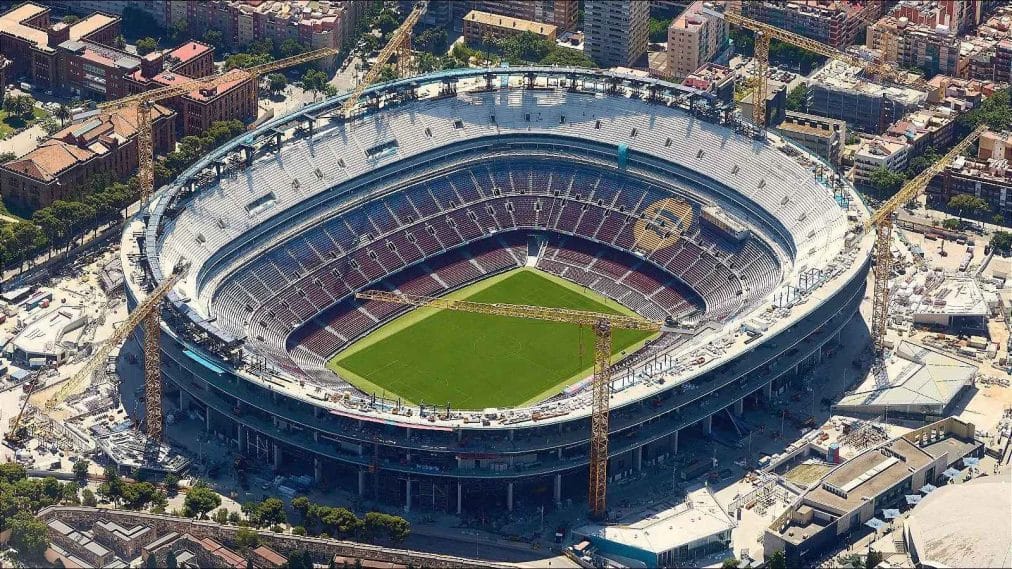
Barcelona have arranged up to 510 million euros in additional financing to help complete the delayed redevelopment of Camp Nou and offset lost income caused by the project’s setbacks.
The Spanish champions will raise the money through two separate debt agreements. Financing will support the remaining stadium work, while also helping the club manage a revenue shortfall resulting from delays to the redevelopment.
A project-finance loan of 300 million euros will be secured against the stadium’s existing securitisation structure. It will be repaid using future income generated at Camp Nou, including revenue from the new VIP hospitality areas, and will run for 30 years.
The debt will be backed by future stadium earnings rather than Barcelona’s wider assets. The club has already held discussions with prospective investors, with Goldman Sachs overseeing the process.
Barcelona will also raise up to 210 million euros through senior debt secured against future television income from La Liga and UEFA competitions.
That funding will be issued through two media note deals worth 105 million euros each. The first was completed in July, while the second is expected to be issued before the end of 2026. The arrangement has a 10-year maturity and is intended to ease the cash-flow pressures created by the delays at Camp Nou.
Work on the stadium began in 2023 and was initially scheduled for completion in 2026. Once finished, the redeveloped ground will have a roof covering the entire stadium and a capacity of about 105,000.
However, Barcelona vice-president Ferran Olive told the club’s general assembly that the complete project would not be finished until the 2028-29 season.
The club are expected to remain at the Olympic Stadium in Montjuic for the first half of the 2027-28 season while the Camp Nou roof is completed. Olive said Barcelona’s budget is based on a return to their home stadium in January 2028, although the reopening could take place sooner.
Olive and club president Joan Laporta have attributed the increased costs and delays to several factors, including the war in Ukraine, broader economic conditions, higher prices and problems affecting supply chains.
-
 Marseille captain Timothy Weah handed one-match ban after PSG red card Sep 24, 2026
 -
South African teenager Mogamat Ashan Andrews on trial at Danish club Holbæk Sep 24, 2026
-
Solomon Letsoenyo weighs North Africa move after TS Galaxy departure Sep 24, 2026
-
Thembelani Majingo seeks career revival after joining Township Rollers Sep 24, 2026




-
AFCON 2025: Fixtures, Results, Scores and Standings Jan 18, 2026
-
Leadership and long-term vision key to rescuing Zamalek and inspiring Egyptian football – Hany Abou Rida Nov 5, 2025
-
Match hero Taiwo Awoniyi reflects on team effort after Chelsea triumph May 5, 2026
-
South African giants Orlando Pirates set to lose influential forward Monnapule Saleng Mar 19, 2025




-
Atletico Madrid vs Real Madrid: Derby date, kick-off time and where to watch Sep 18, 2026
-
Atletico Madrid v Real Madrid: Mbappe backed to score in key La Liga derby Sep 17, 2026
-
Marseille face PSG in Ligue 1’s latest Classique: kick-off time, TV details and form guide Sep 19, 2026
-
Relebohile Mofokeng scores first Europa League goal for Union Saint-Gilloise Sep 17, 2026