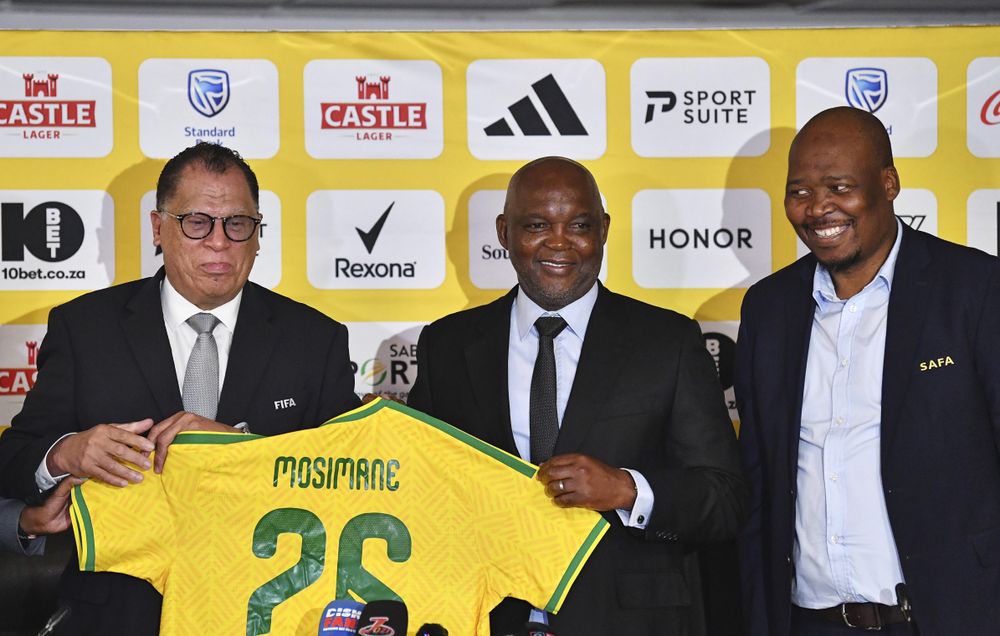
Pitso Mosimane has returned to lead Bafana Bafana for a second spell, but his appointment comes as South African football prepares for one of the most fiercely contested SAFA elections in years.
The new head coach was unveiled alongside SAFA president Danny Jordaan and his deputy, Linda Zwane. His return came a month after he was endorsed by the organisation’s NEC, the body that votes during elections and plays a major role in determining the direction of South African football.
Mosimane will now have to prepare Bafana for the 2027 Africa Cup of Nations qualifying campaign while the association enters a period of considerable political uncertainty.
Jordaan and Sandile Zungu will contest the SAFA presidency on Saturday, with Zungu’s campaign increasingly framing the vote as a choice over governance, accountability and the future direction of the game in South Africa.
Mosimane has no control over the outcome of that contest, but he can decide where his team’s focus lies.
That focus must be on football.
He returns at an awkward moment. Mosimane was appointed after Hugo Broos left following the 2026 World Cup, where Bafana reached the knockout stages for the first time. The achievement has raised expectations around the national team, giving Mosimane a stronger platform but also increasing the pressure on him to maintain that progress.
While he works towards the next qualifying campaign, the administration around the team could be reshaped by the SAFA election. That creates the risk of Bafana becoming caught up in a power struggle that has little to do with results on the pitch.
Mosimane has already begun putting his own structure in place. He brought in trusted figures Kabelo Rangoaga and Musi Matlaba before adding Morena Ramoreboli as his assistant.
His immediate task is to make that technical team effective, settle on a clear playing philosophy and identify the players capable of carrying Bafana into the next phase after the World Cup.
There is little benefit in the coach becoming another participant in SAFA’s political drama. The demands of his job are already substantial: he must build a competitive side, preserve the momentum created by Bafana’s historic World Cup campaign and ensure the team continues to improve.
That does not mean Mosimane can ignore events within the association. SAFA’s administration has a direct effect on his work, including contracts, preparation, travel, player welfare, facilities and the relationship between the national team and the organisation that runs it.
The important distinction will be between understanding those issues and becoming consumed by them.
That distinction is particularly important as the election campaign grows more heated. Zungu has accused the Jordaan camp of using “dirty tricks” against regions supporting his campaign, adding to the tension ahead of Saturday’s vote.
Mosimane should remain outside that dispute. The politics matter because they affect the environment in which Bafana operate, but the national team’s performance must remain the priority.
His return will ultimately be judged not by whether he wins an argument in the SAFA boardroom, but by whether he can build a side capable of winning football matches.
The first test is approaching, with Guinea and Eritrea awaiting Bafana in the 2027 Africa Cup of Nations qualifying campaign.
Mosimane has come back to the national team with significant expectations on his shoulders. His challenge is to ensure that the noise surrounding SAFA does not cross the dressing-room door.
-
 David Akintola: Nigeria winger joins Omonia Nicosia from Hull City Sep 10, 2026
 -
Al-Qwarah sign Saudi Arabia and Central African Republic midfielder Amjad Hawsawi Sep 10, 2026
-
Morocco goalkeeper Abdelali Mhamdi returns to KACM Marrakech on free transfer Sep 10, 2026
-
Ghanaian midfielder Dixon Mohammed joins Hapoel Afula from Maccabi Haifa on loan Sep 10, 2026




-
AFCON 2025: Fixtures, Results, Scores and Standings Jan 18, 2026
-
Leadership and long-term vision key to rescuing Zamalek and inspiring Egyptian football – Hany Abou Rida Nov 5, 2025
-
South African giants Orlando Pirates set to lose influential forward Monnapule Saleng Mar 19, 2025
-
Full schedule for 2025 Africa Cup of Nations in Morocco confirmed Feb 12, 2025




-
PSG v Monaco: Where to watch Friday’s Ligue 1 clash and why the visitors feel confident Sep 3, 2026
-
Al-Ittihad turn to Morocco’s Chemsdine Talbi after failed Anis Hadj Moussa move Sep 3, 2026
-
Inter Milan v SSC Napoli: draw tipped in closely matched Serie A meeting Sep 3, 2026
-
Orlando Pirates backed to overcome La Cure Sylvester in CAF Champions League opener Sep 4, 2026