Lionel Messi’s six defining moments with Argentina, from first cap to World Cup glory
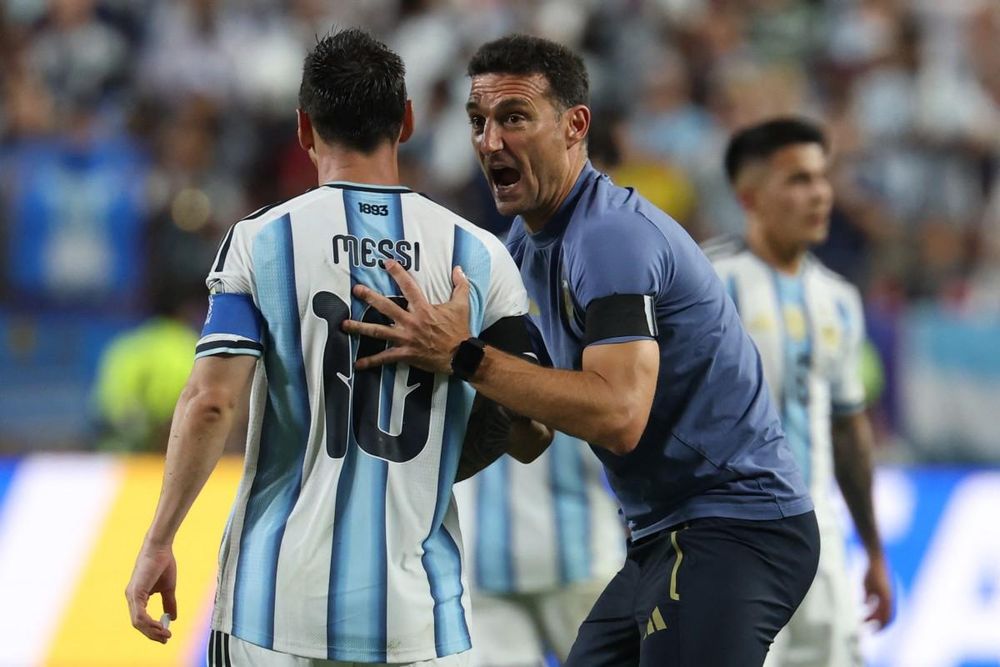
Lionel Messi’s international career contained an extraordinary mixture of early disappointment, repeated final defeats and, ultimately, major tournament success, as the Argentina captain became one of the defining figures in his country’s football history.
Messi announced his retirement from international football on Monday, six weeks after Argentina’s defeat in the World Cup final. His career for his country spanned more than two decades and included over 200 appearances.
His first Argentina cap came in 2005, when he was an 18-year-old with a fresh-faced reputation and a huge future ahead of him. It was an inauspicious debut. Messi lasted only 90 seconds after coming on as a substitute against Hungary in Budapest before being sent off for an elbow, according to the referee.
A year later, he made his World Cup debut in Argentina’s opening match of the 2006 tournament in Germany. Coming off the bench during a 6-0 victory over Serbia and Montenegro, Messi scored his side’s final goal in Gelsenkirchen. It was the first appearance and goal of what became a remarkable World Cup story.
By the time Argentina travelled to Brazil in 2014, Messi was 26 and already regarded as one of the world’s finest players because of his achievements with Barcelona. His international career, however, had already been marked by frustration.
Argentina had been eliminated by Germany in the quarter-finals of the 2006 World Cup and suffered the same fate at the 2010 tournament in South Africa, where Diego Maradona was manager. There had also been defeat by Brazil in the 2007 Copa America final and a disappointing campaign at the 2011 Copa America on home soil.
As captain of Alejandro Sabella’s side in Brazil, Messi scored in each of Argentina’s three group matches. His goals then stopped, but he helped his team reach their first World Cup final since the era of Maradona. Germany ended those hopes at the Maracana.
The disappointment continued the following year, when Argentina lost the Copa America final to Chile on penalties. Messi returned to the Copa America Centenario in the United States in 2016 determined to win a major international trophy. Argentina again reached the final, but Chile stood in their way at MetLife Stadium near New York.
The result was another penalty shoot-out defeat, with Messi missing his kick. After more than 100 international appearances, he was devastated.
“For me the national team is over,” he declared. “I’ve done all I can, I’ve been in four finals and it hurts not to be a champion.”
Six weeks later, Messi reversed his decision and returned to international football.
The appointment of Lionel Scaloni as Argentina head coach in 2018 transformed the second half of Messi’s international career. In 2021, during the Covid pandemic, Messi and Argentina travelled to Brazil for the Copa America and defeated the hosts 1-0 in the final. Angel Di Maria scored the decisive goal as Argentina won their first major international title in 28 years.
Messi’s greatest achievement with Argentina followed at the 2022 FIFA World Cup in Qatar. Aged 35 and playing for PSG, he produced seven goals and three assists in seven matches, taking the team to the final against France. He scored twice in an epic contest and converted his penalty in the shoot-out as Argentina lifted the trophy for a third time.
“Obviously I wanted to finish my career with this. I can’t ask for any more,” Messi said after the triumph.
He decided to continue playing as a world champion and later captained Argentina to another title at the 2024 Copa America. He then went into a record-equalling sixth World Cup in the United States.
Messi was approaching his 39th birthday, but concerns about his age disappeared as he scored eight goals in Argentina’s opening five matches and helped inspire another run to the final. He finished with 34 World Cup appearances, more than any other player, and 21 goals in the competition.
Messi became only the second player to feature in three different World Cup finals. However, the conclusion was deeply disappointing: he and Argentina produced a poor performance before losing in extra time to Spain.
That defeat brought an anti-climactic end to a career that included 207 international matches and 125 goals, as well as major honours won alongside Scaloni.
-
 Matfield says Gardner was urged to scrutinise Springboks scrums Sep 1, 2026
 -
Bilal Dardari: Luxembourg-Morocco midfielder makes Nurnberg U19 switch Sep 1, 2026
-
MEAP Nisou land French-DR Congo centre-back Thadee Kaleba on free transfer Sep 1, 2026
-
Canada-Cameroon midfielder Emrick Fotsing joins Vancouver FC on loan from Vancouver Sep 1, 2026


-
AFCON 2025: Fixtures, Results, Scores and Standings Jan 18, 2026
-
Leadership and long-term vision key to rescuing Zamalek and inspiring Egyptian football – Hany Abou Rida Nov 5, 2025
-
South African giants Orlando Pirates set to lose influential forward Monnapule Saleng Mar 19, 2025
-
Full schedule for 2025 Africa Cup of Nations in Morocco confirmed Feb 12, 2025




-
Barcelona monitoring French-Angolan defender Castello Lukeba at RB Leipzig Aug 25, 2026
-
CAF confirms regional draw procedure for U23 AFCON 2027 qualifying first round Aug 25, 2026
-
Hugo Broos reveals emotional cost of Bafana Bafana exit Aug 27, 2026
-
Hicham Boudaoui in advanced Al-Ittihad talks as OGC Nice exit looms Aug 25, 2026