Lionel Messi retires from Argentina duty after falling short of second World Cup triumph
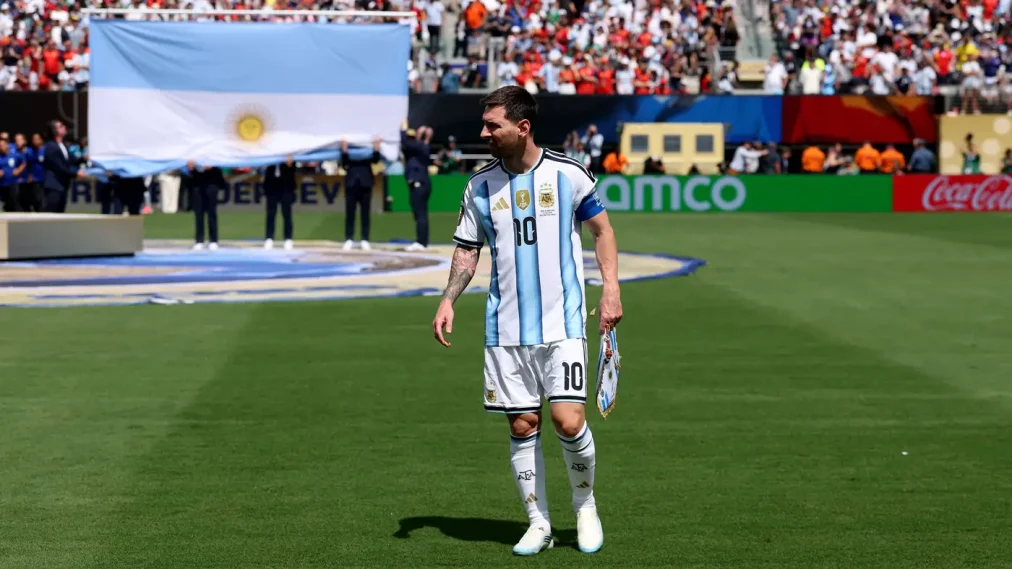
Lionel Messi has ended his extraordinary international career at the age of 39, shortly after inspiring Argentina to a second successive World Cup final.
The Argentina captain’s final match ended in defeat by Spain in the 2026 World Cup final, denying him the perfect farewell and the chance to lift the trophy for a second time. But after a career that transformed Barcelona, Argentina and modern football, there was little left for Messi to prove.
His decision closes a two-decade international journey that began with his emergence on football’s biggest stage and eventually saw him repair a difficult relationship with the Argentina national team.
Messi retires as the record eight-time Ballon d’Or winner, a World Cup champion and a two-time Copa America winner. He also leaves having finally stepped out from Diego Maradona’s enormous shadow to establish a legacy that belongs entirely to him.
From international heartbreak to glory
For years, Messi’s Argentina career was judged as much by what he had failed to win as by what he had achieved. He led the team to the 2014 World Cup final in Brazil, where Argentina lost to Germany after extra time, before suffering consecutive Copa America final defeats in 2015 and 2016.
The second of those losses, against Chile on penalties, left Messi devastated. He briefly retired from international football afterwards, saying: “The national team is over for me”.
It was not, in reality. Messi returned, and the story began to change under Lionel Scaloni.
Argentina built a team around its captain without becoming entirely dependent on him. The older number 10 was surrounded by energy, intensity and collective commitment, giving his individual brilliance the platform to flourish.
The turning point came at the 2021 Copa America, when Argentina defeated Brazil at the Maracana to give Messi his first major international trophy with the senior team.
Eighteen months later came the World Cup in Qatar. Messi produced a magnificent tournament, contributing goals, assists and moments of inspiration as Argentina recovered from a shock opening defeat by Saudi Arabia to reach the final.
He scored twice against France and then converted in the penalty shootout as Argentina finally claimed the trophy that had been missing from his case for greatness. He scored seven goals at the tournament, including two in the final, and lifted the prize he had pursued throughout his career.
That triumph also completed Messi’s transformation in the eyes of Argentina. The shy teenager who left Rosario for Barcelona at 13 had sometimes been portrayed in his homeland as more Catalan than Argentine. He was now the undisputed leader of the national side.
The tears and frustration of earlier failures gave way to songs, murals and celebrations. Comparisons with Maradona remained, but they no longer carried the same accusatory weight. Messi had become Argentina’s Messi.
A final chapter on his own terms
He could have stopped after Qatar, but continued playing. After moving from Paris Saint-Germain to Inter Miami, Messi helped Argentina retain the Copa America title in 2024 before making one final attempt at the World Cup.
By 2026, the explosive acceleration that once left defenders helpless had inevitably declined. Messi adapted by walking more, waiting longer and choosing his moments carefully, conserving his energy while younger legs moved around him.
The defining qualities remained: his awareness of space, the accuracy of his passing and his ability to change a match with a single touch.
Argentina changed with him. The side that reached the 19 July final was no longer a collection of players waiting for Messi to provide the rescue. It had become an experienced, battle-hardened team accustomed to winning and shaped by years alongside its captain.
That development allowed Messi to extend his international career far beyond what once seemed possible and to leave the game on his own terms.
His statistics place him among the giants of international football, although numbers alone cannot explain his journey from expectation to rejection, and from heartbreak to adoration. For years, every defeat was presented as evidence of the gap between Messi and Maradona.
By the end, that argument had largely lost its meaning. Maradona led Argentina to the 1986 World Cup. Messi, after years of trying, did the same in 2022, then returned four years later to take his country within touching distance of another title.
He departs as a player who played a decisive role in the history of Argentine football.
-
 Yan Diomande scores stunning goal as Real Madrid beat RB Leipzig 4-1 Oct 22, 2026
 -
Champions League: Real Madrid and Como win as Bayern Munich and Arsenal draw Oct 22, 2026
-
Inter Milan hold off Shakhtar Donetsk to claim first Champions League win Oct 22, 2026
-
Morocco make futsal history with fourth straight Africa Cup of Nations title Oct 22, 2026



-
AFCON 2025: Fixtures, Results, Scores and Standings Jan 18, 2026
-
Match hero Taiwo Awoniyi reflects on team effort after Chelsea triumph May 5, 2026
-
Leadership and long-term vision key to rescuing Zamalek and inspiring Egyptian football – Hany Abou Rida Nov 5, 2025
-
South African giants Orlando Pirates set to lose influential forward Monnapule Saleng Mar 19, 2025




-
PSG v Barcelona: fiery attacks set up Champions League classic at Parc des Princes Oct 18, 2026
-
Champions League: PSG beat Barcelona as Liverpool complete comeback against Villarreal Oct 20, 2026
-
Real Betis v Barcelona: kick-off time, TV details and match preview Oct 16, 2026
-
PSG beat Barcelona 4-2 in Champions League thriller Oct 21, 2026