Kurt-Lee Arendse cleared to face All Blacks after HIA assessment
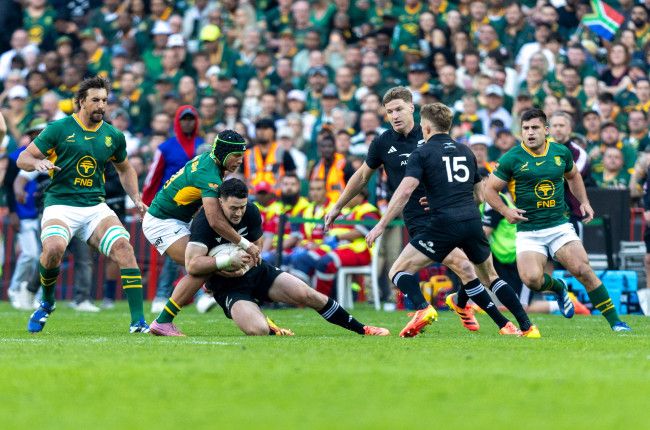
Springbok winger Kurt-Lee Arendse is available for selection for Saturday’s second Test against the All Blacks in Cape Town because the initial Head Injury Assessment (HIA) does not, on its own, diagnose concussion.
Arendse was removed during the opening Test at Ellis Park after being sent for an HIA check. He did not return to the field, but renowned sports scientist Ross Tucker has explained that this does not automatically mean the player suffered a concussion or would be ruled out of the next match.
Under the HIA process, further assessments conducted two hours after the match and again two days later determine whether a player is diagnosed with concussion and can return to selection.
Writing on social media, Tucker said the first assessment is designed to guide the immediate in-match decision rather than provide a final medical diagnosis.
“So the HIA1 test, done at the time of the head impact, is NEVER diagnostic of concussion. That test only informs the in match decision to either remove the player or return them in the match in question. The diagnosis is made based on tests done 2 hrs and 2 days after the match,” Tucker said on X.
The same procedure applies whether a player is removed because of an alert generated by the International Matchday Medical Team (IMG) system or because medical staff have identified clinical reasons for sending them for an HIA.
“This is the case for both IMG alert removals and for cases where the player is taken off for an HIA1 for clinical reasons. Concussion diagnosis is made after the match, not during.”
Tucker also stressed that failing the initial HIA screening should not be interpreted as proof that a concussion has occurred.
“So when a player fails the HIA1 screen, it does not mean a concussion, but they are kept off the field for the rest of the match. It was set up this way to try to incentivize the most precautionary action in the moment of highest risk (rather remove immediately after head impact), and to reduce the risk that a player is returned to avoid a concussion diagnosis,” Tucker said.
The system therefore prioritises the player’s immediate safety after a suspected head impact, even when the later assessments do not lead to a concussion diagnosis. A player who is removed during a match cannot return that same day, but their availability for a subsequent fixture is decided by the follow-up testing process.
Arendse’s absence from the remainder of the first Test at Ellis Park was therefore not, by itself, confirmation that he had been concussed. The two-hour and two-day assessments were the examinations used to establish whether he could be considered for the second Test.
South Africa face New Zealand in Cape Town on Saturday, with kick-off scheduled for 17:10.
-
 Sekhukhune United coach Cedric Kaze sent off after substitutions delay Aug 26, 2026
 -
Kurt-Lee Arendse cleared to face All Blacks after HIA assessment Aug 26, 2026
-
Patrick Vieira refuses Senegal presentation until contract is signed Aug 26, 2026
-
Qarabag target Nigeria winger Taofeek Ismaheel after Gornik Zabrze return Aug 26, 2026



-
AFCON 2025: Fixtures, Results, Scores and Standings Jan 18, 2026
-
Leadership and long-term vision key to rescuing Zamalek and inspiring Egyptian football – Hany Abou Rida Nov 5, 2025
-
South African giants Orlando Pirates set to lose influential forward Monnapule Saleng Mar 19, 2025
-
Full schedule for 2025 Africa Cup of Nations in Morocco confirmed Feb 12, 2025




-
Ajax close in on Franco-Guinean youngster Abdoulaye Camara Aug 19, 2026
-
DR Congo star Fiston Mayele joins Al Ahli Tripoli on two-year deal Aug 20, 2026
-
2026 Joan Gamper Trophy: FC Barcelona vs Al Ahly – When and how to watch Aug 19, 2026
-
Sporting monitor Moussa Diaby as Al-Ittihad winger attracts interest Aug 19, 2026