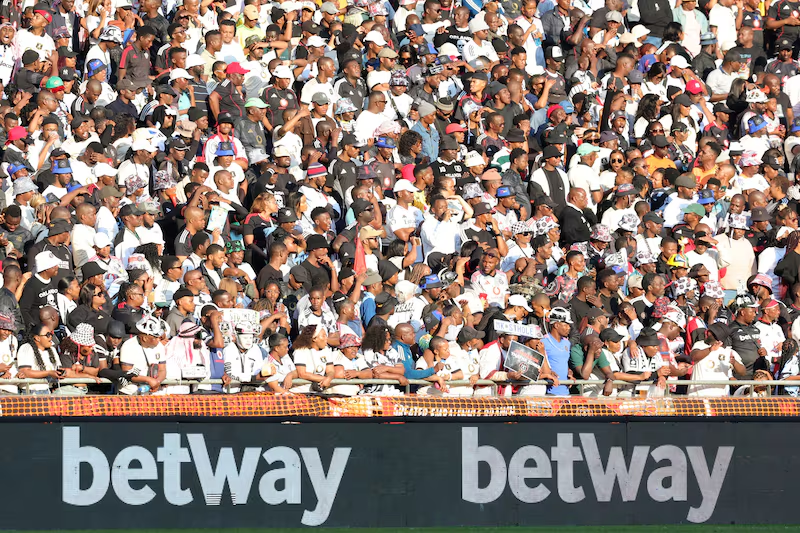
The Premier Soccer League’s latest stadium problems have renewed calls for the competition and its clubs to review their security and event-planning standards after supporters were prevented from entering an Orlando Pirates match at the start of the 2026-27 season.
Pirates apologised to ticket-holders who could not get into Orlando Stadium for the club’s opening fixture, a 2-0 Betway Premiership victory over Milford FC. Organisers closed the gates after crowds began pushing their way into the ground.
The incident has raised further questions about the effectiveness of security arrangements at PSL matches, an issue that has been a concern for several years.
The problem has been particularly visible at the Soweto derby between Orlando Pirates and Kaizer Chiefs, regarded as the showpiece fixture of South African domestic football. In each of the past two seasons, major problems have been reported involving tickets, entry and crowd safety.
Stadium Management South Africa (SMSA) admitted twice last season that crowds exceeding 100,000 had entered FNB Stadium, despite the venue having a capacity of 94,000.
Other high-profile matches have also exposed weaknesses in planning. Several fixtures hosted by TS Galaxy against Amakhosi at Mbombela Stadium began late because of difficulties accessing the ground. Although those matches attracted strong attendances, the crowds were still below the stadium’s capacity, suggesting the arrangements were not adequate even when the venue was not full.
At the end of last season, a gate-breaking incident occurred during a Pirates match against Durban City. Loftus Versfeld, meanwhile, has developed a reputation as an especially difficult stadium for supporters trying to attend football matches.
In an attempt to address the increasing sale of counterfeit tickets by illegal touts and syndicates, SMSA introduced a digital ticketing system for the Soweto derby. However, the system experienced several early problems.
Mobile phone networks in the area reportedly collapsed under the number of supporters arriving for the match. As a result, fans who had tickets saved on WhatsApp or in their email accounts were unable to access them on their phones, creating further disorder.
The network problems appear to have improved, but there have still been occasions when too many supporters arrived, including people without tickets, and attempted to force their way through gates.
That has highlighted concerns about whether enough visible security and police are stationed in the right places to respond quickly when crowds begin to gather or surge.
Supporters must be managed before they reach the stadium entrances, not only once they are inside the ground. Football writers have observed that FNB Stadium has lacked both barricades and staff to organise fans into orderly queues at the gates, allowing large scrums to develop.
The consequences extend beyond safety. Being forced to push through crowds to enter a match is an unacceptable experience for supporters, while poor traffic management can result in people spending hours trying to reach or leave stadiums in private cars, taxis and buses.
In 2026, such conditions should no longer be considered normal at football grounds. The concern is that supporters are being lost to sports where attending live events is a more comfortable experience.
Safety, however, remains the most serious issue. There is a growing perception that security standards at PSL matches have declined in recent years. The league frequently cites compliance with the Safety at Sports and Recreational Events Act (Sasrea) as evidence that it is meeting its obligations, but the repeated incidents suggest that compliance alone is not enough.
At major fixtures in Europe and elsewhere, organisers typically deploy extensive, well-trained security and policing teams so that personnel can respond immediately when unexpected problems occur.
The PSL and its clubs need to reassess how they plan and manage stadium security. The Orkney Stadium disaster in 1991 and the Ellis Park disaster in 2001 claimed a combined 85 lives. It should not take another tragedy on that scale to force the necessary action.
-
 Burkina Faso U17 begin WAFU B campaign against Benin Oct 10, 2026
 -
Orlando Pirates face Mamelodi Sundowns in MTN8 final with title defence at stake Oct 10, 2026
-
Bayern Munich consider Jules Kounde as Sacha Boey replacement Oct 10, 2026
-
Charlotte linked with former Everton midfielder Abdoulaye Doucoure Oct 10, 2026




-
AFCON 2025: Fixtures, Results, Scores and Standings Jan 18, 2026
-
Match hero Taiwo Awoniyi reflects on team effort after Chelsea triumph May 5, 2026
-
Leadership and long-term vision key to rescuing Zamalek and inspiring Egyptian football – Hany Abou Rida Nov 5, 2025
-
South African giants Orlando Pirates set to lose influential forward Monnapule Saleng Mar 19, 2025




-
Croatia face Spain with Nations League hopes on the line in Split Oct 5, 2026
-
France v Belgium: Probable line-ups for Nations League clash Oct 3, 2026
-
Manchester United host winless Tottenham in Premier League clash Oct 7, 2026
-
Morocco coach Mohamed Ouahbi refuses to single out player after Mali draw Oct 4, 2026